St. Laurentius (Cologne-Lindenthal)
A plain brick cube by Emil Steffann in Lindenthal, deconsecrated in 2019 and set to become a university lecture hall. Built in 1961/62, it counts as a notable example of Cologne's post-war architecture.
since 1961
St. Laurentius in Cologne-Lindenthal is a former Catholic parish church, designed by architect Emil Steffann and built between 1961 and 1962. The building has been deconsecrated since 2019 – it no longer serves as a place of worship and is intended to become a lecture hall for the University of Cologne.
Source: Wikipedia
At a Glance
- Architect
- Emil Steffann
- Construction
- 1961–1962, consecrated 1966
- Dedication
- Saint Lawrence of Rome
- Heritage status
- listed since 17 April 2001 (monument list no. 8534)
- Award
- one of the first Cologne architecture prizes (1967)
- Status
- deconsecrated since 13 November 2019
- Future use
- lecture hall of the University of Cologne
The walls of St. Laurentius are built from rubble brick – material salvaged from the ruins of the Second World War – and at the heart of its atrium a basin sends water flowing toward all four cardinal directions as a symbol of the four rivers of paradise.
Things to do here
- Take in the plain rubble-brick cube architecture from the outside
- Discover the atrium with its basin symbolising the four rivers of paradise
- Appreciate the building as an award-winning example of Cologne's post-war modernism
- Follow its conversion into a University of Cologne lecture hall
Age comparison
Age compared with other places in Cologne.
A Parish Without a Church
The parish of St. Laurentius had existed since 1924, yet for decades it had no church of its own – services were held in the chapel of the Hildegardis Hospital in Lindenthal. Only from 1959 did plans for a new church with a parish centre move forward. The foundation stone was laid on 28 May 1961, the first services took place from 4 November 1962, and on 6 February 1966 auxiliary bishop Augustinus Frotz performed the formal consecration.
From 1985 onwards, attendance steadily declined. After several Lindenthal parishes merged into the new parish of St. Stephan, an application for deconsecration was submitted in 2014. A final service was held on 22 October 2017, before Archbishop Rainer Maria Woelki deconsecrated the church on 13 November 2019.
A Sealed Cube
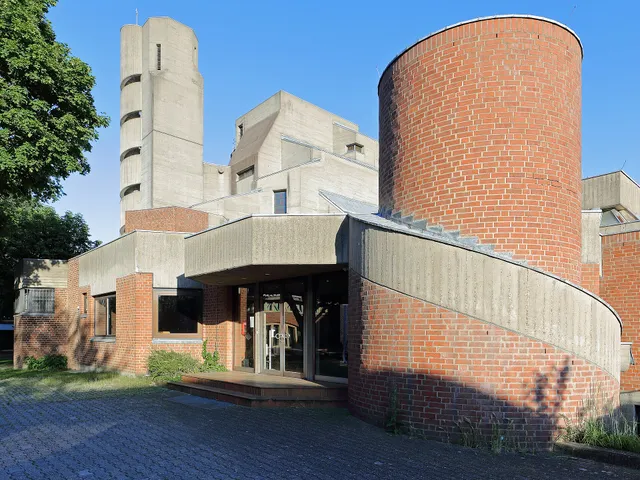
From the outside, St. Laurentius resembles a spare cube: almost windowless walls of rubble brick, a metal-clad roof edge, and beneath it a narrow strip of light running along three sides. Only a single bell reveals that this is a church. An atrium with a covered walkway links the building to the parish structures; at its centre sits a basin set into the floor, its water flowing toward the four cardinal directions as a symbol of the four rivers of paradise.
The interior is a column-free hall with bare brick walls, its floor sloping down toward the slightly raised altar. The diffuse light is complemented by a circular 24-flame ring chandelier that deliberately contrasts with the cubic space. A tiny window in the altar wall holds the eternal light.
Art and Furnishings
The portal was created by Theo Heiermann, while the large ring chandelier of 1962 came from Karl Otto Lüfkens. The liturgical objects – tabernacle, altar table, ambo and paschal candlestick – were designed by Klaus Balke. Considerably older are the altar cross from the 15th century and a Swabian Madonna figure from around 1500. Sculptor Jochem Pechau designed both the foundation stone, depicting the martyrdom of Saint Lawrence, and the atrium floor. The bell from 1961 was cast by Petit & Gebr. Edelbrock, and the single-manual organ with 15 stops was supplied by Leo Verschueren from the Netherlands in 1967.
Gallery
Map
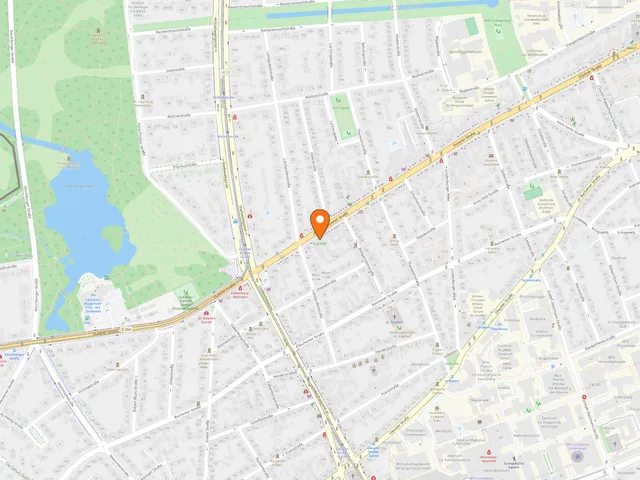
Blue dots: other places nearby — tap to explore.
You might also like — related or nearby
Comments
- Loading comments…
Sources & links
Auto-generated, last verified: 2026-08-28
How this page is made
This page draws on open sources — Wikipedia, Wikidata, official websites and the city’s open data. Every statement is checked against the sources linked here, and pages are refreshed regularly.
Spotted a mistake anyway? Tell us below — we read every submission.