Kiesgruben Paulsmaar
A fenced-off Cologne nature reserve with three former gravel-pit lakes southeast of the city, leased to an angling club and closed to the public.
since 1991
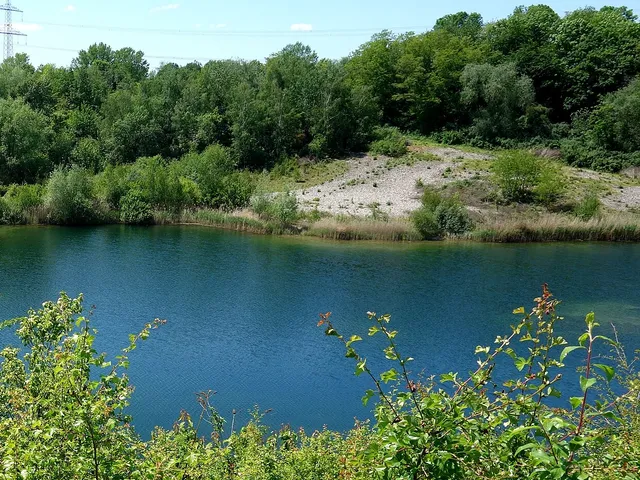
A nature reserve on the former Paulsmaar gravel pits southeast of Cologne: three bodies of water left behind by earlier gravel extraction that today serve as a refuge for birds, amphibians and dragonflies. The site is fenced off and leased to an angling club — it is not open to the public.
At a Glance
- Location
- roughly 5 km from Cologne, 4 km from Troisdorf and 6 km from Niederkassel
- Protection status
- classified as a nature reserve worthy of protection since 1991
- Area
- 24.68 hectares
- Character
- reclaimed gravel-pit site with three bodies of water
- Highlight
- a refuge for waterfowl along the Rhine as well as for threatened amphibians and dragonflies
- Access
- fenced off, no public access — members only
Age comparison
Age compared with other places in Cologne.
Location & Character
The reserve lies southeast of Cologne, in the area around Troisdorf and Niederkassel. Where gravel was once quarried, three bodies of water now define the landscape: a large, older pond to the east, a newer one to the west, and a smaller pond in the northeast that is connected to the large eastern pond. The two large lakes are separated by a tall, shrub-covered embankment that carries a gas pipeline within it. To the south, a former arable field was incorporated into the reserve and planted with a species-rich false oat-grass meadow and shrubs typical of the site.
Use & Protection Status
The fenced site is leased to an angling club — the Angel- und Naturfreunde (ANF) "Heimattreue Zündorf", who have held the lease and cared for the grounds since 1989. Access is restricted exclusively to club members; there is no public entry and no circular trail. The eastern pond is used for fishing, while the western pond is deliberately left unused and is intended to serve nature conservation alone. The small pond in the northeast provides a spawning ground for the fish species introduced here. The fish population includes veiltail carp, pike, bream, perch and roach, among others. Management measures include limited fishing, near-natural shaping of the water bodies, avoiding excess nutrients, and leaving areas to develop naturally.
Wildlife
The ponds are an important stepping stone for waterfowl along the Rhine and a habitat for threatened amphibians and dragonflies. Along the eastern lake, club members have established reed beds in sections which, together with the silting-up zones, provide cover and nesting space.
Plant Life
The narrow silting-up fringes of the large lakes carry fragmentary white willow floodplain woodland, and to the east of the small pond there is a periodically flooded willow-alder grove. Alongside reeds, white water lilies grow in the northeastern pond. The steep excavation slopes are mostly covered with native deciduous trees — including red oak and black locust at the western lake — while the flatter areas hold shrubs typical of the site. The species-rich vegetation includes black alder, white and aspen poplar, pedunculate oak, hornbeam, sycamore, Norway and field maple, ash, wild cherry, Swedish whitebeam, hawthorn, dog rose and field rose, as well as guelder rose.
Map
Blue dots: other places nearby — tap to explore.
You might also like — related or nearby


Comments
- Loading comments…
Sources & links
Auto-generated, last verified: 2026-08-09
How this page is made
This page draws on open sources — Wikipedia, Wikidata, official websites and the city’s open data. Every statement is checked against the sources linked here, and pages are refreshed regularly.
Spotted a mistake anyway? Tell us below — we read every submission.