Malakoffturm
Brick gatehouse of Prussian Rhine fortifications at Rheinauhafen — now linked by a swing bridge to the Chocolate Museum across the water.
The Malakoffturm in Cologne's Altstadt-Süd is a surviving structure of the Prussian Rhine riverside fortifications, built between 1848 and 1858. Its historic swing bridge now connects to the Chocolate Museum on the opposite bank.
At a Glance
- Type
- Gatehouse of the former Rhine fortifications, listed monument in North Rhine-Westphalia
- Location
- Am Holzmarkt, Altstadt-Süd district, Innenstadt borough
- Construction
- 1852–1855
- Architects
- Carl Schnitzler (design), Bernhard Harperath (site supervision)
- Materials
- Brick, four storeys
- Current use
- Pumping station and café (Hafenterrasse, since 2005)
- Owner
- Imhoff-Stiftung
The tower was named in 1855 after the recently captured Fort Malakhov in Sevastopol – even though it had been stormed by French troops, soon to be Prussia's adversary; as late as the 1940s, a Wehrmacht officer stationed in Cologne could find no plausible explanation for the choice of name.
Age comparison
Age compared with other places in Cologne.
History
From 1848, Prussia expanded the city's Rhine-facing defences, including a harbour basin in front of the southern old town and a gatehouse at the northern tip of the basin with an iron swing bridge. The tower was externally complete by 1854 and fully fitted out by 1855. As weaponry advanced, the fortifications lost their military relevance. After the site passed from military to municipal ownership, the Rheinauhafen was developed between 1892 and 1898 — stripping the tower of its defensive role and leaving it facing the city rather than the river.
The Swing Bridge
To operate the swing bridge, a hydraulic pressure pump was installed inside the tower. Both bridge and pump date from 1888, supplied by Harkort of Duisburg and Haniel & Lueg of Düsseldorf. Moving the 420-tonne bridge required 50 bar of pressure, delivered through underground pipes. The entire installation was comprehensively restored in 1986.
A Name of Uncertain Origin
In 1855 the tower was named after Fort Malakhov in Sevastopol, seized by French troops on 8 September 1855 during the Crimean War after Russian defenders had held out through eleven months of siege. Why a Cologne fortress tower received this particular name puzzled contemporaries — as late as the 1940s, a cavalry captain at the Cologne military command could find no explanation in the records.
Architecture
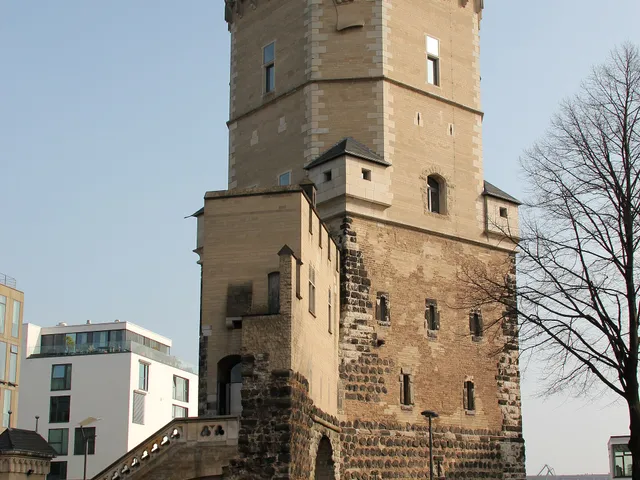
Schnitzler designed the tower in brick, drawing on forms typical of second-generation forts from the 1840s. Above a two-storey base, the square city-facing section rises into a two-storey octagonal upper stage; on the harbour side, a rectangular wing terminates in a semicircular apse where traces of the original riverside fortification are still visible. A bay window projects on the city side, with a commemorative plaque below marking the harbour expansion of 1892–1898; both elements are crowned with battlements.
Today
After the Second World War, freight traffic shifted and the Rheinauhafen declined in importance. The swing bridge is now mostly open to pedestrians and cyclists, who use it to reach the Chocolate Museum — housed in the building opposite since 1993. Just to the southwest of the tower stands the 1911 sculpture known as the Tauzieher (Tug-of-War Players).
Timeline
- 1848Construction of the Prussian Rhine embankment fortification begins
- 1852–1855Construction of the tower and iron swing bridge
- 1854Exterior of the tower and annexes completed
- 1855Interior completed; tower named 'Malakoffturm'
- 1888Hydraulic pressure pump installed to operate the swing bridge
- 1892–1898Complete redevelopment into the Rheinauhafen harbour
- 1911Statue 'Tauzieher' erected southwest of the tower
- 1986Comprehensive renovation of the pump and bridge system
- 1993Chocolate Museum opened opposite the tower
- 2005Harbour terrace at the Chocolate Museum opened at the tower
Map
Blue dots: other places nearby — tap to explore.
Address
Am Leystapel
50678 Köln
Hours
So: 00:00–24:00
You might also like
Comments
- Loading comments…
Sources & links
- Official website
- Official website (retrieved 2026-06-25)
- Wikidata (retrieved 2026-06-24)
- Wikipedia (retrieved 2026-06-24, rev 261291806)
Auto-generated, last verified: 2026-06-26