Mülheim Town Fountain
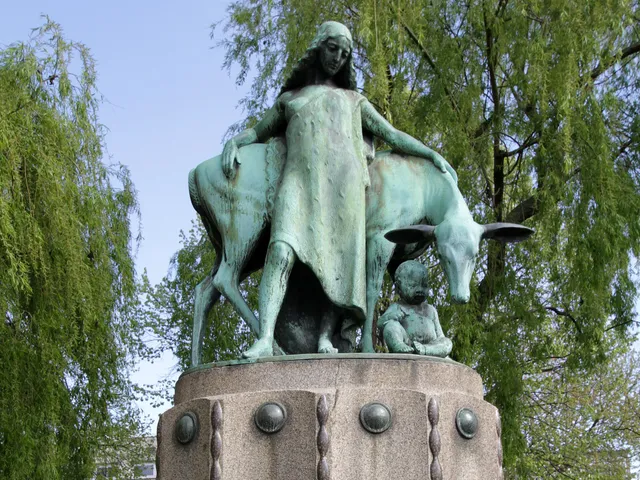
A roughly ten-metre sandstone fountain from 1884 whose crowned patroness, the "Mülheimia", commemorates the devastating Rhine flood of 1784.
since 1884
At the corner of Mülheimer Freiheit and Krahnenstraße stands a tall sandstone fountain crowned by a woman wearing a crown: the Mülheimia, patroness of Mülheim's people. It was built to mark a disaster.
At a glance
- Type
- Figurative town fountain
- Also known as
- Mülheimia
- Sculptor
- Wilhelm Albermann (Cologne) — built to his designs
- Inaugurated
- 1884
- Occasion
- Centenary of the flood of 1784
- Commissioned by
- The Mülheim Beautification Society, on the initiative of mayor Bernhard Clostermann
- Material
- Sandstone
- Height
- about 10 metres
- Location
- Corner of Mülheimer Freiheit and Krahnenstraße, Cologne-Mülheim
- Heritage status
- Listed since 1 July 1980, no. 674 among Mülheim's listed buildings
Locals simply call the fountain the "Mülheimia" — after the crowned patroness at its top, with the coat of arms of the former Free Town of Mülheim am Rhein at her feet.
Age comparison
Age compared with other places in Cologne.
From water pump to monument
A pump for drawing drinking water once stood here — known in the Rhineland as a "Pütz". Today's fountain took its place and no longer has anything to do with supplying water.
The occasion: the flood of 1784
The town fountain was inaugurated in 1884 on the centenary of the flood of 1784. It commemorates the severe devastation that the disaster caused in Mülheim and in many other places along the Rhine.
Who had it built
The initiative came from Bernhard Clostermann, the last mayor of the then still independent town of Mülheim. The Mülheim Beautification Society carried out the project to designs by the Cologne sculptor Wilhelm Albermann — the same artist who created the Hermann Joseph Fountain on Waidmarkt ten years later. The cost at the time came to around 9,500 marks.
The Mülheimia
The main figure wears a crown and robe and embodies the town itself. At her feet lies the coat of arms of the former Free Town of Mülheim am Rhein.
Farming, trade, industry
Below the Mülheimia stand three young men in medieval dress. They stand for the three branches of the economy that shaped Mülheim in the 19th century: agriculture, trade and industry — a reminder of the town's importance at the time.
Heritage status
Since 1 July 1980 the Mülheim Town Fountain has been on the list of protected buildings in Cologne's Mülheim district under number 674.
Timeline
- 1784A devastating Rhine flood ravages Mülheim and many places along the river
- 1884Inaugurated on the centenary of the disaster, at a cost of some 9,500 marks
- 1980Added to the list of protected buildings in Cologne-Mülheim (no. 674)
Map
Blue dots: other places nearby — tap to explore.
Address
Mülheimer Freiheit/Krahnenstraße
51063 Köln
Hours
So: 00:00–24:00
You might also like — related or nearby
Comments
- Loading comments…
Sources & links
- Official website
- Wikidata (retrieved 2026-07-16)
- Wikipedia (retrieved 2026-07-16, rev 260198317)
Auto-generated, last verified: 2026-07-16
How this page is made
This page draws on open sources — Wikipedia, Wikidata, official websites and the city’s open data. Every statement is checked against the sources linked here, and pages are refreshed regularly.
Spotted a mistake anyway? Tell us below — we read every submission.