Katzenbuckelbrücke
A curving prestressed-concrete pedestrian bridge from 1957 that links the Rhine bank in Cologne-Mülheim with the Katzenkopf river peninsula.
since 1957
The Katzenbuckelbrücke – officially the Mülheimer Hafenbrücke – is a pedestrian bridge in Cologne-Mülheim that has linked the Mülheim riverbank with the Katzenkopf river peninsula since 1957. Its curving arch earned it the popular names Katzenbuckelbrücke ("cat's hump bridge"), Drachenbrücke ("dragon bridge") and Katzenkopfbrücke.
At a Glance
- Type
- Pedestrian bridge (prestressed-concrete arch bridge)
- Opened
- 18 April 1957 for the Federal Garden Show
- Location
- Cologne-Mülheim, over the entrance to the Mülheim harbour
- Arch span
- 90.50 metres
- Total span
- 171.40 metres
- Crown height
- about 18 m above mean water level
- Path width
- 3 metres, with gradients of up to 14 %
- Heritage status
- listed since 19 May 1989 (No. 5048 in Cologne's monument register)
Age comparison
Age compared with other places in Cologne.
Location
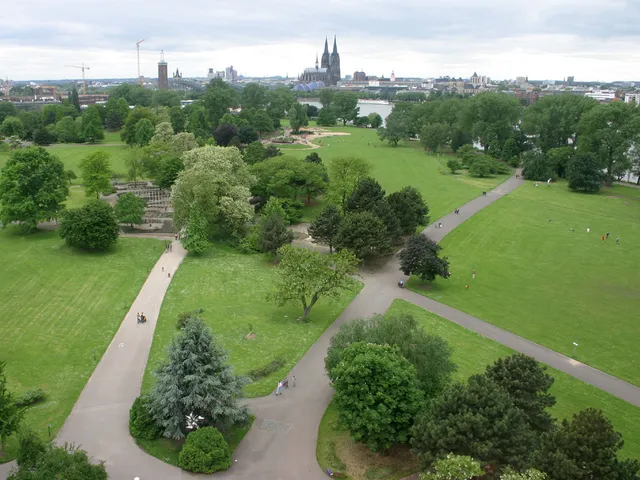
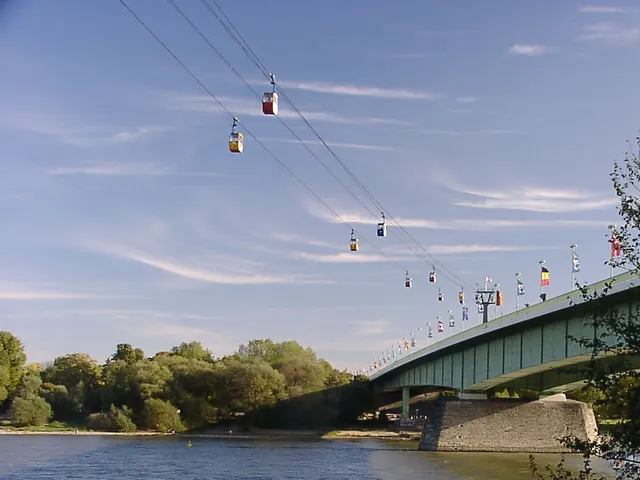
The bridge spans the entrance to the Mülheim harbour, connecting the eastern bank of the Rhine near Hafenstraße with the north-eastern tip of the Cologne Jugendpark on the Katzenkopf river peninsula. The Rheinpark adjoins the site to the south.
Architecture
The arch bridge is built of prestressed concrete. Its arch, roughly 90 metres long and supported by an inclined pier, swings across the water and lands on the far side – carried by a pendulum member – on the crown of the harbour dam. The load-bearing arch, with open spandrels on both sides, splits into two fingers and rests on individual foundations. The three-metre-wide footpath begins parallel to Hafenstraße and is carried in a wide curve over the harbour grounds. The structure served as a model for smaller works elsewhere in the city, such as at the Cologne-Mülheim motorway junction and the Severinsbrücke.
History
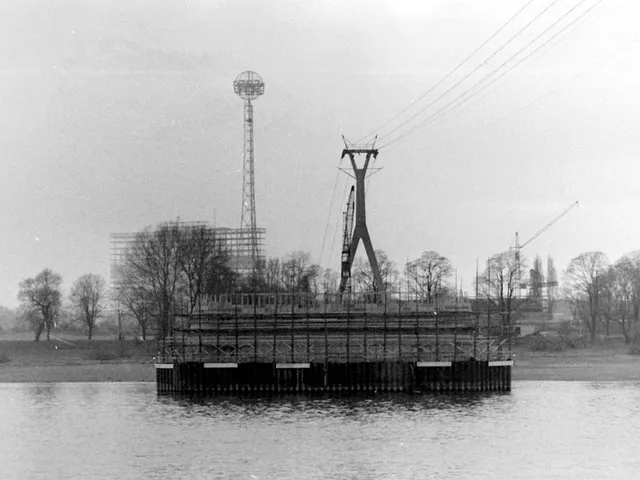
A first design for a bridge over the Mülheim harbour basin was drawn up as early as 1937, to give residents easier access to a Rhine otherwise blocked by the harbour; on cost grounds, however, the planned steel structure with stairways was never built. The plan was revived for the 1957 Federal Garden Show: architect Bernhard Hermkes realised a design by bridge specialist Gerd Lohmer. Lohmer had added a sketch of a mythical creature to illustrate the arch's "animalistic elements" – back, foot, head and tail. The bridge was built by the Frankfurt firm Wayss & Freytag; construction began in 1956 and it opened on 18 April 1957. The cost was 300,000 Deutsche Mark – the actual dragon form with head and tail was dropped because it would have cost 50,000 marks more. The originally bare-concrete bridge later received a protective coating.
Restoration
In 2024 the City of Cologne, the bridge's owner, announced that it needed comprehensive restoration, for which it would be closed for eight months. Initial work had already taken place in 2022; the actual restoration work began on 23 February 2026.
Gallery
Map
Blue dots: other places nearby — tap to explore.
Address
Mülheimer Hafen
51063 Köln
Contact
You might also like — related or nearby
Comments
- Loading comments…
Sources & links
- Official website
- Official website (retrieved 2026-07-17)
- Wikidata (retrieved 2026-07-08)
- Wikipedia (retrieved 2026-07-08)
Auto-generated, last verified: 2026-07-08
How this page is made
This page draws on open sources — Wikipedia, Wikidata, official websites and the city’s open data. Every statement is checked against the sources linked here, and pages are refreshed regularly.
Spotted a mistake anyway? Tell us below — we read every submission.