Herakles Slaying the Stymphalian Birds (Bourdelle)
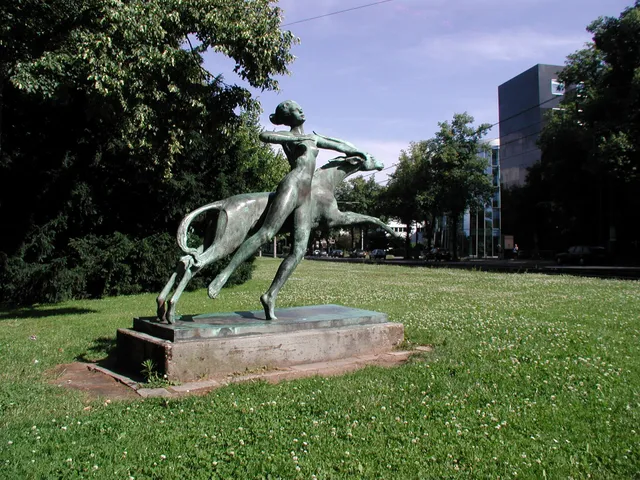
A 1909 bronze sculpture by Antoine Bourdelle – Cologne's cast stands freely accessible in the courtyard of the WiSo building on the campus of the University of Cologne.
since 1909
In the courtyard of the main building of the Faculty of Management, Economics and Social Sciences (WiSo) on the campus of the University of Cologne in Cologne-Lindenthal stands a bronze sculpture by Antoine Bourdelle: "Herakles Slaying the Stymphalian Birds," also known as "Herakles the Archer." The work dates from 1909; the Cologne piece is one of several casts found in museums and public spaces around the world.
Source: Wikipedia
At a Glance
- Artist
- Antoine Bourdelle
- Year
- 1909
- Material
- Bronze (Cologne cast: Susse Foundry, Paris, 1909)
- Subject
- Herakles driving off the Stymphalian birds – the sixth of the twelve Labours of Hercules
- Location in Cologne
- Courtyard of the WiSo building, Universitätsstraße 24, Cologne-Lindenthal
- Access
- freely accessible on the university campus
- Notable
- one of several casts from a series distributed worldwide
Age comparison
Age compared with other places in Cologne.
A Motif from Greek Mythology
The subject comes from Greek mythology. The hero Herakles (Hercules) is tasked with driving the Stymphalian birds – according to tradition monstrous birds of prey, as large as cranes and equipped with iron wings, beaks and claws – from their nesting grounds at Lake Stymphalos in Arcadia. This is the sixth of the twelve Labours of Hercules. Bourdelle depicted the scene as a nude athlete kneeling in rocky terrain and drawing a bow and arrow.
Genesis and Model
Bourdelle began developing the idea for the Herakles sculpture in 1906. As his model he chose the athletically built cavalry officer Paul (André) Doyen-Parigot, whom he had met through Auguste Rodin. Doyen-Parigot posed for about ten hours in total; contemporary photographs document the work. Because the model did not wish to be recognised, Bourdelle reworked the figure's head, drawing inspiration from archaic Greek works. By 1909 he had produced a number of small-scale studies and models, now kept at the Musée Bourdelle in Paris. The final clay sculpture, roughly 62 centimetres tall, prompted the art collector and patron Gabriel Thomas – a cousin of the painter Berthe Morisot – to commission a monumental bronze version for his estate in Meudon-Bellevue. Thomas initially insisted that only a single copy be made. In the summer of 1909 the Rudier Foundry in Paris produced this first monumental bronze cast (250 cm tall), which went to Thomas in 1910 for 10,000 francs. Thomas later reconsidered his demand, and two small series of casts followed.
Versions and Casts
Two versions can be distinguished among the early cast series: unlike the 1909 version, the 1923 version shows small reliefs of the Lernaean Hydra and the Nemean Lion on the side of the rock. In the artist's later years numerous further casts were made, along with individual heads, torsos and full figures of the archer in bronze, gilt bronze and plaster. The original plaster cast long stood in Bourdelle's studio and was only handed over in 1953 by his widow Cléopatre Bourdelle to Bourdelle's birthplace of Montauban, where it can be seen today in the Musée Ingres Bourdelle.
Legacy and Casts Around the World
"Herakles the Archer" was the artist's first unqualified success. In 1910 the bronze was exhibited at the Salon of the Société nationale des beaux-arts to great acclaim, and Bourdelle came to be regarded as a leading French sculptor alongside Auguste Rodin. Today casts of the work stand in numerous international museums as well as in public buildings, squares and gardens. The first bronze cast of 1909 was acquired in 1920 by Prince Eugen of Sweden and can be seen in the sculpture park at Waldemarsudde in Stockholm. Further casts of the first version are held in the Royal Museums of Fine Arts in Brussels, the Metropolitan Museum of Art in New York and the Tokyo Fuji Art Museum.
The Cologne Cast
The Cologne work also dates from 1909 and was cast at the Susse Foundry in Paris. It belongs to the first version of the series and adorns the courtyard of the main building of the Faculty of Management, Economics and Social Sciences (WiSo) at Universitätsstraße 24 in Cologne-Lindenthal. The sculpture is thus freely accessible to anyone visiting the campus – and takes its place within the worldwide series that also includes the casts in Stockholm, Brussels, New York and Tokyo.
Gallery
Map
Blue dots: other places nearby — tap to explore.
Address
Universitätsstraße 24
50931 Köln
You might also like — related or nearby
Comments
- Loading comments…
Sources & links
Auto-generated, last verified: 2026-08-08
How this page is made
This page draws on open sources — Wikipedia, Wikidata, official websites and the city’s open data. Every statement is checked against the sources linked here, and pages are refreshed regularly.
Spotted a mistake anyway? Tell us below — we read every submission.