St. Hedwig
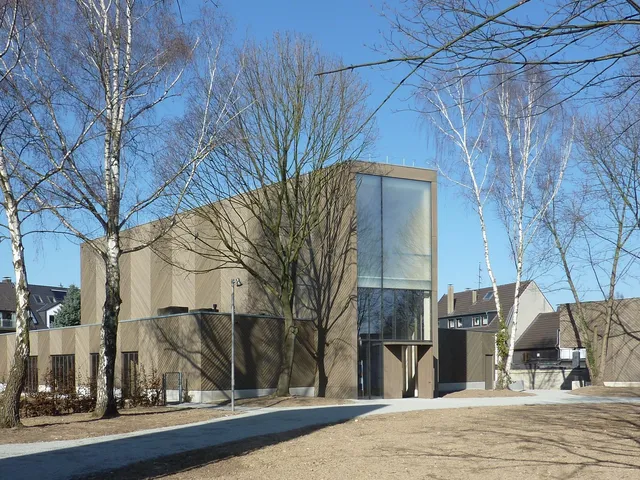
Award-winning Catholic church of 1966/67 in Cologne-Höhenhaus, a plain natural-stone building with a striking pyramid roof.
since 1967
St. Hedwig is a Catholic church in the Cologne district of Höhenhaus, built between 1966 and 1967 to designs by the architects Emil Steffann and Gisberth Hülsmann. As early as 1967 the building was honoured with the Cologne Architecture Prize.
At a Glance
- Type
- Catholic church
- Construction
- 1966 to 1967
- Consecration
- 18 October 1969
- Location
- Höhenhaus district, Cologne
- Architects
- Emil Steffann and Gisberth Hülsmann
- Style
- Plain natural-stone building with a large pyramid roof
- Patron saint
- Hedwig of Andechs (Hedwig of Silesia)
- Award
- Cologne Architecture Prize 1967
Age comparison
Age compared with other places in Cologne.
History
After the Second World War, Höhenhaus grew rapidly as returning soldiers and displaced persons settled there. Alongside the churches of St. Johann Baptist and Zur Heiligen Familie, built in the 1950s, space soon ran short, and in the early 1960s the archdiocesan vicariate general prepared for another parish foundation. Hedwig of Andechs, also known as Hedwig of Silesia, was deliberately chosen as patron saint – a gesture towards the many new residents who came from Silesia.
Emil Steffann was commissioned with the design, and the foundation stone was laid in 1966. The congregation already began using the church for services from 29 June 1967, though it was not officially consecrated until 18 October 1969.
Architecture
Set within an ensemble of parish buildings, St. Hedwig stands as a plain, rectangular structure of unplastered natural stone – according to one author partly sourced from rubble stones – beneath a large pyramid roof. Only a few niche-like round-arched windows pierce the walls, while projecting stone piers articulate three walls along three axes each. A golden pine cone crowns the tip of the roof.
A low annexe on the north side, sheltering an atrium, a weekday chapel and the sacristy under one roof, provides access to the dimly lit interior. A vestibule leads on through arcades into the square nave, where pillar-articulated walls carry the open, barn-like timber roof structure. The altar zone sits in a single niche of the chancel wall, set off from the rest of the room by two steps.
Furnishings
The golden pine cone on the roof was created by Klaus Balke. Set into its base, a wooden sculpture of the patron saint holds relics of the saint along with a stone from Trebnitz Abbey. Both were donated by a nun from Trzebnica in Silesia who survived the war and later made a new home in the west. A 24-flame wheel chandelier by Jakob Overzier, eleven metres across, hangs above the centre of the room.
The altar cross combines the corpus of a former South Tyrolean wayside cross with a new, colourful cross in the shape of a tree of life by Jochem Pechau. Walled into the weekday chapel is a stone Madonna that the first parish priest of St. Hedwig brought back from Spain. The three-manual organ built by Paul Ott in 1954 was enlarged in 1996 by Fischer & Krämer Orgelbau and has 18 stops.
Good to Know
The church manages entirely without a bell tower: its bell, cast in 1967 by Petit & Gebr. Edelbrock and sounding the note e2, hangs on the outside of the building. The design model of St. Hedwig is today preserved in the model collection of the German Architecture Museum.
Gallery
Map
Blue dots: other places nearby — tap to explore.
Address
Von-Ketteler-Straße 2
51061 Köln
You might also like — related or nearby
Comments
- Loading comments…
Sources & links
- Official website
- Official website (retrieved 2026-07-17)
- Wikidata (retrieved 2026-07-10)
- Wikipedia (retrieved 2026-07-10, rev 242998847)
Auto-generated, last verified: 2026-07-10
How this page is made
This page draws on open sources — Wikipedia, Wikidata, official websites and the city’s open data. Every statement is checked against the sources linked here, and pages are refreshed regularly.
Spotted a mistake anyway? Tell us below — we read every submission.