Christi Geburt
A Catholic parish church built 1969–1971 in Bocklemünd/Mengenich, notable for its rare dedication to the Nativity of Christ and its angular, right-angle-free architecture.
since 1969
The Catholic parish church of Christi Geburt stands in the Cologne district of Bocklemünd/Mengenich and was built between 1969 and 1971 to designs by the architect Eduard Frieling. Its dedication to the Nativity of Christ is considered probably unique for a Catholic church in Germany.
Source: Wikipedia
At a Glance
- Denomination
- Roman Catholic parish church
- District
- Bocklemünd/Mengenich
- Architect
- Eduard Frieling (Hamburg)
- Construction
- 1969–1971
- Consecration
- 3 September 1972 by Joseph Cardinal Höffner
- Dedication
- the Nativity of Christ (probably unique for a Catholic church in Germany)
- Layout
- pentagonal nave with a triangular tower
The dedication to the Nativity of Christ is considered probably unique for a Catholic church in Germany.
Things to do here
- Explore the angular, many-pointed concrete architecture and the pentagonal nave
- View Ludwig Schaffrath's asymmetrical leaded-glass windows and the blue tones of the Lady Chapel
- Discover Sepp Hürten's marble furnishings and Hermann Gottfried's mural
- See the black wooden cross in front of the church and the courtyard with its parish ensemble
- Experience the Seifert organ with its asymmetrical oak case and the four-bell peal
Age comparison
Age compared with other places in Cologne.
History
From the mid-1960s the large Bocklemünd/Mengenich housing estate grew in the west of Cologne, planned for around 10,000 residents. The archdiocese acquired a central and, at roughly 4,000 m², comparatively small plot for a church and parish centre, and in 1966 launched an architectural competition won by the Hamburg architect Frieling. After the first ground-breaking in September 1968 and the laying of the foundation stone on 30 March 1969, an initial construction phase produced the church, a priests' house and sisters' apartments, with the topping-out ceremony held on 5 September 1969. Services began on 4 April 1971, and on 3 September 1972 Joseph Cardinal Höffner performed the consecration. A black wooden cross placed on the site at the start of construction still stands in front of the church today. In 2002 a vestibule designed by the Cologne architect Johannes Schilling was added.
Architecture
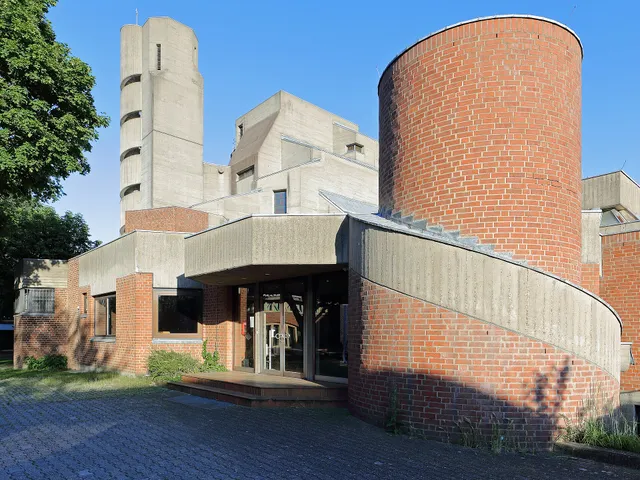
The church, the parish buildings and a day-care centre sit slightly raised above street level and group around a courtyard whose main entrance opens onto a pedestrian zone. With its many-pointed, folded surfaces free of right angles, the church forms the visual centre; from them a triangular tower rises toward the courtyard. Compared with the neighbouring residential high-rises, the complex remains restrained in scale. The nave rests on a pentagonal plan with the altar at its jagged apex, while a side chapel with a gallery above extends the space. The floor slopes gently toward the altar, heightening the diagonal lines of the room, and the altar area, raised by three steps and made of white marble, stands out in material and colour. Above the rear altar wall with its large mural, an angled shaft channels indirect light from above into the sanctuary.
Furnishings
The asymmetrical windows are the work of Ludwig Schaffrath: the two narrow side windows, which admit most of the light, use an almost colourless leaded glazing, while blue tones dominate in the Lady Chapel and the south window. In 1971 the sculptor Sepp Hürten designed the altar, ambo, tabernacle and font in white marble, as well as the eternal light, the altar cross and the altar candlestick. A concrete relief by Klaus-Heinz Monecke breaks open one wall surface, and Hermann Gottfried created both a fresco-like mural with New Testament motifs and the Stations of the Cross. Further pieces include a late-Baroque wooden Madonna of the 18th century in the confession chapel and a Baroque-style figure of Saint Joseph added in 1984. The organ, built in 1976 by Romanus Seifert & Sohn, has two manuals and 21 stops, its oak case echoing the asymmetry of the architecture. In the tower a peal cast by the Petit & Gebr. Edelbrock foundry, begun in 1970 with three bells, was expanded in 1983 by a fourth and largest bell.
Timeline
- 1968First ground-breaking in September; a black wooden cross is placed on the site.
- 1969Foundation stone laid on 30 March, topping-out of the first phase on 5 September.
- 1971First services held in the church from 4 April.
- 1972Consecration by Joseph Cardinal Höffner on 3 September.
- 1976Installation of the two-manual, 21-stop organ by Romanus Seifert & Sohn.
- 1983The peal is expanded with a fourth and largest bell.
- 2002Addition of a vestibule designed by Johannes Schilling.
Gallery
Map
Blue dots: other places nearby — tap to explore.
You might also like — related or nearby
Comments
- Loading comments…
Sources & links
Auto-generated, last verified: 2026-08-26
How this page is made
This page draws on open sources — Wikipedia, Wikidata, official websites and the city’s open data. Every statement is checked against the sources linked here, and pages are refreshed regularly.
Spotted a mistake anyway? Tell us below — we read every submission.