Fort X of the Cologne Fortification Ring
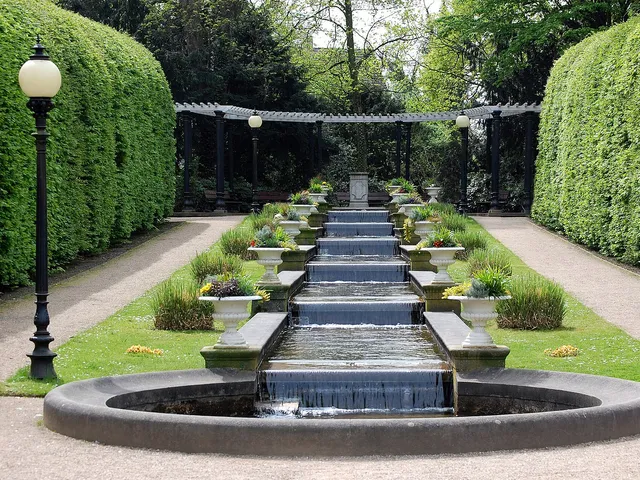
The best-preserved Prussian fort of Cologne's inner defensive ring — now a 'green fort' with a rose garden set within a generous parkland in Neustadt-Nord.
Fort X in Cologne's Neustadt-Nord district is a preserved military fortification from the Prussian defensive ring around the city. It is the only Cologne fort from the first construction phase that still reveals how the individual defensive elements worked together.
Source: Wikipedia
At a Glance
- Type
- Prussian fort of the left-bank fortification ring
- Location
- Neusser Wall 33, Neustadt-Nord, inner city district, near Innere Kanalstraße and Neusser Straße
- Built
- 1819 to 1825, designed by Ernst Ludwig von Aster
- Former name
- "Prinz Wilhelm von Preußen" (from 1825)
- Highlight
- Symmetrically laid-out rose garden on the envelope
- Preserved elements
- Main works, ramparts with casemates, moats, and mine galleries
- Status
- Listed monument in North Rhine-Westphalia
- Getting there
- City rail (Stadtbahn) to Lohsestraße or Reichenspergerplatz
The rose garden at Fort X was largely shaped by Konrad Adenauer – then mayor of Cologne and passionate rose enthusiast – who transformed the former military fortress into a garden landscape.
Age comparison
Age compared with other places in Cologne.
Origins
After the Congress of Vienna, Cologne passed to Prussia. King Frederick William III ordered a strengthening of the Rhine line; a royal decree of 1816 called for eleven forts on the inner ring around left-bank Cologne. For financial reasons, only five were initially built, Fort X among them. All followed a rectangular layout with horseshoe-shaped, bomb-proof redoubts and could accommodate 300 soldiers each. Fort X was rated as particularly important, alongside Fort II.
Spared from Demolition
The Treaty of Versailles of 1919 called for the demolition of fortifications east of the Rhine. Fort X was spared from destruction thanks to prior preservation petitions. In 1921, parks director Fritz Encke transformed it into the "green fort" and created a rose garden on the envelope — a project closely associated with rose enthusiast and then-mayor Konrad Adenauer. In 1930 the city parks department set up offices in the redoubt; in 1939 the SS used the fort as a social club.
World War II and After
During World War II the fort took two direct hits: one destroyed the upper storey of the right traitor, the other damaged the casemates of the mortar battery. The cellars and defence gallery served as air-raid shelters, as evidenced by surviving blast doors and concrete reinforcements. After the war, bombed-out families lived in the fort; its last resident died in May 2011.
Today
Fort X is almost completely intact and integrated into a generously landscaped park of 98.43 hectares, where visitors can trace the layout and function of an early 19th-century defensive work. Following restoration in 2013, the rose garden displays over 70 varieties of rose.
Good to Know
All Cologne streets located where former forts once stood carry the name "Wall" — which explains the address on Neusser Wall.
Timeline
- 181415 Jan.: Cologne liberated by Prussian troops, ceded to Prussia
- 181622 Apr.: Royal decree ordering construction of 11 forts west of the Rhine in Cologne
- 18194 Oct.: Construction of Fort X begins, designed by Ernst Ludwig von Aster
- 1825Sept.: Completion; 9 Sept.: King names Fort X 'Prince Wilhelm of Prussia'
- 1912Repurposed: apartments established inside the fort
- 191928 Jun.: Treaty of Versailles orders demolition of all fortifications within 50 km east of the Rhine
- 1921Encke converts Fort X into a 'green fort'; rose garden laid out on the envelope
- 2013July: Rose garden renovation completed; over 70 rose varieties
Map
Blue dots: other places nearby — tap to explore.
You might also like
Comments
- Loading comments…
Sources & links
Auto-generated, last verified: 2026-06-26