Fischmarkt
Historic square on the Rhine riverfront in Cologne's Altstadt — for centuries the heart of the city's fish trade, first recorded as "forum piscium" in the 12th century.
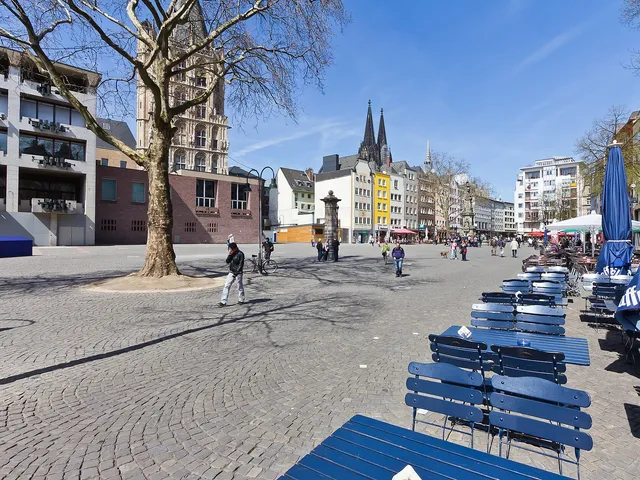
The Fischmarkt is a small square on the Rhine riverfront in Cologne's Altstadt, close to the Romanesque church of Groß St. Martin. For centuries it served as the centre of Cologne's fish trade.
At a Glance
- Type
- Riverside square (listed as attraction on Google Maps)
- District
- Altstadt-Nord, Innenstadt borough
- Location
- between Buttermarkt and Mauthgasse, near Groß St. Martin
- Address
- Am Leystapel, 50667 Cologne
- History
- first documented as "forum piscium" in the 12th century
- Stapelhäuschen
- five pointed-gable houses, two demolished in 2024
- Today
- colourful historic houses, a fountain, and cafés with outdoor seating
Thanks to Cologne's Stapelrecht (staple right) granted in 1259, all goods transported on the Rhine – including fish – had to be offered for sale to Cologne's citizens for three days before they could be moved on.
Things to do here
- Stroll across the historic riverside square
- Admire the colorful, gabled old-town houses
- Photograph the square and nearby Great St. Martin church
- Take a break at a café with outdoor seating
- Linger by the fountain and watch the bustle
- Wander from the square along the Rheingarten to the riverside promenade
History
The site was first developed around 1100, with the earliest buildings likely standing on the grounds of the Benedictine abbey of Groß St. Martin. From the 13th century the square occupied the land between the choir of Groß St. Martin and the medieval city wall along the Rhine — known locally as "upme Vischmarte". A lane connected it to the Alter Markt, the city's main market at the time.
Trade and Commerce
Fresh "green" fish was sold openly from Karen (fish crates) along the riverbank. Cologne's Stapelrecht (staple right), confirmed in 1259, required fish shipped along the Rhine — mostly from Holland — to be offered for sale to Cologne's citizens for three days. Stalls were leased to middlemen known as Feschmenger; salmon was cut and sold at dedicated benches on the south side, while smaller fish and crayfish were often sold by women, the Feschwiever. During the period of French rule the square was briefly renamed "Marché aux Poissons"; by the mid-19th century trade had largely moved into shops.
Wartime Destruction and Rebuilding
World War II destroyed 90 % of Cologne's Altstadt, including the Fischmarkt and Groß St. Martin. In the post-war decades many of the narrow, pointed-gable houses were rebuilt in their historic style. In 2024, two of the five Stapelhäuschen were found to be beyond repair and demolished; a full restoration of the timber-frame structure is not expected.
From Traffic to Riverside Park
In the late 1970s, the construction of the Rhine tunnel eased the heavy traffic that had run between the Altstadt and the riverfront. When the tunnel opened on 5 November 1982, the Rheingarten was created along the Rhine between Deutzer Brücke and Hohenzollernbrücke, linking the Altstadt to the riverside promenade.
Timeline
- 1100First buildings at the Fischmarkt between Lintgasse and Mühlengasse
- 12. JahrhundertEarliest documented mention as "forum piscium"
- 13. JahrhundertMarket occupies grounds between Groß St. Martin and the city wall
- 1259Staple right granted, boosting Cologne's fish trade
- Anfang 19. JahrhundertRenamed "Marché aux Poissons" under French rule
- Mitte 19. JahrhundertFish trade increasingly moves into shops
- 5. November 1982Rhine tunnel opens, creating the Rheingarten promenade
- September 2024Two of the five gabled Stapelhäuschen demolished
Map
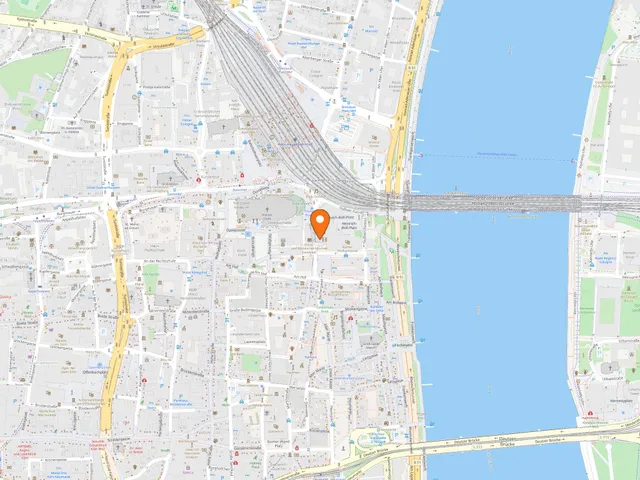
Blue dots: other places nearby — tap to explore.
You might also like — related or nearby

Comments
- Loading comments…
Sources & links
- Official website
- Official website (retrieved 2026-06-25)
- Wikidata (retrieved 2026-06-24)
- Wikipedia (retrieved 2026-06-24, rev 256733356)
Auto-generated, last verified: 2026-06-26
How this page is made
This page draws on open sources — Wikipedia, Wikidata, official websites and the city’s open data. Every statement is checked against the sources linked here, and pages are refreshed regularly.
Spotted a mistake anyway? Tell us below — we read every submission.