Germania Judaica
Europe's most extensive specialist library on the history of German-speaking Jewry — founded in Cologne in 1959 with Heinrich Böll among its founders.
since 1959
Germania Judaica is a scholarly specialist library dedicated to the history of German-speaking Jewry. Citizens of Cologne established it in 1959 as a registered association; its collection is considered the most comprehensive of its kind in Germany and Europe.
At a Glance
- Type
- Academic specialist library (registered association)
- Founded
- 1959
- Location
- Altstadt-Süd, inner-city district
- Housed in
- Cologne's Central Library since 1979
- Holdings
- around 85,000 volumes and some 500 periodicals
- Focus
- History and culture of German-speaking Jewry
- Funding
- City of Cologne, membership fees, and private donations
- Suitable for
- Research and reading by visitors from Germany and abroad
The library was founded in 1959 with just 180 printed works – and has since grown to around 90,000 volumes, making it the largest specialist collection on the history of German-speaking Jewry in all of Europe.
Things to do here
- Browse Europe's largest specialist library on German-speaking Jewish history
- Explore the open-access shelves and discover books
- Research and read up on Jewish history and culture
- Leaf through historical German-Jewish newspapers and magazines
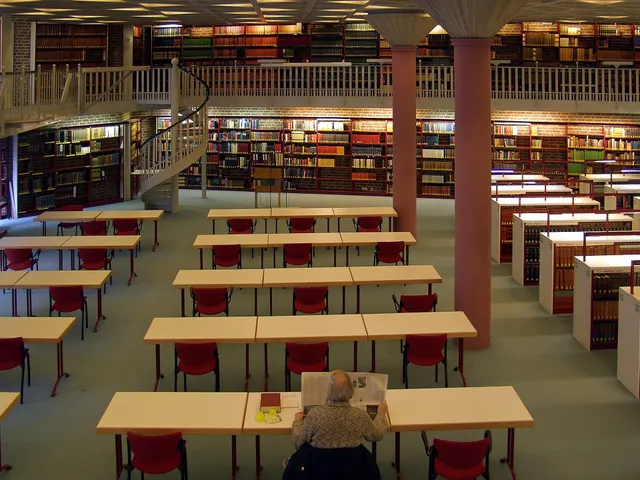
- Read in a quiet atmosphere inside the Central Library
Age comparison
Age compared with other places in Cologne.
History
The catalyst was a visit by Martin Buber in 1958. Buber advised representing a subject properly rather than fighting antisemitism — a philosophy the library made its own. The founding circle in 1959 included authors Heinrich Böll and Paul Schallück, journalist Wilhelm Unger, publisher Ernst Brücher, Cologne's head of cultural affairs Kurt Hackenberg, and bookseller Karl Keller; Klaus von Dohnanyi joined later. Their shared conviction: ignorance breeds prejudice. When Cologne's synagogue was desecrated at the end of 1959, the incident gave the project further momentum.
From Modest Beginnings to a Specialist Library
The collection started with just 180 printed works, housed in the Hansahochhaus. In 1979 the library moved into Cologne's Central Library, which now administers it. Around 45,000 volumes are available on open shelves, with a comparable number held in closed stacks.
Collection and Themes
The core focus is literature on the history of Jews in Germany from the early modern period onward, with particular emphasis on local and regional history. The library also covers general Jewish history and culture, Zionism, Palestine and Israel, antisemitism, and the portrayal of Jews in literature and film. Over 500 German-Jewish newspapers and journals round out the holdings.
Mission and Work
The institution aims to spread knowledge and counter prejudice. Every three years its Arbeitsinformationen publishes a survey of current research on the history of German Jewry and antisemitism. It should not be confused with the research and publication project of the same name, which has documented Jewish settlements in the German Reich since 1903.
Timeline
- 1958Martin Buber visits Cologne, inspiring the library's founding
- 1959Germania Judaica founded as a registered association
- 1959Desecration of Cologne synagogue underlines need for the library
- 1960Jutta Bohnke-Kollwitz starts as second managing director
- 1970erInstitutional funding by City of Cologne and NRW begins
- 1979Move to Cologne City Library premises at Neumarkt
- 1984Monika Richarz takes over as director
- 1993Annette Haller takes over as director (until 2017)
- 2006State of NRW withdraws from funding
- 2018Ursula Reuter becomes new managing director (from April)
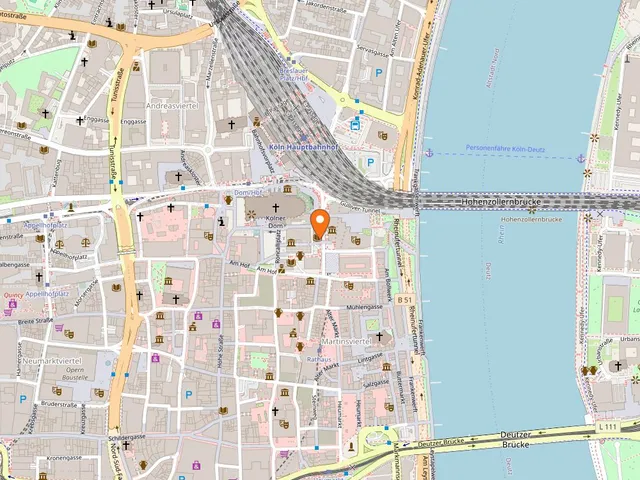
Map
Blue dots: other places nearby — tap to explore.
Address
Hohe Str. 68-82
50667 Köln
Hours
Mo: 13:00–18:00
Di: 10:00–20:00
Mi: 10:00–18:00
Do: 10:00–20:00
Fr: 10:00–18:00
Sa: 10:00–18:00
So: 13:00–18:00
You might also like — related or nearby

Comments
- Loading comments…
Sources & links
- Official website
- Official website (retrieved 2026-07-06)
- Wikidata (retrieved 2026-06-26)
- Wikipedia (retrieved 2026-06-26)
Auto-generated, last verified: 2026-06-26
How this page is made
This page draws on open sources — Wikipedia, Wikidata, official websites and the city’s open data. Every statement is checked against the sources linked here, and pages are refreshed regularly.
Spotted a mistake anyway? Tell us below — we read every submission.