Helios (Electrical Engineering Company)
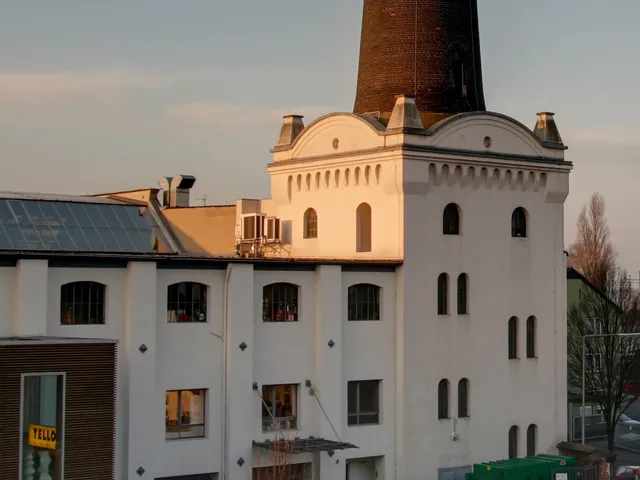
Electrical engineering pioneer from Ehrenfeld — its 44 m Heliosturm, a faux lighthouse, still defines the neighbourhood today.
Helios AG für elektrisches Licht und Telegraphenanlagenbau was an electrical engineering company from the industry's pioneering era, headquartered in what was then the independent municipality of Ehrenfeld, incorporated into Cologne in 1888. Its administrative building, production halls, and the 44-metre Heliosturm are now among Cologne's best-preserved industrial monuments.
Source: Wikipedia
At a Glance
- Type
- Electrical engineering company from the early days of the industry
- Founded
- 31 July 1884 as Helios AG (from a predecessor firm dating to 1870)
- Location
- Venloer Straße 387–389, Ehrenfeld
- Workforce
- Up to 2,000 employees
- Landmark
- 44 m Heliosturm, a faux lighthouse with no function as a navigational aid
- Track record
- 23 power stations and six tram networks across Germany
On the Helios AG factory grounds, there was a dedicated test circuit for electric trams that could be switched between alternating and direct current as needed – a remarkably unusual rail-based laboratory for the pioneering days of electrical engineering.
Age comparison
Age compared with other places in Cologne.
History
The company's predecessor was the Gesellschaft für elektrisches Licht und Telegraphenbau Barthel Berghausen und Cie, founded in Ehrenfeld in 1870, from which Helios AG emerged on 31 July 1884. The site on Venloer Straße was chosen for its proximity to the horse-drawn tram line to Cologne and to Ehrenfeld station on the Cologne–Aachen railway. After demand slackened and the costly acquisition of the Berliner Bank für elektrische Industrie in 1899 proved ruinous, the company became a restructuring case: Siemens and AEG stepped in during 1904, and from 1905 AEG managed the liquidation. The works finally closed in 1930.
What Helios Made
The factory, named after the Greek god of the sun, built complete power stations using the then-novel alternating current system, along with generators, transformers, incandescent lamps, and lighting equipment. Its product range also included lighthouses and navigational beacons; Helios equipped installations on Borkum, Sylt, and Wangerooge, as well as the marine signalling technology of the Kiel Canal. Electric trams were another speciality — the factory grounds featured a test loop that could run on either alternating or direct current. From 1903 to 1906, and again from 1923, Helios also manufactured motor vehicles, and in 1891 the company exhibited at the International Electrotechnical Exhibition with its own stand.
The Heliosturm
The tower replaced an earlier demonstration installation for navigational lights three years after the factory opened, serving experiments and public presentations. Its 12-metre base building in historicist style has a square footprint and stands at the north-western corner of the main factory hall. After Helios AG closed, the tower fell into disrepair; in 1996 it received a new lamp housing and has since cast a faint, steady glow over Ehrenfeld.
Timeline
- 1870Founding of the Society for Electric Light and Telegraph Construction in Ehrenfeld
- 1882Founding of Helios AG (according to Wikidata)
- 1884Reconstitution as Helios AG on 31 July 1884
- 1888Ehrenfeld incorporated into Cologne
- 1891Exhibition stand at the International Electrotechnical Exhibition
- 1899Acquisition of the Berlin Bank for Electrical Industry at a loss
- 1904Siemens and AEG take a stake in the company
- 1905Liquidation of the company begins under AEG
- 1930Final closure of the works after completion of liquidation
- 1996Reconstruction of the Helios Tower with a new lamp room
Gallery
Map
Blue dots: other places nearby — tap to explore.
You might also like

Comments
- Loading comments…
Sources & links
Auto-generated, last verified: 2026-06-26