Wallrafplatz
Historic square in Cologne's Altstadt-Nord between the Hohe Straße and the Cathedral, created around 1830 on the site of the demolished Dompropstei.
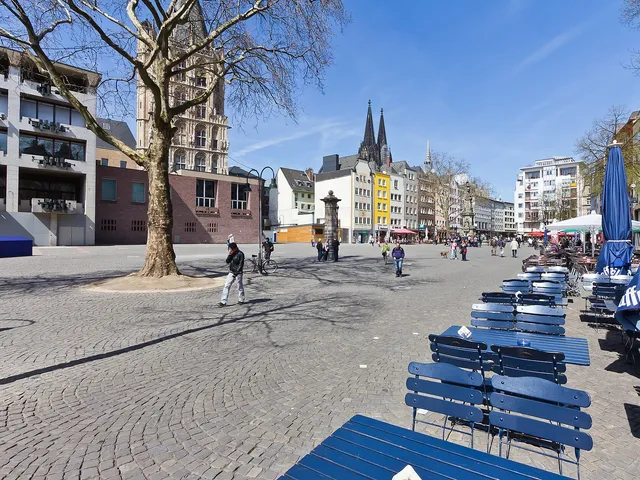
Wallrafplatz is a city square in Cologne's Altstadt-Nord district, nestled between the Hohe Straße shopping street and the famous Cologne Cathedral. It owes its name to Ferdinand Franz Wallraf, a celebrated art collector and the last rector of Cologne's old university.
At a Glance
- Type
- urban square
- District
- Altstadt-Nord, Innenstadt borough
- Location
- between Hohe Straße and Cologne Cathedral
- Named after
- Ferdinand Franz Wallraf (1748–1824)
- Established
- around 1830, after demolition of the Dompropstei
- Historical use
- medieval printers' and booksellers' quarter
- Urban context
- one of three new squares laid out along Hohe Straße
When the old cathedral provostry was demolished in 1830 to make way for the square, excavations uncovered three Roman Matron stones – an unexpected find right next to Cologne Cathedral.
From Crossroads to Printers' Quarter
In the Middle Ages, the streets "An der Hohen Schmiede" and "Am Hof" intersected here with what is now the Hohe Straße and "Unter Fettenhennen" — a busy crossroads with no square to speak of, as Arnold Mercator's 1570 city map confirms. Over time, the area developed into a hub for printers and booksellers. In 1598, Johann Gymnich IV. bought the house "Zum Bären an der hohen Schmiede" and set up a print shop; by 1614 he had built a new stepped-gable structure called "Zum Einhorn" on the consolidated site, which remained home to printing families for generations.
Ferdinand Franz Wallraf
Since 1363, the Dompropstei (Cathedral Provostry) had stood at the corner of Unter Fettenhennen and Am Hof. During the French occupation, Ferdinand Franz Wallraf — the last rector of Cologne's old university and founder of a significant art collection — was granted free use of the vacant building in 1794 to house himself and his collection.
Creation of the Square
After the Prussian authorities approved the land exchange in 1829, the city demolished the Dompropstei in June 1830. Excavations uncovered three Roman Matron stones. The newly opened view of the still-unfinished Cathedral proved so compelling that plans for a replacement building were dropped. Citizens spontaneously began calling the open space "Wallraf's-Platz." City architect Matthias Biercher formalized it as a gathering point at the entrance to the narrow Hohe Straße, while also creating a link between the shopping street and the Cathedral precinct.
Three New Squares
By 1830, three new squares had been created along the Hohe Straße: the Augustinerplatz, Laurenzplatz, and Wallrafplatz. The freshly laid-out Wallrafplatz hosted its first public fairground performance as early as 1831.
Timeline
- 1363Cathedral provostry built at the corner of Hohe Schmiede / Unter Fettenhennen
- um 1554Small chain houses built along the Hohe Schmiede street
- 1794Cathedral provostry left vacant; Wallraf granted permission to live and store his art collection there
- 17. Juni 1823Prussian government rejects Cologne's application to acquire the provostry site
- 11. Februar 1829Royal government approves demolition of the provostry and creation of a public square
- Juni 1830Provostry demolished; view of the cathedral opens up; three Roman matrona stones discovered
- 1830Citizens name the open area 'Wallraf's-Platz'; three new squares along Hohe Straße completed
- 15. Februar 1831First public fairground performance held on the newly created Wallrafplatz
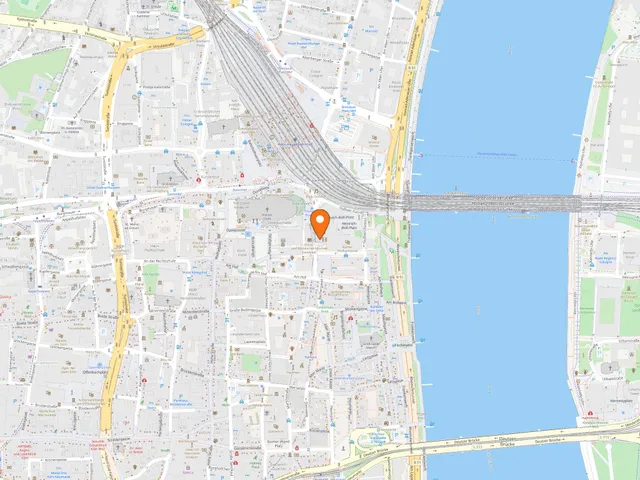
Map
Blue dots: other places nearby — tap to explore.
Address
Wallrafpl.
50667 Köln
You might also like — related or nearby
Comments
- Loading comments…
Sources & links
Auto-generated, last verified: 2026-06-27
How this page is made
This page draws on open sources — Wikipedia, Wikidata, official websites and the city’s open data. Every statement is checked against the sources linked here, and pages are refreshed regularly.
Spotted a mistake anyway? Tell us below — we read every submission.