Offenbachplatz
The theatre square in Cologne's Altstadt-Nord, fronting the Opera House and Schauspielhaus, centred on the long-neglected Opernbrunnen by Jürgen Hans Grümmer.
Offenbachplatz lies at the heart of Cologne's city centre along the Nord-Süd-Fahrt, serving as the forecourt to the twin theatre complex of the Opera House and Schauspielhaus. Its name links the memory of composer Jacques Offenbach with that of the Glockengasse Synagogue, destroyed during the November Pogrom.
At a Glance
- Type
- Theatre square in the city centre
- Location
- Altstadt-Nord, Innenstadt district, on the Nord-Süd-Fahrt
- Layout
- "large" Offenbachplatz in front of the Opera House, "small" Offenbachplatz in front of the Schauspielhaus
- Buildings
- Riphahn ensemble (Opera House 1957, Schauspielhaus 1960–1962)
- Centrepiece
- listed Opernbrunnen, inaugurated 21 December 1966
- Square design
- Jürgen Hans Grümmer, completed 1967
The opera fountain on Offenbachplatz incorporates mosaic pieces from the swimming pool of shipping magnate Aristotle Onassis's luxury yacht "Tina" – alongside fragments of apostle heads salvaged from the destroyed Kaiser Wilhelm Memorial Church in Berlin.
Things to do here
- Admire the architecture of the Riphahn ensemble in front of the opera and playhouse
- Discover the listed opera fountain with its mosaics
- View the bronze sculpture "Sappho" on the small Offenbachplatz
- Pause at the memorial plaque to Jacques Offenbach and the Glockengasse synagogue
- Photograph the theatre square and soak up the atmosphere in the city centre
- Stroll across the square before a theatre or opera visit
Name and Memory
The square honours Jacques Offenbach, the French composer born in Cologne in 1819. It also commemorates the Glockengasse Synagogue in Altstadt, where Offenbach's father served as cantor — the synagogue was destroyed during the Kristallnacht pogrom of 1938. A bronze plaque by Jürgen Hans Grümmer on the north side of the Opera House marks the synagogue's former location.
The Theatre Ensemble
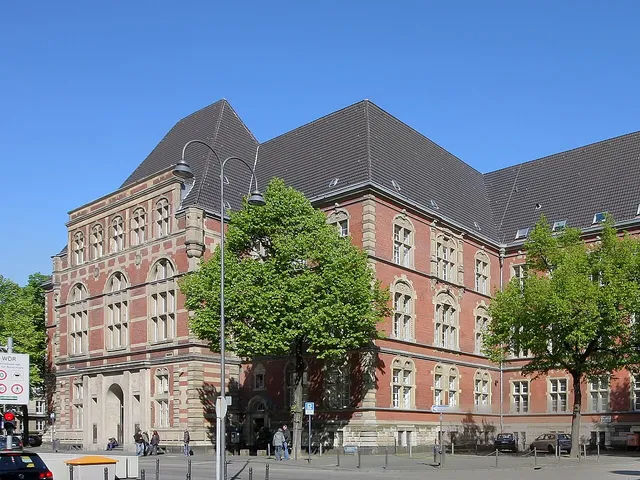
The "large" Offenbachplatz is framed to the west and south by the Opera House, opened in 1957, and the pavilion of the theatre restaurant "Opernterrassen". Both were designed by Wilhelm Riphahn and his associate Hans Menne. Between 1960 and 1962, the Schauspielhaus was added to the south-west as the ensemble's third element.
The Opernbrunnen
The square — used as a car park until the 1960s — and its fountain were designed by Jürgen Hans Grümmer in the early 1960s. His circular reinforced-concrete structure, clad in ceramic and glass mosaics, picks up the grey tones, white, and red of the Riphahn buildings, adding accents of blue and gold with underwater floodlights. A tall central jet originally dominated the fountain, with further nozzles spraying water in a wreath-like ring. Grümmer wove in found mosaics as artistic quotations, including ceramics from the swimming pool of shipping magnate Aristotle Onassis's yacht Tina and apostle heads salvaged from the destroyed Kaiser Wilhelm Memorial Church in Berlin. The "small" Offenbachplatz features the bronze sculpture Sappho by Émile-Antoine Bourdelle.
Current Condition
Heavy limescale build-up has obscured the once-vivid colours of the fountain for years. The nozzles are clogged, bent, or missing, the lighting has been dismantled, and the jets have been reduced. The fountain basin and paving survive, but the ensemble as a whole has an air of neglect.
Timeline
- 1819Jacques Offenbach born in Cologne (namesake of the square)
- 1938Glockengasse synagogue destroyed during the November pogrom
- 1956North-South road conceived in the general traffic plan
- 1957Opera house opened, designed by Wilhelm Riphahn
- 1960–1962Cologne Schauspielhaus built as third element of the Riphahn ensemble
- 1966Opera fountain by Jürgen Hans Grümmer inaugurated on 21 December
- 1967Square design by Grümmer completed – artistic completion of the ensemble
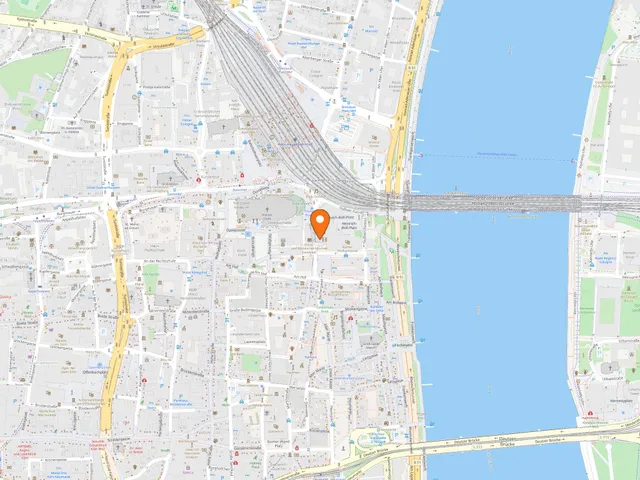
Map
Blue dots: other places nearby — tap to explore.
Address
Offenbachpl.
50667 Köln
You might also like — related or nearby
Comments
- Loading comments…
Sources & links
Auto-generated, last verified: 2026-06-27
How this page is made
This page draws on open sources — Wikipedia, Wikidata, official websites and the city’s open data. Every statement is checked against the sources linked here, and pages are refreshed regularly.
Spotted a mistake anyway? Tell us below — we read every submission.