Kunibertsturm
Remnant of a medieval gate fortress at the northern end of Cologne's city wall, its small round tower Weckschnapp still standing today.
The tower once formed part of a gate fortress guarding the Rhine bank, caught between archiepiscopal ambition and civic rebellion.
Source: Wikipedia
At a Glance
- Type
- originally the defensive tower of a medieval gate fortress
- Other name
- Riehlerturm
- Location
- northern end of Cologne's city wall, Altstadt-Nord district, Innenstadt borough
- First mentioned
- around 1233, referred to as "nova turris" in 1244
- Building material
- almost entirely columnar basalt with tuff-stone infill
- Outworks
- two
At the Kunibertsturm, prisoners were not only locked in vaulted dungeon chambers but, according to a 1592 inspection, also subjected to torture on the so-called 'Marterstuhl' (torture chair) during interrogations.
Between Archbishop and Citizens
The city itself built the original gate fortress, but after capturing Cologne in 1261, Archbishop Engelbert expanded it into a stronghold of control. He spent 6,000 marks fortifying both riverbank fortifications, including the "Kunibertsburg zu Riehle." In 1262 rebellious citizens stormed and demolished the complex, leaving only the towers standing—much like the Bayenturm at the wall's southern end, the Kunibertsturm became a mere fragment of its former self.
The Ark on the Rhine
Sources describe the so-called "Ark" inconsistently: either as a wooden walkway connected to the tower, built before 1370 and running on piles over the towpath to a watchhouse in the river, or as a solid rectangular watchtower erected around 1371, contemporary with the Bayenturm's own Ark. Access ran through an arched opening in the northern outwork. The ice drift of winter 1784 largely destroyed the structure, though remnants reportedly survived into the French era.
Prison and Interrogation
A 1592 inspection report mentions vaulted prison cells where interrogations under torture took place on the "chair of pain." A 1709 protocol records three vaulted cells within the tower.
The Weckschnapp
The second outwork led via a battlemented wall to a small round watchtower, built alongside it and documented as the "nuwer ronder Torn" since 1446. It measures 6 meters in diameter and stands about 17.30 meters tall, its late-14th-century masonry alternating basalt and tuff courses in the style of Cologne's mill towers. The domed ground floor was originally accessible only through a hatch from above; of the three upper floors with arrow slits, the layouts vary between flat brick vaulting, timber ceilings, and a domed roof. The platform still carries its crenellated crown, resting—as at the Bayenturm—on a corbelled arcade of trefoil arches.
Preservation
Unlike the rest of the gate fortress, the little tower was spared demolition. The city acquired it in 1891, and in 1898 it was restored for 15,000 marks under a design by Josef Stübben, supervised by "Sesterhenn."
Timeline
- um 1233First documented mention as a gate fortification
- 1244Mentioned as 'nova turris' in sources
- 1261Extensive expansion into a stronghold after capture by Archbishop Engelbert
- 1262Storming and partial demolition during citizens' uprisings
- vor 1370Construction of the Ark, a defensive walkway with guardhouse over the towpath
- um 1371Ark built simultaneously with that of the Bayenturm
- 1446First mention of the Weckschnapp tower as 'nuwer ronder Torn'
- 1592Inspection reports vaulted prison cells in the tower
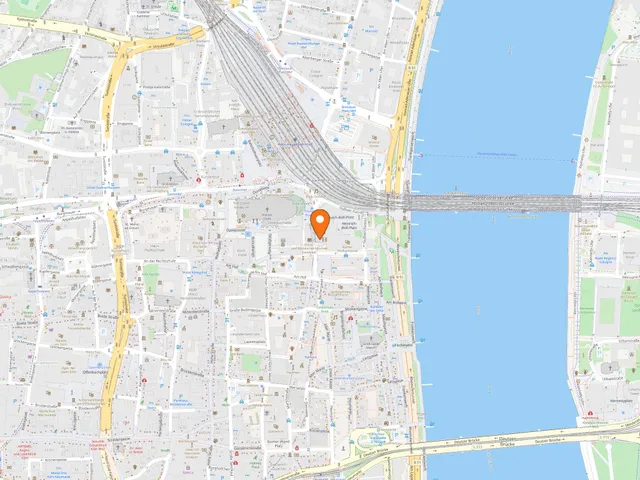
Map
Blue dots: other places nearby — tap to explore.
You might also like — related or nearby
Comments
- Loading comments…
Sources & links
Auto-generated, last verified: 2026-09-25
How this page is made
This page draws on open sources — Wikipedia, Wikidata, official websites and the city’s open data. Every statement is checked against the sources linked here, and pages are refreshed regularly.
Spotted a mistake anyway? Tell us below — we read every submission.