Minoritenkirche
Burial church of Adolph Kolping and Johannes Duns Scotus — a 13th-century Gothic mendicant church and place of pilgrimage.
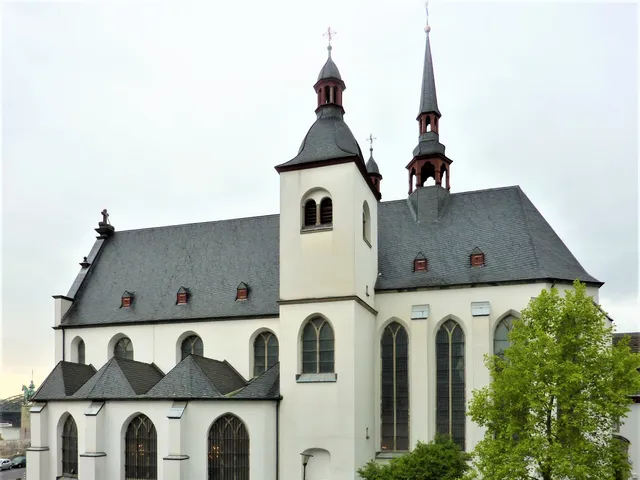
The Minoritenkirche, officially named St. Mariä Empfängnis (Immaculate Conception), stands on Kolpingplatz in Cologne's Altstadt-Nord district. With the tombs of the 'journeymen's father' Adolph Kolping and the medieval theologian Johannes Duns Scotus, it is a place of pilgrimage.
At a Glance
- Type
- Roman Catholic church, originally a Franciscan friary church
- Dedication
- Immaculate Conception (St. Mariä Empfängnis)
- Location
- Kolpingplatz, Altstadt-Nord, inner city district
- Architectural style
- Gothic (13th–14th century)
- Dimensions
- originally approx. 58 m long, 32 m wide and 21 m high
- Notable
- alongside the Dominican church, the oldest mendicant church in Cologne
- Interior
- Late Gothic winged altarpiece (c. 1480)
- Listed
- Protected monument in North Rhine-Westphalia
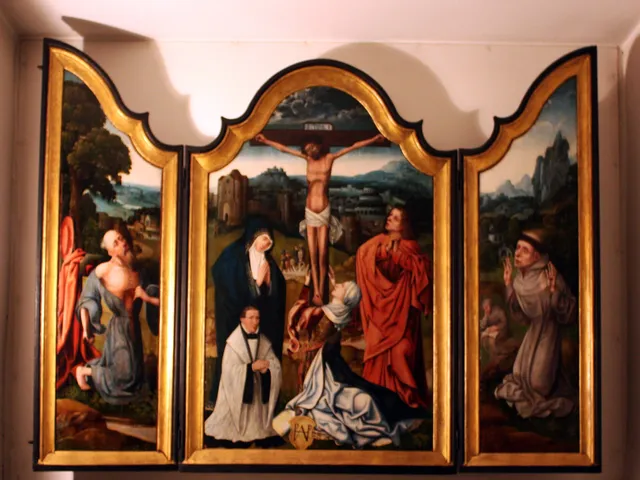
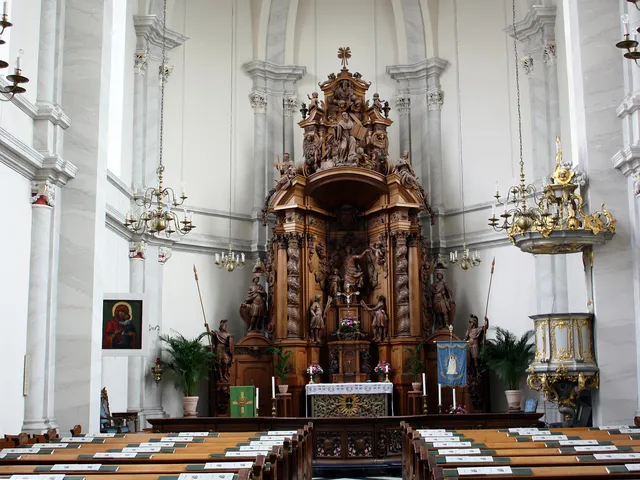
The high altar of the Minoritenkirche is a winged altarpiece made around 1480 in Lower Saxony, originally from the St. Nicholas Church in Alfeld (Leine), which only made its way to Cologne in 1889 – a year after its removal from that church in 1888 – as a gift marking Bishop Baudri's 60th anniversary of ordination.
Things to do here
- Admire the 13th-century Gothic mendicant church
- Visit the tombs of Adolph Kolping and John Duns Scotus
- Take in the late-Gothic winged altarpiece from around 1480
- Discover the floating glass crucifix above the altar in the choir
- Pause and linger in the quiet church
- Photograph the simple Gothic architecture
History
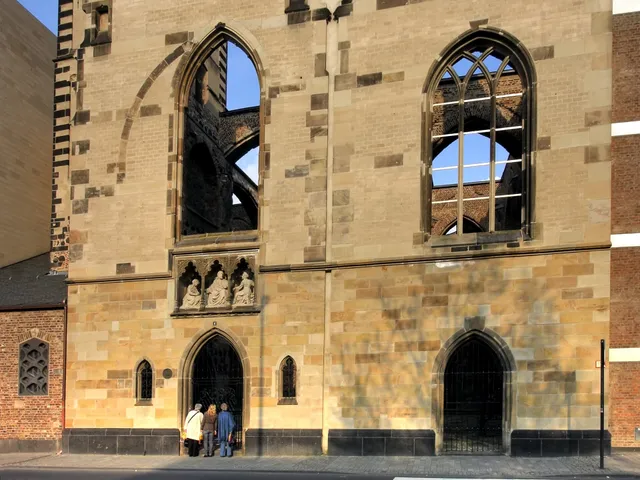
The Franciscans settled in Cologne in 1222 and from 1245 built a church and friary on the present site. The Cologne convent became the provincial headquarters and from around 1260 housed the order's own studium generale, where Johannes Duns Scotus taught from 1307. During secularisation the friary was dissolved — Wikipedia gives 1802, the official website 1804. The friary buildings were taken over by the city's poor relief administration and demolished in 1855, while the church itself passed to the Cathedral Chapter as an auxiliary church in 1846. The Museum of Applied Arts now stands on the former friary grounds; the tracery of the cloister's west wing has survived and is incorporated into the museum.
Architecture
The church is an elongated Gothic structure without a transept. The Early Gothic choir was built between 1245 and around 1260; the three-aisled nave with eight bays and rib vaulting followed in the 14th century, with the detailing becoming plainer towards the nave — an expression, according to Meinrad Sehi, of the Franciscan ideal of simplicity. As a mendicant church it has no tower; instead, since 1438 it has had a ridge turret, renewed in 1713.
Kolping and the Kolpingwerk
Adolph Kolping was appointed rector at the Minoritenkirche in 1862 and funded its interior renovation through public donations. His Cologne journeymen's association had already been using the church since 1849. Today it serves the international Kolpingwerk, whose headquarters stands directly opposite.
Today
Fire during the Second World War destroyed much of the church, including the vaults and parts of the south aisle. The Kolpingwerk completed the rebuilding in 1958, and a comprehensive restoration followed in 2009/10. Since then, a glass crucifix by Düsseldorf artist Thomas Kesseler has hung above the altar in the chancel.
Timeline
- 1222Franciscans settle in Cologne
- 1245Construction of the monastery church begins at its current site
- 1260Consecration of the Early Gothic choir by Bishop Heinrich von Lützelburg
- 1438Erection of a ridge turret (instead of a bell tower)
- 1802Monastery dissolved in the course of secularisation
- 1846Church transferred to the cathedral chapter as an annex of Cologne Cathedral
- 1958Reconstruction completed after wartime destruction in World War II
- 2009/10Comprehensive restoration including roof, ridge turret, and interior
Gallery
Map
Blue dots: other places nearby — tap to explore.
Address
Kolpingpl. 1
50667 Köln
Contact
You might also like — related or nearby
Comments
- Loading comments…
Sources & links
- Official website
- Official website (retrieved 2026-06-25)
- Wikidata (retrieved 2026-06-24)
- Wikipedia (retrieved 2026-06-24, rev 268044704)
Auto-generated, last verified: 2026-06-26
How this page is made
This page draws on open sources — Wikipedia, Wikidata, official websites and the city’s open data. Every statement is checked against the sources linked here, and pages are refreshed regularly.
Spotted a mistake anyway? Tell us below — we read every submission.