St. Maria Magdalena zur Busse (Bethlehem Convent), Cologne
A former beguine community on the Eigelstein that became an Augustinian convent in 1475, surviving until secularization in 1802.
The epithet "zur Busse" derives not from penance but from a former house owner named Reyner Busse (Latin: ad pixidem, "at the box").
Source: Wikipedia
At a Glance
- Type
- Former women's convent, originating from a beguine community
- Location
- On the Eigelstein, today part of Altstadt-Nord in the Innenstadt district
- Alternate name
- Bethlehem
- Rule
- Augustinian Hermits' rule from 1475
- Duration
- Existed until dissolution during secularization in 1802
- Records
- 33 charters and 0.5 m of files from 1455 onward, held at the Landesarchiv NRW
In 1471 the converted convent initially took in 24 destitute, work-incapable maids and so-called "fallen girls" – in 1492 a revolt broke out there, presumably over forced labor.
History
The house was founded by Richmud, widow of Gottschalk von Wippervurde and daughter of Ludwig von der Mühlengasse, intended to house 50 beguines. As the convent's means were limited, only eight beguines remained by 1452. In 1471 the Quatermart family converted the house into a convent, initially taking in 24 destitute, no-longer-able-bodied maidservants as well as so-called "fallen girls." Two years later, oversight passed to the city of Cologne.
From Beguinage to Convent
From 1475 the community followed the rule of the Augustinian Hermits and took the name Bethlehem, confirmed by Pope Sixtus IV the following year. This came with permission to maintain a church with altars, a bell and bell tower, cemetery, cloister, dormitory, and refectory. At the urging of Emperor Friedrich III, the city supported construction from 1480 and permitted the processing of wool and linen, though it capped the number of residents at 50 again in 1486. Cologne chroniclers record an uprising in 1492, likely over forced labor.
Buildings and Fate
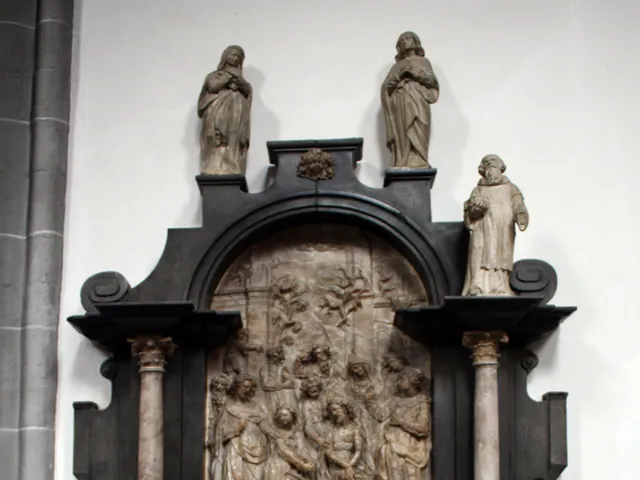
According to Clemen/Vogt (1937), a chapel dedicated to St. Mary Magdalene and Mary of Egypt is said to have existed as early as 1471, though Marianne Gechter notes the evidence for this is weak. Better documented is that the church promoted by Friedrich III existed and was in use by 1525. Further building work followed in the 17th century, including a new sacristy. Baroque furnishings—altars, paintings, a pulpit, and an organ—are documented, though parts no longer survive. The convent was dissolved during secularization in 1802; its properties passed to the municipal poor relief administration, and the church was subsequently demolished.
Timeline
- 1452Only eight beguines still live in the house
- 1471Conversion into a convent by the Quatermart family
- 1473Supervision of the house transferred to the city of Cologne
- 1475Adoption of the Augustinian Hermit rule, name Bethlehem
- 1476Pope Sixtus IV approves the founding of the convent
- 1480City supports construction of convent and church
- 1486Number of residents limited again to 50
- 1492Uprising recorded at the convent
- 1802Dissolution of the convent, church later demolished
Map
Blue dots: other places nearby — tap to explore.
You might also like — related or nearby
Comments
- Loading comments…
Sources & links
Auto-generated, last verified: 2026-09-15
How this page is made
This page draws on open sources — Wikipedia, Wikidata, official websites and the city’s open data. Every statement is checked against the sources linked here, and pages are refreshed regularly.
Spotted a mistake anyway? Tell us below — we read every submission.