St. Maria Magdalena
Founded before 1196 as a chapel of St. Severin's collegiate church, demolished in 1805 — parts of its furnishings survive to this day.
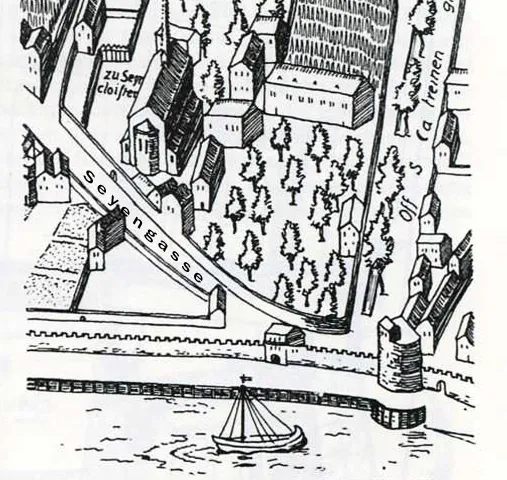
The church stood in Cologne's southern suburb, surrounded by vineyards, farmsteads and administrative buildings of the district.
Source: Wikipedia
At a Glance
- Type
- Former Catholic parish church, originally a vicariate chapel of the St. Severin collegiate foundation
- Style
- Romanesque hall church with a small square ridge turret
- Dimensions
- Nave roughly 11.50 m long and about 7 m wide
- Furnishings
- Two documented side altars (Eustace, Sebastian)
- Survivals
- Fragments of the furnishings preserved in St. Severin, the Wallraf-Richartz Museum, and the University and City Library
History
The chapel, built by the St. Severin foundation, was first mentioned in shrine records toward the end of the 12th century. A foundation charter from 1196 records an endowment for a memorial service as well as the covering of lighting costs on Sunday nights. Further mentions as a chapel followed in 1218 and 1251. By 1312/1313 its role as a parish church had emerged, with a dedicated plebanus and his own parish recorded. Construction likely fell during the tenure of Provost Konrad von Blankenheim (1165–1196).
Building
The nave terminated to the east in a round apse said to have measured about 4.50 m in diameter. The saddle roof carried the ridge turret at its centre. A covered walkway connected the church to the sexton's house to the north. Shrine records from 1361 and 1366 name two side altars, dedicated to St. Eustace and St. Sebastian.
Surroundings
Set on a small plot, the church stood, separated by the street, opposite St. Severin's church. To the north lay a churchyard, behind which stood the Walravenhof (near today's Brunostraße / An St. Magdalenen); the surrounding vineyards ended westward at the city wall. Facing Severinstraße, on the neighbouring plot toward the Severinstorburg, stood the magistrates' courthouse, the district's old smithy (Haus Balchem), and the customs house. Toward the city, across An St. Magdalenen, stood the Mommersloch farmstead on Severinstraße, adjoined by St. Bonifatius.
End and Later Use
During secularisation the church was closed in 1802 and demolished in 1805. The site of the church and churchyard passed to St. Severin. In 1834/35 a new rectory was built there, with lodgings for the chaplain and sexton.
Surviving Furnishings
Parts of the furnishings survive to this day. The Cologne University and City Library received a missal from the Lazarus altar, while other pieces are held at St. Severin and the Wallraf-Richartz Museum. The museum's holdings include a Crucifixion painting bearing two coats of arms (canvas, 1.20 × 1.46 m), dated 1564. St. Severin houses a marble memorial altar of 1614 for the donor and church warden Jakob Deutzmann and his wife Christina; its carved relief depicts the raising of Lazarus, the work of the turner Johann in der Mühlen, and is thought to allude to the churchyard once located behind the church. Also preserved are four 18th-century chalices and an oil painting on wood in the sacristy, whose unknown painter depicted the Crucifixion of Christ at the centre, flanked by side panels showing the donor family — church warden Johann Odendall and his wife Lucia.
Worth Knowing
Regarding the donor of the 1564 Crucifixion painting, the sources conflict: the main text names the depicted banneret as "Laurenz Schwarzburg," while the cited inscription on the painting instead gives his name as "Gerit Schwartzbitch" and his wife as Anna. Which form is correct cannot be determined from the available source.
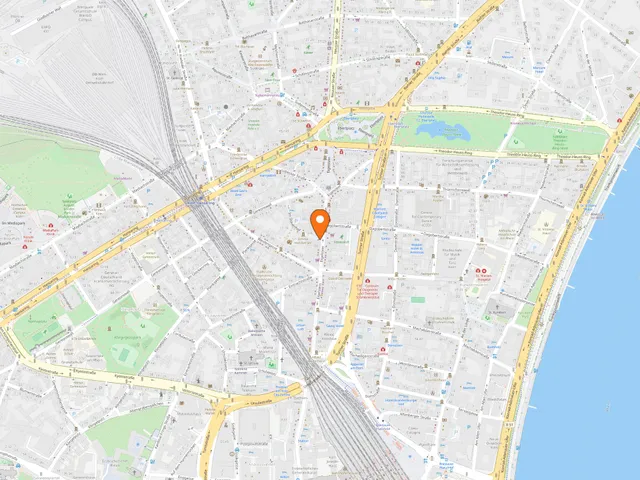
Map
Blue dots: other places nearby — tap to explore.
You might also like — related or nearby
Comments
- Loading comments…
Sources & links
Auto-generated, last verified: 2026-08-30
How this page is made
This page draws on open sources — Wikipedia, Wikidata, official websites and the city’s open data. Every statement is checked against the sources linked here, and pages are refreshed regularly.
Spotted a mistake anyway? Tell us below — we read every submission.