Ubierhaus
Luxuriöses Wohnensemble von 1914/15 am Südende der Kölner Ringe: drei Flügel mit neoklassizistischer Werksteinfassade, direkt am Rhein und unter Denkmalschutz.
The building complex was designed by Leopold Schweitzer and Jacob Koerfer, who also had it built themselves. The name "Ubierhaus" is used by the architectural historian Klemens Klemmer in his monograph on Koerfer.
Source: Wikipedia
At a Glance
- Type
- Listed residential ensemble
- Location
- Neustadt-Süd, Cologne, Innenstadt district
- Buildings
- Agrippinaufer 2, 4, 6 and 8; Trajanstraße 16 and 18
- Construction
- 1914 to autumn 1915, according to Klemmer
- Architects
- Leopold Schweitzer, Jacob Koerfer
- Façade
- Ashlar stone with neoclassical elements
- Heritage protection
- Covered by four entries in Cologne's list of monuments
The Ubierhaus was originally built as a complex of luxury apartments, with its architects Leopold Schweitzer and Jacob Koerfer also acting as the developers; today three Stolpersteine commemorate persecuted former residents Adolf, Henriette and Otto Jonas.
Layout and Dating
A self-contained building complex was planned from the outset, with wings spread across Agrippinaufer, Ubierring and Trajanstraße. It initially housed spacious rental apartments, which Klemmer describes as luxury flats. The heritage portal gives the year 1917 for Trajanstraße 16. The sources consulted leave open how this can be reconciled with Klemmer's dating.
Façades and Interiors
According to Klemmer, the fronts comprise 16 window bays facing Agrippinaufer, five facing Ubierring and nine facing Trajanstraße. Stylistically they form a unit, defined by evenly spaced rows of window bays. Tuff stone is documented at Agrippinaufer 8. Agrippinaufer 6 has four storeys, topped by a plastered attic storey beneath a gabled roof, with a colossal order structuring the three bays of the front. Inside, the listing describes a vestibule with stucco and marble staircases, as well as the stairwell, historic door surrounds and partly preserved doors and stucco ceilings.
War Damage and Remembrance
According to a 1947 City of Cologne war damage map, Agrippinaufer 6 and 8 suffered heavy damage, Trajanstraße 16 and 18 moderate damage, and Agrippinaufer 2 and 4 light damage. Three Stolpersteine commemorate former residents persecuted under National Socialism. Two in front of Agrippinaufer 2 honor Adolf and Henriette Jonas, and one in front of Trajanstraße 18 honors Otto Jonas.
Setting on the Rhine
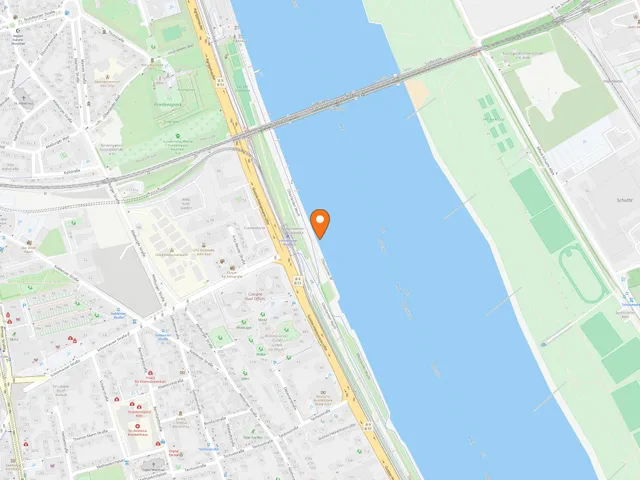
The long front on Agrippinaufer opens toward the Rhine and the Rheinauhafen. Ubierring marks the beginning of the Cologne Ringe; it runs from the riverbank to Chlodwigplatz, an important traffic hub in southern Cologne. Römerpark, Friedenspark and the medieval Bayenturm, now home to the FrauenMediaTurm, are not far away.
Names and Tradition
According to tradition, "Kölle Alaaf" was first heard at the Bayenturm in 1262, when Cologne's citizens recaptured it. Agrippinaufer is named after Agrippina the Younger, Nero's mother. At her instigation, Emperor Claudius elevated her birthplace, the Oppidum Ubiorum, to the Colonia Claudia Ara Agrippinensium in AD 50. Ubierring recalls the Ubii.
Timeline
- 50 n. Chr.Claudius elevates the Oppidum Ubiorum to the Roman colony Colonia Claudia Ara Agrippinensium
- 1262Cologne citizens retake the Bayenturm (tradition: first cry of "Kölle Alaaf")
- 1914Construction of the Ubierhaus begins, designed by Schweitzer and Koerfer
- 1915Construction completed in autumn (according to Klemmer)
- 1917Dating of Trajanstraße 16 in the heritage portal
- 1947City of Cologne war damage map records light to severe damage
Map
Blue dots: other places nearby — tap to explore.
You might also like — related or nearby


Comments
- Loading comments…
Sources & links
Auto-generated, last verified: 2026-10-23
How this page is made
This page draws on open sources — Wikipedia, Wikidata, official websites and the city’s open data. Every statement is checked against the sources linked here, and pages are refreshed regularly.
Spotted a mistake anyway? Tell us below — we read every submission.