Historical Archive with Rhenish Image Archive
Germany's largest municipal archive — collapsed during subway construction in 2009, reopened in a new building at Eifelwall in 2021.
The Historical Archive with Rhenish Image Archive serves as Cologne's city archive, preserving the records of municipal bodies and offices, along with materials from companies, associations, and private individuals with ties to the city.
Source: Wikipedia
At a Glance
- Type
- City archive (municipal archive) with Rhenish Image Archive
- Scale
- approximately 30 shelf-kilometres of archival material
- Rank
- largest municipal archive in Germany
- Current location
- new building at Eifelwall, Südstadt district (Innenstadt borough)
- Collapse
- 3 March 2009, during subway tunnel construction
- Holdings
- charters, files, manuscripts, personal papers
On 3 March 2009, the building of Germany's largest municipal archive collapsed due to construction errors during the building of a subway tunnel, burying around 90 percent of its holdings – including medieval documents – in groundwater, killing two people.
Age comparison
Age compared with other places in Cologne.
Significance of the Collections
Because the holdings stretch back to the High Middle Ages with almost no gaps, the material is considered historically exceptional. Until January 2023 the institution was known as the Historical Archive of the City of Cologne; on 1 January 2023 the Rhenish Image Archive was merged in, though it continues to operate under its own name — an arrangement with the city's cultural administration that is permanently guaranteed.
Early Storage
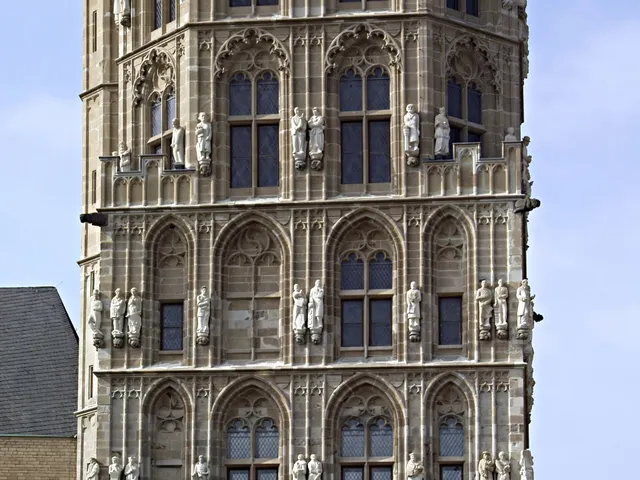
For centuries the city kept its charters, privileges, and financial documents in the Town Hall tower, built between 1407 and 1414. The late-Gothic structure resembles Dutch belfries and rises to 61 metres. This reflected a long-standing Cologne merchant tradition of securing valuable goods and documents in purpose-built vaulted storerooms.
The 2009 Collapse
The archive survived the Second World War unscathed. On 3 March 2009, however, the entire building complex and two neighbouring houses collapsed — triggered by errors during the construction of a subway tunnel. Two people died, and roughly 90 percent of the holdings were buried under the rubble, a large portion of them in groundwater.
Recovery and New Building
By the end of the recovery phase in 2011, around 95 percent of the buried material had been salvaged; cataloguing the individual items continued until 2021, and many pieces still require restoration. Construction of a new building began in 2017 at Eifelwall, about one and a half kilometres southwest of the original site; it opened on 3 September 2021. Since March 2022 all archival items that had been temporarily housed in other archives are once again stored in Cologne.
Legal Framework
The archive's work is governed primarily by the North Rhine-Westphalia Archive Act of 1989, whose Section 10 extends its provisions to municipal archives. Cologne's own archive bylaws — last amended in 2007 — also apply; federal archive legislation does not.
Timeline
- 1406City council resolves to build the Town Hall tower as first archive location
- 1407–1414Construction of the Town Hall tower for secure storage of city documents
- 1857Opening of the archive building (Wikidata)
- 3. März 2009Building collapse due to subway construction errors; 2 killed, ~90 % of holdings buried
- 2011Recovery phase completed; around 95 % of buried holdings salvaged
- 2017Construction of new archive building at Eifelwall begins
- 3. September 2021New building at Eifelwall opens
- 1. Januar 2023Rheinisches Bildarchiv incorporated; archive renamed
Gallery
Map
Blue dots: other places nearby — tap to explore.
You might also like
Comments
- Loading comments…
Sources & links
- Official Instagram (@hastk_rba)
- Wikidata (retrieved 2026-06-26)
- Wikipedia (retrieved 2026-06-26)
Auto-generated, last verified: 2026-06-26