Weckschnapp
Medieval tower of Cologne's Kunibert fortifications on the Rhine — a surviving piece of the city wall and setting of a chilling legend.
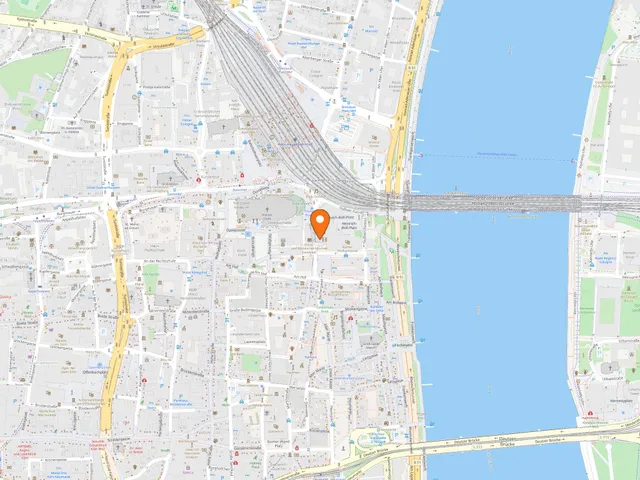
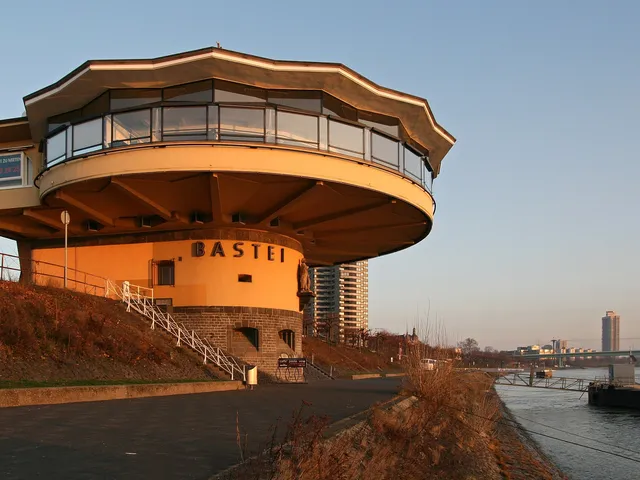
The Weckschnapp is a medieval tower with a modern extension on the Konrad-Adenauer-Ufer in Cologne's Altstadt-Nord district. It is the last surviving part of the former Kunibert fortifications and once belonged to the city's medieval wall.
At a Glance
- Location
- Konrad-Adenauer-Ufer, Altstadt-Nord (west bank of the Rhine)
- First recorded
- 1446
- Origin
- Forward tower of the Kunibert gate, part of the city fortifications
- Today
- Converted for residential use in 1956, with a single-storey extension
- Official name
- Listed as "Kunibertsturm" on the current German base map
- Notable for
- Giving its name to a well-known Cologne legend
The Legend of the Weckschnapp
The name comes from a gruesome Cologne legend. In the tower's prison chamber, the guards are said to have hung a "Weck" — a small loaf of bread — from the ceiling. Given no other food, the prisoners would eventually try to jump up and "snap" at the bread. In doing so, a trapdoor would open and drop them through a knife-lined shaft straight into the Rhine. Only one prisoner, so severely emaciated that he was thin enough to fall between the blades without touching them, is said to have escaped.
The tale was first written down in 1826 by the Cologne author Ernst Weyden (1805–1869), who recorded it as a short prose story from oral tradition.
Legend Versus Reality
The legend's setting is not historically verified. The surviving tower never had a direct link to the Rhine, and prisoners were not held at such an exposed spot. The story most likely refers originally to an "Ark" — a fortification standing in the Rhine, connected to the Kunibert defences by a wall-walk bridge. This Ark was largely destroyed in the great flood of 1784. In the 19th century, popular usage transferred the name "Weckschnapp" to the remaining little tower, and it even made its way onto official maps.
History of the Tower
The little Kunibert tower has been documented since 1446 and was linked to the main Kunibert tower by a wall-walk. Arnold Mercator's 1570 view of Cologne clearly shows the gate, tower and Ark. Because this tower standing in front of the city wall was unique in Cologne, it long served as a landmark for directions — from the harbour to the railway station "by the little tower." Street names such as "Thürmchenswall" still recall it. When the city wall was demolished, the Kunibert fortifications were torn down in 1895; the little tower survived and was restored by city architect Josef Stübben.
From Watchtower to Home
The tower came through the Second World War without major damage. In 1956, architect Martin Kratz first converted the tower for residential use and, once the property questions were settled, added a single-storey house. Today the Weckschnapp combines medieval fabric with modern living.
Gallery
Map
Blue dots: other places nearby — tap to explore.
Address
Konrad-Adenauer-Ufer
50668 Köln
You might also like — related or nearby
Comments
- Loading comments…
Sources & links
- Official website
- Wikidata (retrieved 2026-07-19)
- Wikipedia (retrieved 2026-07-19)
Auto-generated, last verified: 2026-07-19
How this page is made
This page draws on open sources — Wikipedia, Wikidata, official websites and the city’s open data. Every statement is checked against the sources linked here, and pages are refreshed regularly.
Spotted a mistake anyway? Tell us below — we read every submission.