St. Salvator (Cologne-Weidenpesch)
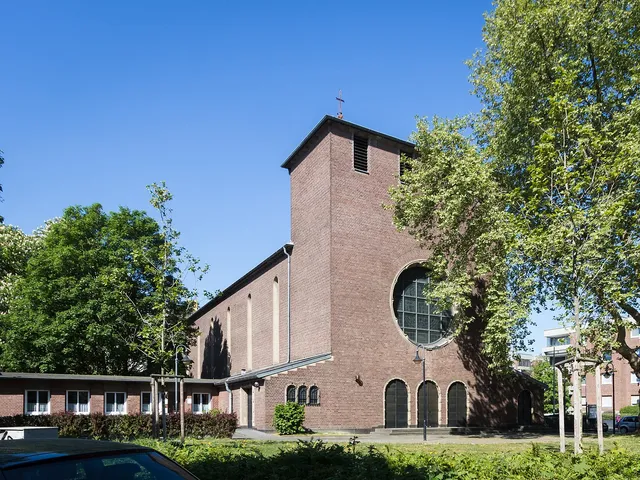
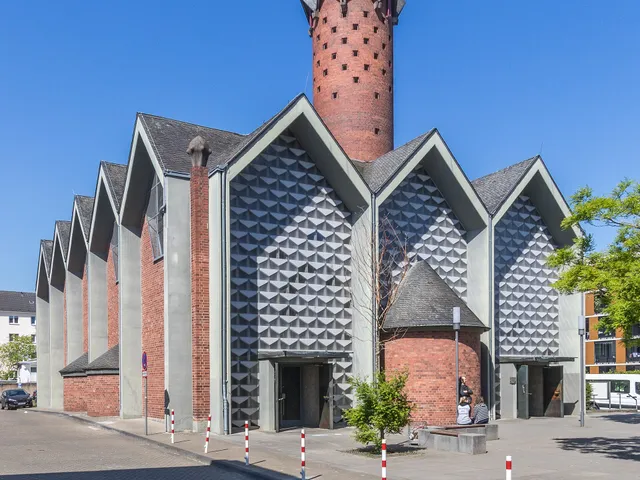
1958 brick hall church with concrete honeycomb windows, a freestanding bell tower, and a natural-stone Christ mosaic.
St. Salvator emerged as an independent Catholic parish carved out of St. Quirinus, St. Clemens, and Heilig Kreuz in 1958, at a time when Cologne's postwar districts were gaining their own places of worship.
Source: Wikipedia
At a Glance
- Type
- Roman Catholic church, hall church with a rectangular floor plan
- Location
- Weidenpesch district, Cologne, Nippes borough (west of the Rhine)
- Built
- 1958
- Architect
- Theodor Kelter
- Tower
- Freestanding bell tower with a five-bell peal
- Heritage status
- Listed as a protected building since 13 October 1995 (No. 7657)
- Organ
- 23 stops, built in 1963 by Verschueren Orgelbouw
The church only received a weathercock on its tower spire in August 2005, on the occasion of World Youth Day in Cologne.
History
When the independent parish was founded on 3 May 1958, architect Theodor Kelter was commissioned to build a church together with a rectory and the provincial house of the Salvatorians. Today St. Salvator belongs to the MauNieWei parish association, which unites the Catholic communities of Mauenheim, Niehl, and Weidenpesch.
Architecture
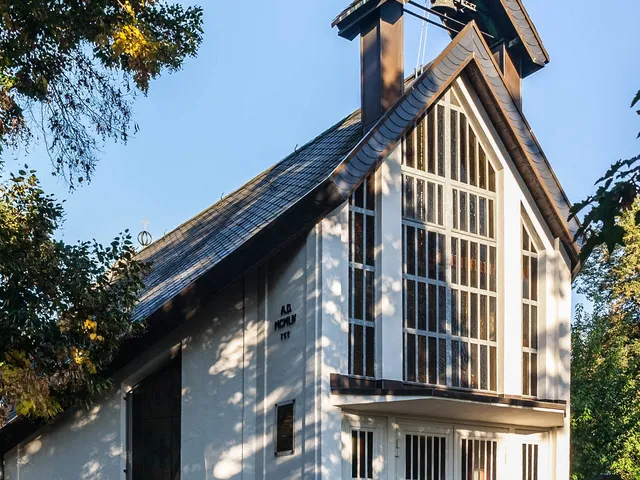
The brick structure is topped by a shallow gabled roof, its façade largely defined by concrete honeycomb windows. The freestanding tower is clad in white-rendered concrete with framed brick elements, echoing design features of the neighboring church. In August 2005, at the start of World Youth Day in Cologne, the tower's spire was crowned with a weathervane in the shape of a rooster.
Interior
The interior features a wooden ceiling, while its north wall is built from fired bricks. A mosaic of varied natural stones, designed by Salvatorian father Ivo Schaible, depicts the enthroned, transfigured Christ as Savior of the world. The altar, pulpit, and ambo were created by sculptor Rudolf Peer, and the tabernacle by master silversmith Wilhelm Nöthen. Artist Bernd Hartmann-Lintel of Wiedenbrück contributed a bronze baptismal font, a Madonna in a silver mantle with the Christ child, and roughly one-meter-tall Nativity figures carved from lime wood.
Timeline
- 1958Parish of St. Salvator founded on 3 May; Theodor Kelter commissioned to build
- 1963Organ with 23 stops by Verschueren Orgelbouw installed
- 1995Listed as protected monument on 13 October under number 7657
- 2005Weathercock added in August for World Youth Day
Gallery
Map
Blue dots: other places nearby — tap to explore.
You might also like — related or nearby
Comments
- Loading comments…
Sources & links
Auto-generated, last verified: 2026-09-03
How this page is made
This page draws on open sources — Wikipedia, Wikidata, official websites and the city’s open data. Every statement is checked against the sources linked here, and pages are refreshed regularly.
Spotted a mistake anyway? Tell us below — we read every submission.