Karmel St. Joseph Cologne
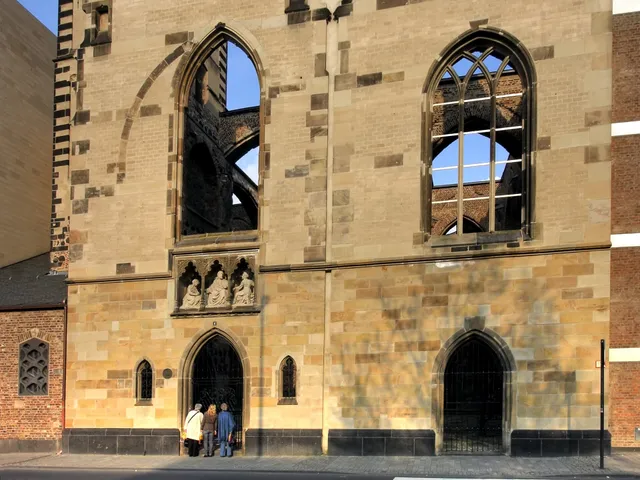
Former Carmelite convent whose neo-Gothic chapel survives only as a truncated core embedded within a modern office complex.
Political measures of the Kulturkampf cut short the community's existence after only about 25 years, leaving behind just a fragment of the convent church, which was later absorbed into an administrative building.
Source: Wikipedia
At a Glance
- Type
- Former Carmelite convent with chapel
- Location
- Altstadt-Nord, Innenstadt district, at Gereonskloster west behind St. Gereon
- Founded
- approved 1850, occupied 1853
- Existed
- until 1875
- Architect
- Vincenz Statz
- Chapel
- consecrated 1863
- Heritage status
- listed monument in North Rhine-Westphalia
The remaining shell of the former convent chapel was incorporated into the office complex of the ex-Gerling insurance company, designed from 1945 onward by sculptor and architect Arno Breker – today the vaulted church space with marble columns serves as a library and conference venue with a large oval wooden table.
History
The convent was a daughter foundation of the Carmel of Maria vom Frieden, established in 1639 in the Schnurgasse and dissolved in 1802. After French revolutionary troops disbanded the original monastery from 1794 onward, Cologne's citizens campaigned from 1830 for a new foundation, finally achieved in 1850. Three sisters from a convent in Liège formed the founding nucleus, with Sr. Josepha Herbertz elected first prioress; the community grew to fourteen cloistered sisters, two novices, and three lay sisters. The nuns initially settled in the deanery of St. Kunibert in northern Cologne, placing the Carmel under the patronage of the Immaculate Conception.
Convent and Chapel
In 1851 the sisters acquired a house and plot at Gereonskloster, moving into newly built quarters in 1853 and rededicating the Carmel to St. Joseph. Sr. Franziska, elected prioress in 1856, was a Cologne citizen who had championed the new foundation's approval and later joined the order herself; the Josef Chapel likely owes its construction to her. Built of reddish-brown brick in neo-Gothic style, the convent church featured a rectangular front facade, a stepped gable topped with a cross, a saddle roof over a short nave, buttresses, and tracery-adorned round-arched windows, with tuff stone accenting pier caps, windows, and a partial cornice.
End of the Convent
During the Kulturkampf, numerous religious houses in the Archdiocese of Cologne were dissolved by 1877; the sisters relocated to Echt near Roermond, partly financing their new building there with proceeds from selling the Cologne convent. The Cologne site became a girls' home, run under a foundation established in 1854 by parish priest Jakob van Gils and administered by the Vincentian Sisters of Nippes, with services continuing in the chapel. In 1896 some Carmelite sisters returned and founded the Karmel Maria vom Frieden in Lindenthal.
Today
Stripped of its front facade, the surviving core of the chapel was incorporated into the former Gerling insurance headquarters (now Talanx), largely shaped from 1945 onward by Arno Breker; the surrounding quarter is known as the Friesenviertel. The enclosed space is bordered on three sides by a paved courtyard. The vaulted nave leads into a choir with a 5/8 apse; ochre-colored vault ribs rest on side corbels in the choir, while in the nave they also converge on the capitals of two dark marble columns. The restored space has served as a library and occasional conference room, complemented by a striking oval table of fine wood.
Timeline
- 1639Carmel Maria vom Frieden founded in Schnurgasse
- 1794Cologne taken by French revolutionary troops, monastery dissolved
- 1802Carmel Maria vom Frieden dissolved
- 1830Efforts to re-establish the order begin
- 1850Permission for resettlement granted, three sisters from Liège arrive in Cologne
- 1851Acquisition of a house and land at Gereonskloster
- 1853Move into newly built monastery buildings by Vincenz Statz
- 1856Sr. Franziska elected prioress
- 1863Consecration of St. Joseph's chapel
- 1877By this year 74 religious houses in the Archdiocese of Cologne dissolved, sisters move to Echt
- 1896Return of some Carmelites, founding of Carmel Maria vom Frieden in Lindenthal
- 1945Redesign of the building complex by Arno Breker begins
Gallery
Map
Blue dots: other places nearby — tap to explore.
You might also like — related or nearby
Comments
- Loading comments…
Sources & links
Auto-generated, last verified: 2026-09-07
How this page is made
This page draws on open sources — Wikipedia, Wikidata, official websites and the city’s open data. Every statement is checked against the sources linked here, and pages are refreshed regularly.
Spotted a mistake anyway? Tell us below — we read every submission.