Wasserwerk Westhoven
Historic waterworks from 1903–1904 with a Romanesque-style rendered façade, still supplying drinking water today and serving as a learning venue, the "Wasserschule Köln".
The site was chosen with care: its location was meant to rule out the kind of contamination that had hit the Mülheim waterworks in 1893 and 1901.
Source: Wikipedia
At a Glance
- Type
- Historic waterworks
- Location
- Köln-Westhoven, Porz district
- Built
- 1903–1904
- Client
- Rheinische Wasserwerks-Gesellschaft
- Heritage status
- Listed building in North Rhine-Westphalia since 10 November 1995
- Operator today
- RheinEnergie
The Westhoven waterworks was deliberately built in 1903–1904 far from settlements (at least two kilometres) and the Rhine (one kilometre), so that contamination like that at the Mülheim waterworks in 1893 and 1901 would not recur.
History
The waterworks on Porzer Ringstraße was built to improve the drinking water supply of the Porz area. When it opened, the nearest settlements were at least two kilometres away and the Rhine was one kilometre distant. The complex also included a half-timbered house where employees lived. After the Second World War it was rebuilt only in a simplified form.
Architecture
The main building is a solid structure with Romanesque-style elements. Large windows articulate the façades, and stone crowning elements finish off the gables. The rendered façade is structured with brickwork.
Old and New: The 1980s Conversion
In the late 1980s the plant was converted to large activated carbon filters, which required structural changes. Instead of an extension matched to the old building, a light steel-and-glass hall was built for drinking water treatment. The pumping station stayed in the historic building. A water educational trail was laid out on the grounds at the same time.
Today: Supply and Learning Venue
The plant initially supplied the municipality of Porz. Today it serves the northern districts, while Porz is supplied by the Zündorf and Leidenhausen waterworks. Output rose from an initial 600 m³ per hour to 3,500 m³ per hour by 1990. The raw water from deep wells is blended with 10% bank filtrate from the Rhine. Under the name "Wasserschule Köln", the site also serves as an out-of-school learning venue.
Timeline
- 1903–1904Waterworks built by the Rheinische Wasserwerks-Gesellschaft
- Ende der 1980erConversion to activated carbon filters; steel-and-glass hall and water trail added
- 1990Output increased to 3,500 m³/hour
- 1995Listed as a heritage monument on 10 November
Gallery
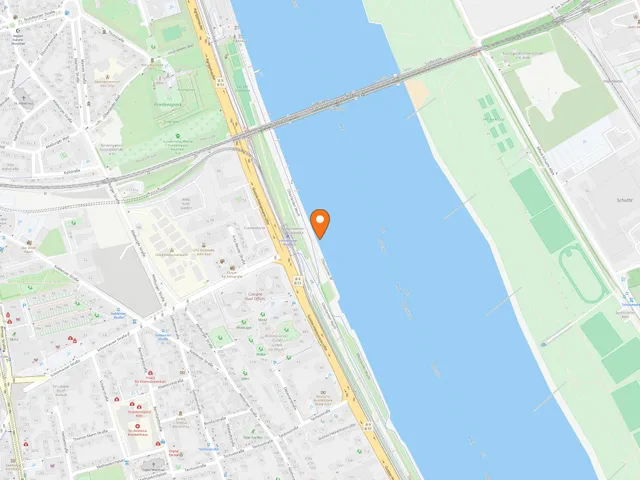
Map
Blue dots: other places nearby — tap to explore.
You might also like — related or nearby
Comments
- Loading comments…
Sources & links
Auto-generated, last verified: 2026-10-23
How this page is made
This page draws on open sources — Wikipedia, Wikidata, official websites and the city’s open data. Every statement is checked against the sources linked here, and pages are refreshed regularly.
Spotted a mistake anyway? Tell us below — we read every submission.