Siedlung Volkspark
Uniformly planned villa estate in Cologne's green belt, built 1949–1951 for occupying forces and protected as a whole since 1995.
Right down to details like open fireplaces, the British occupiers dictated not just the overall layout but the very fittings of the houses.
Source: Wikipedia
At a Glance
- Type
- Residential estate, also known as the English Settlement
- Location
- Raderthal, Rodenkirchen district, in Cologne's outer green belt
- Construction
- 1949–1951
- Heritage status
- Protected as an ensemble since 1995, a listed building in North Rhine-Westphalia
- Distinctive feature
- A cohesive architectural character resulting from unified planning and simultaneous construction, considered unique of its kind
In 1949, the housing units in the settlement cost an average of 100,000 DM each – ten times the cost of typical social housing at the time.
History
From June 1945, British and Belgian occupying forces and their arriving families lived in Cologne, initially housed in requisitioned properties in largely undamaged outlying areas such as Marienburg and Junkersdorf. The estate itself arose from two building programmes, the JOINT Program (1949/50) and the ZECO Program (1950/51). State and city authorities, the Arbeitsgemeinschaft Besatzungsbauten Köln, and the GAG Köln were all involved, with various Cologne architects contributing standardised designs. In 1949, construction costs averaged 100,000 DM per housing unit—ten times the cost of contemporary social housing.
Buildings and Architecture
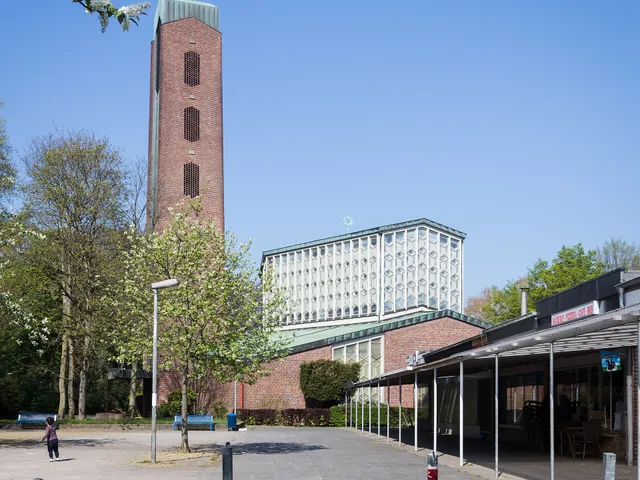
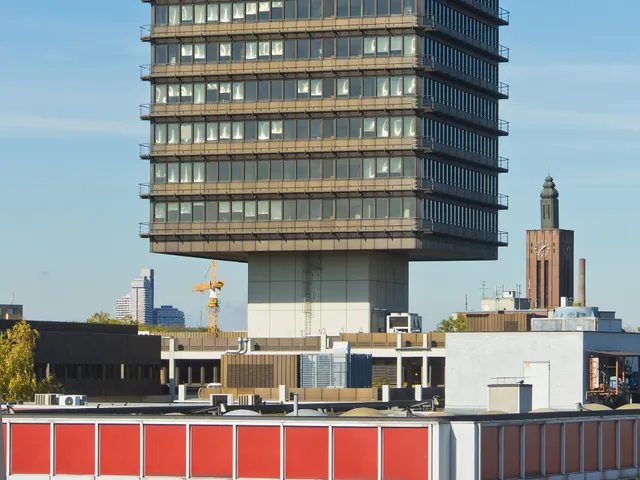
The estate comprises 147 single-family houses—freestanding villas as well as terraced and linked houses—mostly two-storey, rendered, and topped with pitched roofs. Officers resided at the centre, non-commissioned officers on the periphery. Despite the overall uniformity, the individual house types retain their own character, notably those designed by Schaller with their distinctly "light" architectural style. The eastern edge is marked by four three-storey terrace blocks with 12 flats each, a seven-storey tower block with 73 flats, and the "All Saints" church. Designed by Wilhelm Riphahn, the tower block avoids rigidity thanks to its west-facing open façade and won the Cologne Architecture Prize in 1967.
Urban Planning Significance
The estate is regarded as an example of a suburban villa settlement whose cohesive built form—arising from unified planning and simultaneous construction—is considered unique. At the same time, it documents a broad spectrum of 1950s architecture. Its urban design is still held in high esteem today; the abundance of public and private greenery, together with its position within the green belt, exceeds what is typical for a villa quarter.
Location and Greenery
The estate is bounded to the south by Militärringstraße, to the west by Brühler Straße, and to the north by Urfelder Straße, with the rest of Raderthal and green spaces adjoining to the east. Bonner Straße and Brühler Straße connect it to the city centre. Winding streets and footpaths run through the area, while broad front gardens with hedges shield the houses from the road. The former WERAG (later WDR) transmission building, built as early as 1927, was incorporated into the estate. The western part of the Volkspark, laid out in the 1920s, was built over with single-family houses, once interspersed with a NAAFI shop that has since disappeared; further housing units and the church adjoin to the east. The remaining park was restored from 2001 and renamed Fritz-Encke-Volkspark in 2002, honouring the creator of many of Cologne's green and sports spaces.
Today
Most of the single-family houses are now privately owned. The tower block and terrace buildings, however, remain federal property, represented by the Bundesanstalt für Immobilienaufgaben.
Timeline
- 1927WERAG broadcasting house built, later integrated into the settlement
- 1949–1951Construction of the Volkspark settlement
- Juni 1945Start of British/Belgian occupation of Cologne, housing requisitioned
- 1949/50JOINT Program for uniform reconstruction of the settlement
- 1950/51Subsequent ZECO Program for development
- 1949Average construction costs of 100,000 DM per housing unit
- 1967Riphahn's residential tower awarded Cologne Architecture Prize
- 1995Volkspark settlement placed under heritage protection
Gallery
Map
Blue dots: other places nearby — tap to explore.
You might also like — related or nearby
Comments
- Loading comments…
Sources & links
Auto-generated, last verified: 2026-09-08
How this page is made
This page draws on open sources — Wikipedia, Wikidata, official websites and the city’s open data. Every statement is checked against the sources linked here, and pages are refreshed regularly.
Spotted a mistake anyway? Tell us below — we read every submission.