Bruder-Klaus-Siedlung
Cologne housing estate named after Switzerland's national saint, Brother Klaus. Many streets bear Swiss place names in gratitude for Swiss postwar aid.
The foundation stone of the estate, laid in 1948, was a stone from the north tower of Cologne Cathedral. Its beginnings lie with a group of bombed-out residents, war refugees and returnees whom a Catholic priest brought together from 1946 onward.
Source: Wikipedia
Auf einen Blick
- Type
- Housing estate in the Cologne district and borough of Mülheim
- Location
- Northeast of the district, bordered by Stammheim to the north and Höhenhaus to the east
- Origins
- Settlers' association founded in 1947, expansion mainly in the 1950s
- Namesake
- Niklaus von Flüe, known as Brother Klaus, patron saint of Switzerland
- Street names
- Swiss places and landscapes
- Parish church
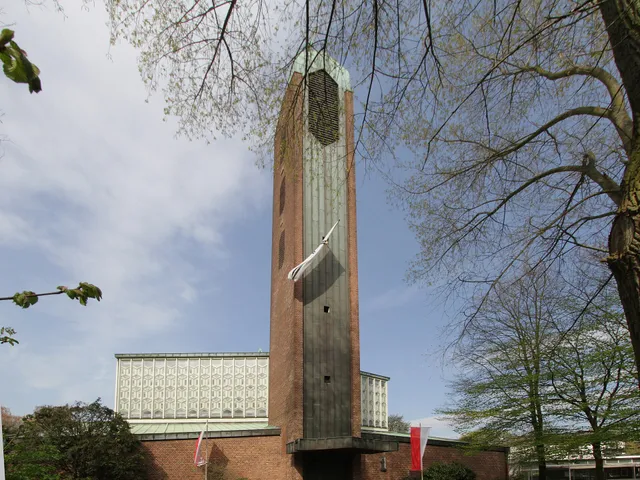
- St. Bruder Klaus, designed by Fritz Schaller, tower 35 m
The settlement's foundation stone was laid in 1948 by Cardinal Josef Frings, using a stone from the north tower of Cologne Cathedral. Its streets bear Swiss place names (e.g. Davoser and Zermatter Klause) as thanks for aid from Switzerland after World War II.
From Self-Help to Planned Expansion
The initiator was Karl Müller, then parish priest of St. Franziskus in Köln-Bilderstöckchen. Under his chairmanship, the settlers' association Neuland e.V. was founded on 18 March 1947 and still exists today. The building client was initially the settlement agency of the Archdiocese of Cologne; Cardinal Josef Frings laid the foundation stone on 14 August 1948. The first houses were built through self-help and neighbourly cooperation on plots meant to supply residents with farm produce and small livestock – an approach that took longer than planned.
In 1949 the settlers' association helped found the Gemeinnützige Siedlungsgesellschaft m.b.H. Aachen, which took over the expansion under its management. The city of Cologne acquired the area on 28 October 1949. In the 1950s the Deutsche Wohnungsgesellschaft (DEWOG) joined as another developer. On 18 July 1960, Chancellor Konrad Adenauer visited the estate together with the Stegerwaldsiedlung – both 1950s housing developments by the CDU-affiliated DEWOG.
Swiss Street Names and Boundaries
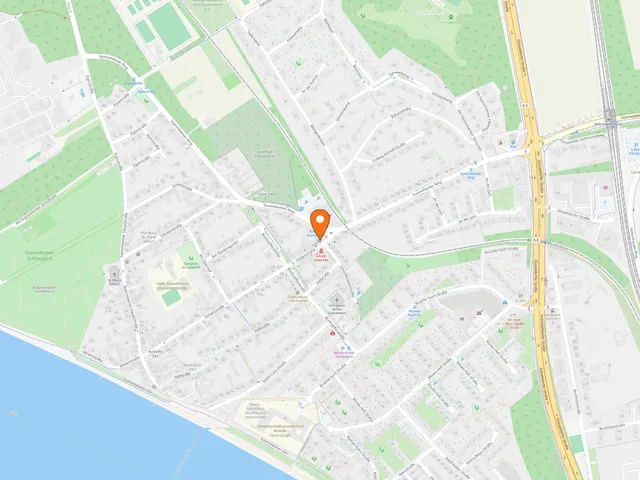
In gratitude for aid from Switzerland after the Second World War, the new streets were given Swiss names. Examples include the Davoser, Schwyzer, Genfer, Zuger and Zermatter Klause as well as the Solothurner, Luzerner and Züricher Weg. The estate is bounded to the southeast by the Mülheimer Zubringer, to the east by the A3, to the north by the Dünnwalder Kommunalweg (L101) and to the west by a railway line.
St. Bruder Klaus Church
On 20 August 1956 the parish was split off from St. Antonius in Mülheim as a rectorate parish. After Cardinal Frings blessed the congregation, the foundation stone was laid on 28 August 1956, the eve of the 77th German Catholic Convention in Cologne. After 15 months of construction, the church was consecrated in November 1957. The broadly laid-out building is distinguished by a tall, hexagonal nave of soaring concrete tracery. The founding priest and longtime pastor was Heinrich Eisenhut.
Community Life
Besides the church, the parish ran a day-care centre, a youth centre and, from 1964, a country school hostel in Winnerath. It also supports the neighbouring Catholic primary school, which the city of Cologne built between 1959 and 1962. In 1966 the parish district had 3,007 Catholics. The residents were initially young and had many children: at its peak, 2,500 children and young people belonged to the parish, which sustained extensive youth work.
Arson Attack and Protest in 2016
On 2 January 2016, two far-right extremists tried to set fire to a refugee shelter in the estate where a Yugoslav family lived. They used torches and flares bearing Pegida slogans. The attack failed only by chance; three adults and nine children were unharmed. The next day, 400 people held a spontaneous protest on Wiener Platz in Mülheim. In court, the defendants refused to offer a personal apology and were sentenced to two years' probation.
Timeline
- 1946Pastor Karl Müller gathers bombed-out people and refugees
- 1947Siedlergemeinschaft Neuland e.V. founded (18 March)
- 1948Foundation stone laid by Cardinal Frings (14 August)
- 1949City of Cologne sells the site (28 October)
- 1956St. Bruder Klaus parish founded; church foundation stone laid
- 1957Church consecrated (19 November)
- 1960Visit by Chancellor Konrad Adenauer (18 July)
- 2016Failed racist arson attack on refugee housing (2 January)
Gallery
Map
Blue dots: other places nearby — tap to explore.
You might also like — related or nearby
Comments
- Loading comments…
Sources & links
Auto-generated, last verified: 2026-10-22
How this page is made
This page draws on open sources — Wikipedia, Wikidata, official websites and the city’s open data. Every statement is checked against the sources linked here, and pages are refreshed regularly.
Spotted a mistake anyway? Tell us below — we read every submission.