Schlosspark Stammheim
English-garden landscape park on the Rhine, laid out 1828–1832 by Maximilian Weyhe — today a public green space and, since 2002, a venue for contemporary art.
Schlosspark Stammheim is a public park in the city of Cologne on the right bank of the Rhine. It traces its origins to a medieval knight's estate acquired in 1818 by Baron Theodor von Fürstenberg.
Source: Wikipedia
At a Glance
- Type
- Public landscape park in the English garden style
- Location
- Stammheim district, Mülheim borough, right bank of the Rhine
- Designed
- 1828–1832 by Maximilian Friedrich Weyhe
- Area
- approximately 8 hectares, extended northward to around 12 hectares in 2009
- Planting
- originally around 600 trees and 500 shrubs
- Status
- Listed monument in North Rhine-Westphalia
- Use
- Recreation, and since 2002 a venue for contemporary art exhibitions
The roughly 1,100 plants for the park (600 trees, 500 shrubs) were supplied mainly by the Cologne Botanical Garden – directed by Jakob Greiß, who happened to be a former student of the park's own architect, Weyhe: the teacher designed the park, the pupil delivered the plant material.
Area comparison
Area compared with other Cologne parks and green spaces.
History
The Stammheim manor changed hands in 1757 and passed in 1818 to Imperial Baron Theodor von Fürstenberg zu Neheim, who acquired it for his son Egon. The family commissioned garden architect Maximilian Friedrich Weyhe — later Royal Director of Horticulture from 1834 — to design a landscape park, laid out between 1828 and 1832 with a workforce of 50.
Layout and Planting
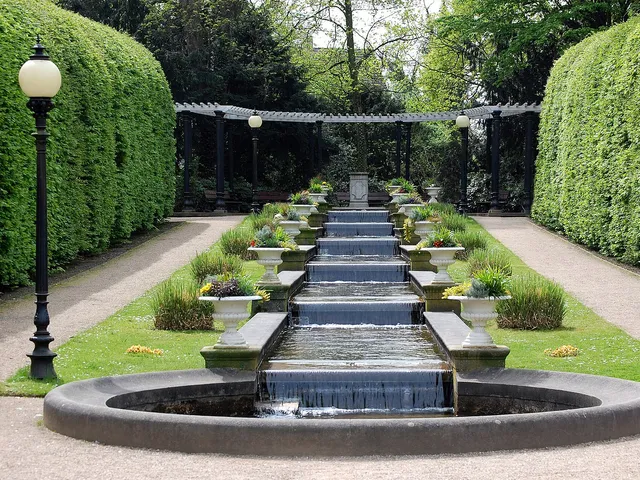
The design featured an intricate network of paths, with the main routes leading to the manor house as tree-lined allées. Lime-tree avenues still define the park today — one along the Rhine and one running through the centre. Weyhe's planting scheme encompassed around 600 trees and 500 shrubs, predominantly native species alongside exotics such as catalpa, tulip tree, Japanese magnolia, and American white oak, with plant material sourced in part from the nearby Cologne Botanical Garden.
Location and Surroundings
The park lies opposite the left-bank district of Cologne-Niehl and adjoins the old village core of Stammheim. The main entrance leads from Stammheimer Hauptstraße, beside the historic church of Sankt Mariä Geburt, into the lime-tree avenue. To the north it transitions into the Flittard flood-meadow landscape, and it marks the current endpoint of a planned eleven-kilometre riverside promenade from the Südbrücke to Stammheim — of which only sections have been completed.
Did You Know?
Count Franz Egon von Fürstenberg-Stammheim, made an honorary citizen of Cologne in 1856, continued expanding the grounds until his death in 1859. Distinctive design features included winding "pretzel paths" (Brezelwege), two circular clearings, and a raised viewpoint at the southern Rhine bank with views across the river to Cologne Cathedral.
Timeline
- 1757Stammheim knightly estate transferred from Baron von Wyhe to Baron von Pfeill
- 1818Theodor von Fürstenberg acquires the estate for his son Egon
- 1828–1832Garden architect Weyhe designs the park in the style of an English landscape garden
- 18. Dez. 1856Count Franz Egon von Fürstenberg-Stammheim receives honorary citizenship of Cologne
- 1859Death of Count Franz Egon von Fürstenberg-Stammheim
- 2002Park additionally used for exhibitions of modern art
- 2009Park extended northward to approximately 12 hectares
Map
Blue dots: other places nearby — tap to explore.
You might also like
Comments
- Loading comments…
Sources & links
Auto-generated, last verified: 2026-06-27