Mülheimer Stadtgarten
Historic public park in Cologne-Mülheim, established 1912/13 — featuring a lake, sweeping lawns, and the 1914 Fairy-Tale Fountain. Listed landmark.
The Mülheimer Stadtgarten stretches across the Mülheim district of Cologne, with its first layout dating to 1912/13. Its present character is largely shaped by a 1928 design by landscape architect Theodor Nußbaum.
At a Glance
- Type
- Public city and people's park; listed monument in North Rhine-Westphalia
- Location
- Cologne-Mülheim, east of Bergischer Ring, between Lassallestraße (south) and Wiener Platz (north)
- Entrances
- Main entrances on Jan-Wellem-Straße (formerly Strundener Straße) to the east
- Established
- First layout 1912/13; northward extension 1928
- Highlight
- Fairy-Tale Fountain from 1914
The 1928 expansion of Mülheimer Stadtgarten was built by unemployed workers as part of so-called 'emergency relief works' – and the grand staircase constructed in the 1930s was subsequently used for the Hitler Youth's Sunday parades.
Area comparison
Area compared with other Cologne parks and green spaces.
History
The site was once a shallow depression carved by the Strunder Brook, whose current powered a mill belonging to the Merkerhof estate — property of the Barons von Fürstenberg, later passed to the then-independent town of Mülheim am Rhein. Around 1900, the town council considered converting the area into a public garden; landscape architect Joseph Vincentz received the design commission in 1906. The small streets on the eastern side still bear his legacy today — Fürstenbergstraße, Merkerhofstraße, and Vincenzstraße.
Layout and Design
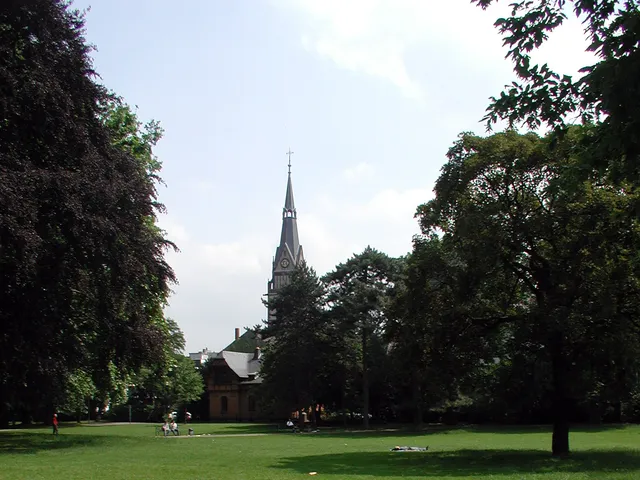
The park followed the model of Cologne's garden director Fritz Encke, who designed his "people's parks" without fences, welcoming visitors onto the lawns and allowing ball games. Where the mill pond had once stood, a small asymmetric lake with a fountain was created in the hollow, framed by broad meadows. Planting was kept restrained — clusters of oak, beech, birch, ash, and alder alongside evergreen shrubs and conifers that provided colour even in winter. In 1916, wealthy Mülheim residents funded a teahouse. A three-part rose garden with a water lily basin formed the southern boundary.
Fairy-Tale Fountain
At street level on the southeastern edge, opposite Sonderburger Straße, the Fairy-Tale Fountain was added in 1914. It realised a design by Cologne sculptor Wilhelm Albermann, who had died the year before. Its four bronze animal figures, which had been placed in a container during renovation works, were stolen in October 2023.
Extension and the 1930s
During the period of mass unemployment, the park was extended northward to Wiener Platz in 1928 through so-called "relief works" carried out by the unemployed, with design and planning by Theodor Nußbaum of the Cologne Parks Department. In the 1930s, a grand outdoor staircase descending into the park was built on Jan-Wellem-Straße — on Sundays, it served as an assembly ground for Hitler Youth parades.
Today
The Second World War destroyed the teahouse; the Stadthalle (civic hall) now stands in its place. The Jan-Wellem monument, originally erected at Wiener Platz, was relocated after the war to the side of the garden staircase. In 1984, an artwork of inscribed stone blocks was added at the first entrance on Jan-Wellem-Straße — its texts serving as a warning against all forms of violence. Along the northwest side, a large playground for young children spreads out beneath the shade of old trees.
Timeline
- 1906Joseph Vincentz commissioned to design Mülheimer Stadtgarten
- 1912/13First garden layout created with pond, fountain and meadows
- 1914Fairy tale fountain erected based on Wilhelm Albermann's design
- 1916Wealthy citizens of Mülheim donate funding for a tea house
- 1928Garden extended northward to Wiener Platz under Theodor Nußbaum
- 1930er JahreOpen staircase built at Jan-Wellem-Straße
- 1984Stone block artwork (warning against violence) placed at the entrance
- Oktober 2023Four bronze animal figures of the fairy tale fountain stolen from a container
Map
Blue dots: other places nearby — tap to explore.
Address
Mülheimer Stadtgarten
51065 Köln
You might also like
Comments
- Loading comments…
Sources & links
Auto-generated, last verified: 2026-06-26