Südpark
Crescent-shaped park in Marienburg — one of Cologne's most distinctive green spaces, known for its pine grove and a bronze panther sculpture.
Südpark in the Marienburg district follows a striking crescent-shaped layout, unique among Cologne's parks, tracing the former course of the Militärringstraße. Despite its distinctive form, it is one of the city's smallest green spaces.
At a Glance
- Type
- Public park, listed monument
- Location
- Marienburg district, Rodenkirchen borough
- Laid out
- 1898–1901
- Landscape architect
- Adolf Kowallek
- Area
- 4.65 ha
- Listed
- 1 July 1980
- Highlight
- Bronze sculpture Panther (1920) by Fritz Behn
The Südpark Restaurant, which opened in 1900 as an upscale destination for Cologne's residents, was repurposed in March 1938 as a Hitler Youth home, before being heavily damaged in World War II and demolished in 1951.
Area comparison
Area compared with other Cologne parks and green spaces.
Layout and Design
The park sits at the southern edge of Marienburg, enclosed by the crescent street Am Südpark on one side and the rear plots of Leyboldstraße on the other. A continuation of Goethestraße runs through its centre, serving as the main axis of the Marienburg street grid. The curved path system follows an asymmetric design concept oriented around an existing stand of pine trees, which was retained and complemented with rhododendrons. The tree cover along Am Südpark has thinned somewhat compared to its pre-war density.
History
The park was developed on the basis of a zoning plan adopted in 1896, with the City of Cologne as the client. By 1900 the bordering street Am Südpark had been laid out, lined with villas facing the park. From 1904 it served as the terminus of a tram line — a service that ran until 2002. Before the Second World War, Südpark was a popular destination for Cologne residents and was locked with gates after dark.
The Südpark Restaurant
In 1900–01 the city commissioned architect Johannes Kleefisch to build a restaurant in the style of a Rhenish manor house, combining stone, render, and half-timbering. From 1938 it was used as a Hitler Youth home, and wartime bombing left the building badly damaged. The ruins were demolished in 1951; a children's playground now occupies the site.
The Panther
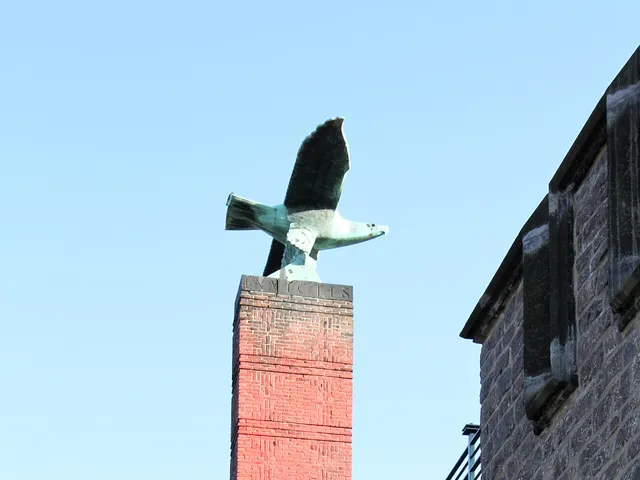
The park's centrepiece is Panther, a bronze sculpture created in 1920 by sculptor Fritz Behn. Like the park itself, the statue is a protected monument.
Timeline
- 1896Development plan for the park comes into effect
- 1898–1901Südpark laid out to a design by Adolf Kowallek
- 1900/01Südpark-Restaurant built to a design by Johannes Kleefisch
- 1904Südpark becomes the terminus of a tram line
- 1920Panther sculpture by Fritz Behn installed in the park
- 1938Restaurant repurposed as a Hitler Youth home from March
- 1951Ruins of the WWII-damaged restaurant demolished
- 1980Park listed as a protected monument by the City of Cologne on 1 July
Map
Blue dots: other places nearby — tap to explore.
Address
Südpark
50968 Köln
You might also like
Comments
- Loading comments…
Sources & links
Auto-generated, last verified: 2026-06-27