Friedenspark
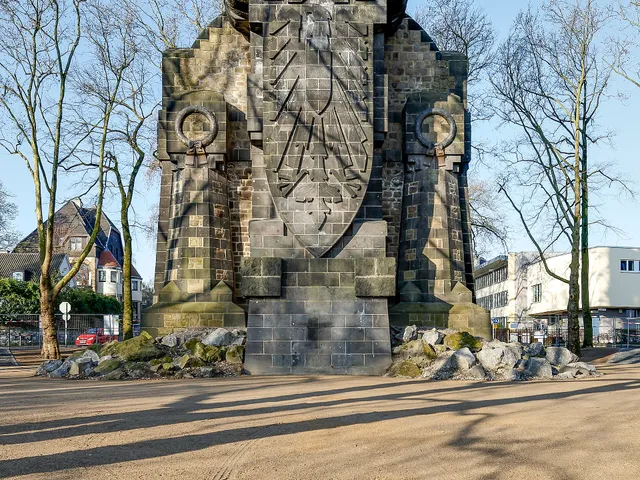
Cologne city park on the grounds of former Fort I — featuring ivy-covered fortress walls, a rose garden, and a WWI monument with an eagle cast from cannons.
Friedenspark is a city park in Cologne's Südstadt district, established in 1914 on the grounds of the former Fort I. Garden director Fritz Encke incorporated the old fortress walls and moats into his design, giving the park its distinctive character of moss-covered stonework that persists to this day.
At a Glance
- Type
- City park on a former fortress site
- Location
- Südstadt, between Alteburger Straße and Oberländer Wall
- Size
- 4.5 hectares
- Founded
- 1914, designed by Fritz Encke
- Monument
- War memorial with eagle sculpture (1927)
- Status
- Listed monument in North Rhine-Westphalia
- Part of
- Cologne Green Belt
The 15-metre war memorial in the park was made from melted-down cannons of World War I – the eagle at its top is literally forged from the metal of the very weapons whose victims it was meant to honour.
Area comparison
Area compared with other Cologne parks and green spaces.
Origins
Encke wove the old walls and moats into a landscape of herbaceous borders and a rose garden. A pergola frames the rose garden toward the Rhine, while a sunken garden features a fountain and hedge-enclosed alcoves. The park initially had no name.
The War Monument
In 1927, the park received a 15-metre monument by Otto Scheib, topped with an eagle sculpture by Georg Grasegger commemorating soldiers fallen in World War I. Notably, the eagle was cast from actual WWI cannons. Dedicated on 3 July 1927 under the patronage of Reich President Paul von Hindenburg, the park was named Hindenburgpark at the time — a name it carried until 1985, when it was renamed Friedenspark (Peace Park). The monument inspired the Cologne band Bläck Fööss to write their song "Ungerm Adler" (1986), a plea that war must never happen again.
Changing Uses
After the University of Cologne moved in nearby in 1919, Fort I served as a canteen until 1934, then as an anti-aircraft position during WWII, and later as a branch tax office. Since 1978, the fort has housed the "Bauspielplatz Friedenspark," an open youth and children's centre. A climbing wall with around 30 routes at difficulty grades 5 to 9 was added near the Südbrücke bridge.
Memory and Legacy
In 2002, a nearby street was named after Hans Abraham Ochs, an eight-year-old boy who was attacked by Hitler Youth members in 1936 and died shortly after. In 2012, a ground-level monument of basalt stones honouring John Lennon's peace anthem "Imagine" was added. Heinrich Böll, who was born nearby, played in the park as a child — references to his novel Billiards at Half-Past Nine can be found throughout the grounds.
Timeline
- 1914City council decision and creation of the park on the grounds of Fort I
- 1919University of Cologne uses Fort I as cafeteria from 12 June
- 1927Inauguration of the war memorial with eagle sculpture on 3 July; park named Hindenburgpark
- 1934University of Cologne vacates Fort I on 1 October
- 1939–1945Fort I serves as anti-aircraft position
- 1978Adventure playground Friedenspark (youth centre) moves into the fort
- 1985Renamed from Hindenburgpark to Friedenspark
- 2002Small street in the park named after Hans Abraham Ochs
- 2012Memorial for John Lennon's peace anthem Imagine inaugurated
Map
Blue dots: other places nearby — tap to explore.
Address
Hans-Abraham-Ochs-Weg 1
50678 Köln
Hours
So: 00:00–24:00
You might also like
Comments
- Loading comments…
Sources & links
Auto-generated, last verified: 2026-06-26