Heumarkt
Cologne's second-largest square and one of its oldest — built on a former Rhine island, hence its historic name 'Inselmarkt' (Island Market).
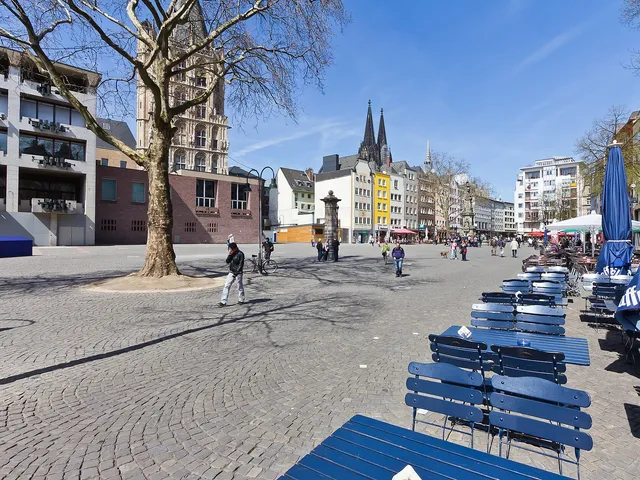
The Heumarkt is located in Cologne's Altstadt (Old Town) and ranks among the city's most ancient squares. Its surface is largely cobblestoned, flanked by alleyways and arterial roads.
At a Glance
- Type
- Square in Cologne's Old Town
- Location
- Altstadt-Nord district, Innenstadt borough
- Size
- Second-largest square in Cologne
- Surface
- Mostly cobblestone
- Historic name
- "Inselmarkt" (Island Market)
- First market use
- Around 957 AD
- Notable find
- Roman cargo vessel discovered in 2007
Beneath today's Heumarkt once lay a Rhine channel up to 13 metres deep, creating a river island – and in 2007, during subway construction works, a Roman transport vessel from the 1st century AD was recovered from 12 metres underground, still loaded with building stones intended for the city.
Things to do here
- Stroll across the wide, cobbled square
- Soak up the historic Old Town atmosphere
- Discover Cologne's second-largest square and its history
- Take great photos of this history-steeped square
- Explore the surrounding Old Town lanes from here
From Rhine Channel to Market Square
During Roman times, a Rhine channel roughly 13 metres deep ran through this area, placing it on an island about 1,000 metres long. The Roman harbour lay approximately where the city hall stands today, accommodating up to 200 ships across some 60,000 m². By the 3rd century a sandbank had extended to the city walls, and the harbour was abandoned. Both the Heumarkt and the Alter Markt (Old Market) took shape once the Rhine channel had silted up.
The 'Island Market'
The old name "Inselmarkt" recalls the site's original position on a Rhine island just outside the city. The earliest market surface has been dated — based on timber finds — to around 957 AD, after the land had been cleared of all structures; the redesign is attributed to Archbishop Bruno. A ruling by Emperor Frederick I in 1164 decreed that the square must remain unbuilt, cementing its role as Cologne's central marketplace.
Separation and Names
The Heumarkt and the Alter Markt to the north originally formed a single space and were only divided at a later date. Around 1250 the Latin term "forum feni" (feni = hay) appeared, and from 1400 onward it referred to the entire square. In Arnold Mercator's 1570 map of Cologne it is labelled "Hewmarckt".
Did You Know?
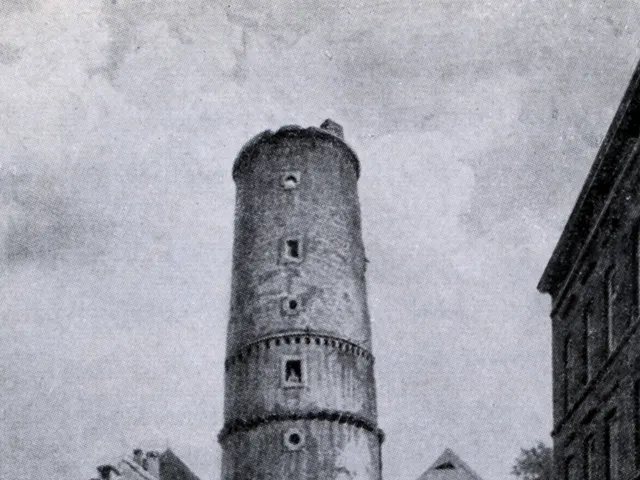
During construction work on the Cologne metro in December 2007, a Roman flat-bottomed cargo barge was unearthed at a depth of twelve metres, dated to between 50 and 100 AD — it had once carried stone for building the city. Mercator's map also shows a pillory and a gallows at the northern end of the square.
Timeline
- 50–100 n. Chr.Roman transport vessel active in Rhine arm (found 2007)
- 3. Jh.Harbour abandoned after sandbank extends to city wall
- 957First market surface laid out under Archbishop Brun
- 1024Second market surface created under Pilgrim of Cologne
- 1082Third market surface built up under Archbishop Sigewin von Are
- 1164Emperor Frederick I. rules the Inselmarkt must remain unbuilt
- 1400Name 'forum feni' (Heumarkt) applies to the whole square
- 1545Marstor gate demolished by council decree
Gallery
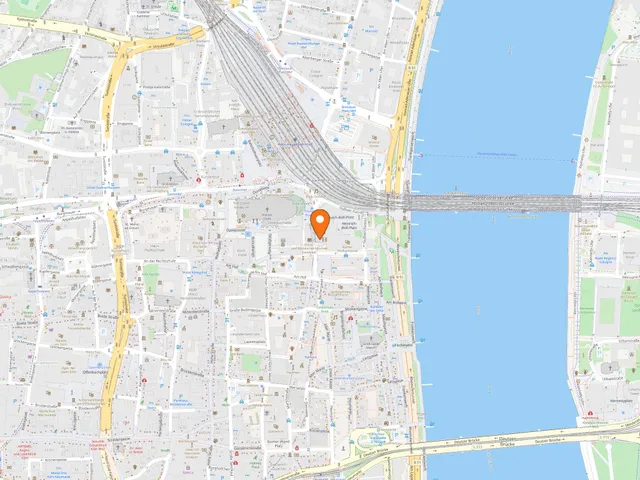
Map
Blue dots: other places nearby — tap to explore.
Address
Heumarkt
50667 Köln
You might also like — related or nearby

Comments
- Loading comments…
Sources & links
Auto-generated, last verified: 2026-06-26
How this page is made
This page draws on open sources — Wikipedia, Wikidata, official websites and the city’s open data. Every statement is checked against the sources linked here, and pages are refreshed regularly.
Spotted a mistake anyway? Tell us below — we read every submission.