Thekenschaaf
Im „Beichtstuhl“ Kölner Brauhäuser sitzt der Wirt: Das Thekenschaaf bot ihm ursprünglich zugleich Blick auf Gaststube, Hausflur und Bierfässer.
The word translates from Kölsch as "counter cabinet". From this spot, the innkeeper monitors and runs the business of his establishment.
Source: Wikipedia
At a Glance
- Type
- Seat and workplace of the innkeeper, a small office built into the furnishings
- Distribution
- Cologne brewery taverns (Brauhäuser) and inns
- Material
- dark-stained wood
- Form
- usually a half-open booth, open on one side and fitted with glass windows on the other
- Etymology
- "Schaaf" derives from Old High German "scaf" or "scaph", meaning vessel
- Today
- still found in some Cologne brewery taverns
In the Free Imperial City of Cologne, executioners, knackers, court servants and city soldiers were not allowed to enter an inn's taproom and could only use the entrance hallway – exactly where the innkeeper's Thekenschaaf often gave a view of both the hallway and the taproom.
Confessional, Little Counting House, Counter
Because of its appearance, the Thekenschaaf is also called a "Beichtstuhl" (confessional), and because of its function a "Kontörchen" (little counting house). The short form is simply "Theke". In Aachen, by contrast, only the term "Theke" was used for the innkeeper's bay-like projecting seat. In the Middle Ages, "Schaff" changed in meaning from a container with wooden walls to a lockable cabinet. In Cologne, the word is attested for a cabinet from the 14th century, and after the 18th century in the form "Schaaf", as in Kleiderschaaf (wardrobe).
Taproom and Parlor
From the 17th century, a typical floor plan was common in small Cologne house breweries. Behind the entrance door lay a hallway leading to the side into the parlor and straight ahead to the brewery and cellar. This hallway served as the taproom ("et Zappes") and as the point of contact for takeaway sales. In the free imperial city of Cologne, the executioner and his assistants, the knackers, and the city soldiers were allowed to enter only this hallway, not the parlor. The French period ended this "class society", but usage separated by social rank remained widespread.
A Seat with a View into Two Rooms
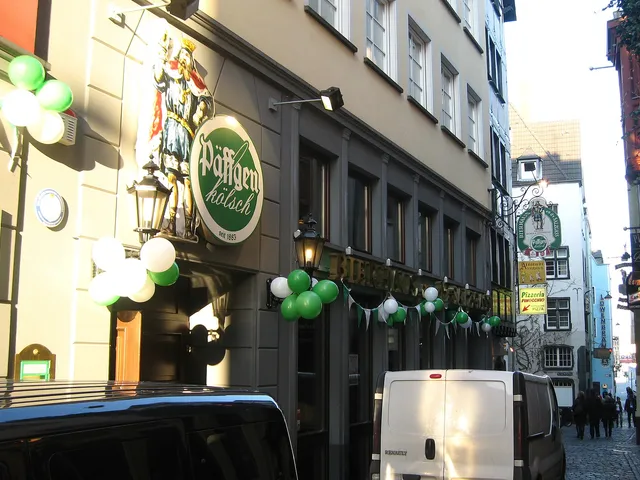
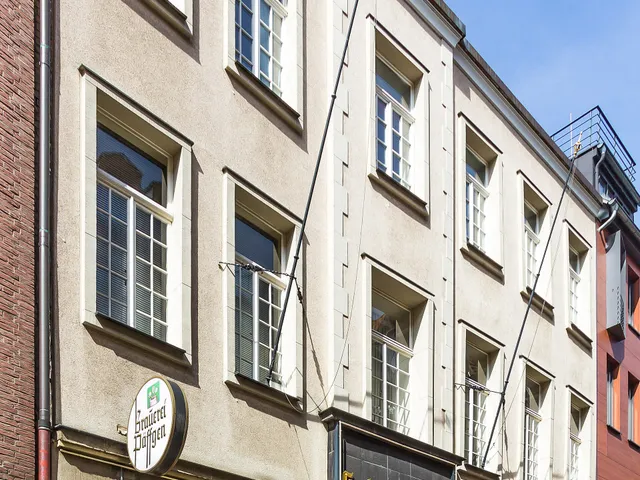
When the first Thekenschaaf came into being is not precisely documented. In houses with the layout described, it was built into the wall between parlor and taproom as a seat for the landlord and landlady. On the hallway side it had a counter-like, usually round glass enclosure. This allowed the innkeeper to observe both rooms with public traffic and to see the beer barrels. The desire to keep guests and "Köbesse" (waiters) in view throughout the establishment probably led to the introduction of the Schaaf. This layout can still be seen today at the Brauhaus Päffgen and at Haus Töller.
Structure and Furnishings
In its original form, the glazed Schaaf projects as a semicircular bay from the parlor into the hallway. An opening serves for conversation and as a serving hatch; some could be closed with a sliding window, the "Thekerüttsche". Inside is a fixed double bench with opposing seats for landlord and landlady, with a small payment and writing desk between them. A "Thekenschlitz" (counter slot) in it could channel beer tokens or small change into the "Thekenschöttche(n)" beneath. Drawers, compartments, and key hooks keep the business organized; some confessionals feature carved work or Art Nouveau elements.
New Designs and Use Today
From around the second half of the 19th century, rectangular floor plans, chairs instead of benches, and installation within a bar counter emerged, as at the Brauhaus zur Malzmühle, founded in 1858. At Em Golde Kappes in Köln-Nippes, the Thekenschaaf stood between the bar and the kitchen until a renovation in 2009. Since the advent of electronic cash register and billing systems, the fixture is only rarely used for its original purpose.
Timeline
- 14. JahrhundertTerm for a cupboard ('Schaff') first attested in Cologne
- ab 17. JahrhundertTypical floor plan of small Cologne house breweries with a Schwemme becomes common
- nach 18. JahrhundertSpelling 'Schaaf' becomes common in Cologne (e.g. Kleiderschaaf)
- ab 2. Hälfte 19. JahrhundertOther installation locations and designs of the Thekenschaaf become more common
- 1858Brauhaus zur Malzmühle founded, with Thekenschaaf integrated into the counter
- 1913Em Golde Kappes (Cologne-Nippes) founded
- 2009Em Golde Kappes remodeled; Thekenschaaf's position changed
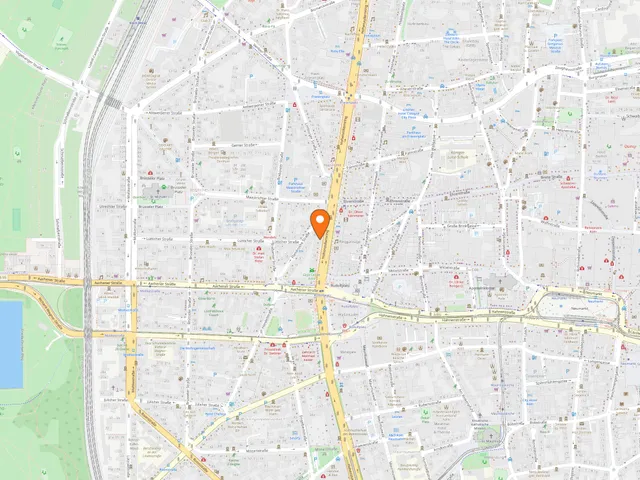
Map
Blue dots: other places nearby — tap to explore.
You might also like — related or nearby
Comments
- Loading comments…
Sources & links
Auto-generated, last verified: 2026-10-15
How this page is made
This page draws on open sources — Wikipedia, Wikidata, official websites and the city’s open data. Every statement is checked against the sources linked here, and pages are refreshed regularly.
Spotted a mistake anyway? Tell us below — we read every submission.