St. Severin
One of Cologne's twelve great Romanesque churches, grown from a late-antique burial chapel — home to the relics of Saint Severin.
St. Severin is a Romanesque pier basilica in the south of Cologne and one of the city's twelve great Romanesque churches. It is dedicated to Saint Severin, the third bishop of Cologne.
At a Glance
- Type
- Romanesque pier basilica, Catholic parish church, former collegiate church
- Location
- Altstadt-Süd in the Innenstadt district
- Patronage
- St. Severin, with co-patrons Cornelius and Cyprian
- Origins
- Hall church (cella memoriae) from the 4th century
- Status
- Basilica minor since 1953
- Heritage
- Listed monument in North Rhine-Westphalia
When the reliquary was opened for scientific examination in 1999, analysis of a tooth root revealed the deceased had been 55 years old; both the bones and the precious silk textiles wrapping them dated to around AD 400 — the very era when Bishop Severin was said to have lived.
From Burial Ground to Collegiate Church
In Roman times, the southern road to Bonn passed through here, flanked on both sides by burial grounds — today's Severinstraße takes its name from the church. Beneath the current nave, a small rectangular hall with a western apse was built in the 4th century and expanded over the following centuries, possibly prompted by the transfer of Saint Severin's relics to the Carolingian crypt. The hall crypt was consecrated in 1043; its western section survives to this day.
Architecture
During the Salian period the church received a new nave with two side chancels. The Romanesque west tower was replaced in 1393 by a late Gothic successor, whose façade was not completed until the mid-16th century. The nave itself was also rebuilt in the late Gothic style between the late 14th and 16th centuries; the net vault of the central nave dates from around 1500. From the original floor, an octagonal labyrinth survives — it is now part of the Diocesan Museum's collection.
The Relics of Saint Severin
In 1999 the reliquary shrine was opened for examination. The bones discovered inside, along with the silk textiles in which they were wrapped, have been dated to around 400 AD; the wooden shrine itself was made between 939 and 949. The textiles and the so-called Severinus disc have been on display in a sacrarium in the south crypt since 2005. As early as 799, Pope Leo III is said to have visited the saint's tomb on his journey to Westphalia.
Today
The church belongs to a parish in southern Cologne and is open to visitors during opening hours. In 1953, Pope Pius XII elevated it to the rank of Basilica minor.
Timeline
- 4. Jh.Small hall church (cella memoriae) built beneath today's nave
- vor 866Western extension completed; relics transferred to Carolingian crypt
- 1043Hall crypt consecrated
- 1237Choir completed (masonry of southern apse preserved)
- 1393Romanesque west tower demolished; Late Gothic successor begun
- um 1500Net vault of the nave constructed
- 1888Sculptor Mengelberg designs neo-Romanesque high altar
- 1953Pope Pius XII elevates the church to a minor basilica
Gallery
Map
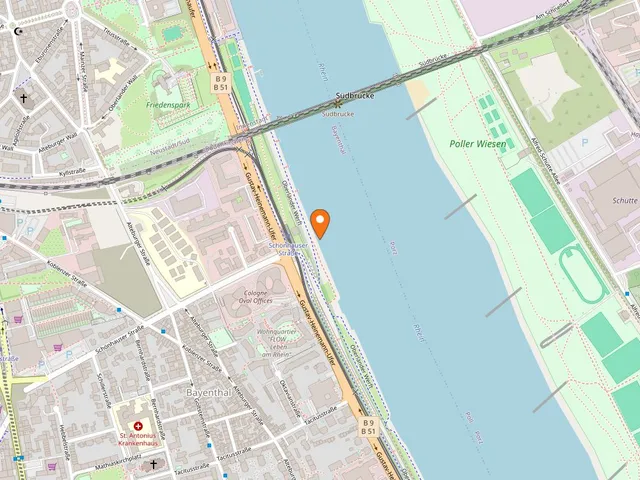
Blue dots: other places nearby — tap to explore.
Address
Im Ferkulum 29
50678 Köln
Hours
Mo: 10:00–18:00
Di: 10:00–18:00
Mi: 10:00–18:00
Do: 10:00–18:00
Fr: 10:00–18:00
Sa: 10:00–13:00
So: 10:00–17:00
You might also like — related or nearby
Comments
- Loading comments…
Sources & links
- Official website
- Official Instagram (@sanktseverinkoeln)
- Wikidata (retrieved 2026-06-24)
- Wikipedia (retrieved 2026-06-24, rev 265082590)
- Official website (retrieved 2026-06-24)
Auto-generated, last verified: 2026-06-27
How this page is made
This page draws on open sources — Wikipedia, Wikidata, official websites and the city’s open data. Every statement is checked against the sources linked here, and pages are refreshed regularly.
Spotted a mistake anyway? Tell us below — we read every submission.