St. Margareta
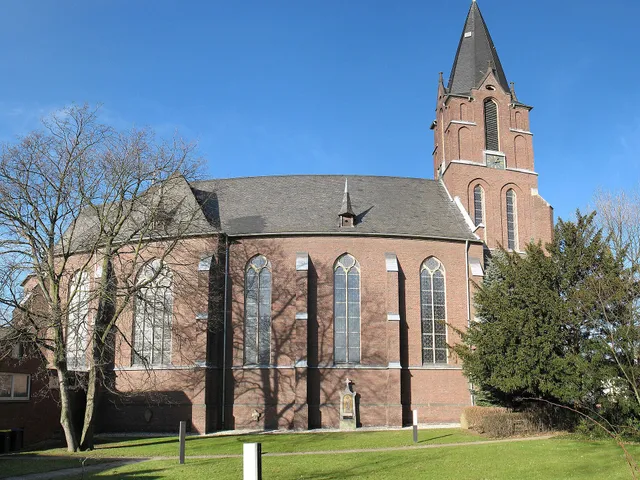
Neo-Gothic brick basilica of 1909–1911 in Cologne-Libur, whose original interior—altars, pulpit, and windows—survives intact.
The church was built to designs by parish priest Hubert Huthmacher, after whom the neighboring street is named.
Source: Wikipedia
At a Glance
- Type
- Roman Catholic parish church
- Architectural style
- Neo-Gothic
- Construction period
- Built 1909 to 1911
- Location
- Libur district, Porz borough, Cologne
- Heritage protection
- Listed since 19 January 1983 (No. 1290)
- Patron saint
- Margaret of Antioch
- Notable feature
- Part of the Porz Cultural Trail
Of the three bronze bells cast in 1909, only the smallest survived the bell destructions of both World Wars.
History
Libur once belonged to the parish of Niederkassel and became an independent parish in 1849. Today's church replaced a chapel built in 1582 and dedicated to St. Margaret. Construction was funded by donations from wealthy farmers as well as by parish priest Hubert Huthmacher (1862–1915), who had served since 1901 and designed the building himself.
Architecture
St. Margareta is a three-aisled brick basilica with a tower attached to the northwest. Its original furnishings—stone altars, pulpit, organ loft, windows, and sculptures—have all been preserved. The original wall paintings were restored in 1981.
Surroundings
Adjacent to the church lies the old cemetery, with gravestones dating back as far as 1650.
Bells
In 1909 the Otto bell foundry of Hemelingen, near Bremen, cast a three-bell bronze peal. Only the smallest of these survived the bell melt-downs of the two world wars. After World War II, Otto cast a replacement bell in both 1949 and 1959, restoring the three-bell peal, which today rings out in the notes G, B-flat, and C.
Timeline
- 1582A chapel dedicated to St. Margaret was built
- 1650Oldest surviving gravestones in the old cemetery
- 1849Libur becomes an independent parish
- 1901Hubert Huthmacher becomes parish priest
- 1909Church construction begins; Otto foundry casts three-bell chime
- 1911Completion of St. Margaret's parish church
- 1949New bell delivered by Otto
- 1959Another new bell delivered by Otto
Gallery
Map
Blue dots: other places nearby — tap to explore.
You might also like — related or nearby

Comments
- Loading comments…
Sources & links
Auto-generated, last verified: 2026-09-04
How this page is made
This page draws on open sources — Wikipedia, Wikidata, official websites and the city’s open data. Every statement is checked against the sources linked here, and pages are refreshed regularly.
Spotted a mistake anyway? Tell us below — we read every submission.