Wahn Palace
A late-Baroque palace in Cologne's Wahn district – today home to a major theatre collection and a civil wedding venue.
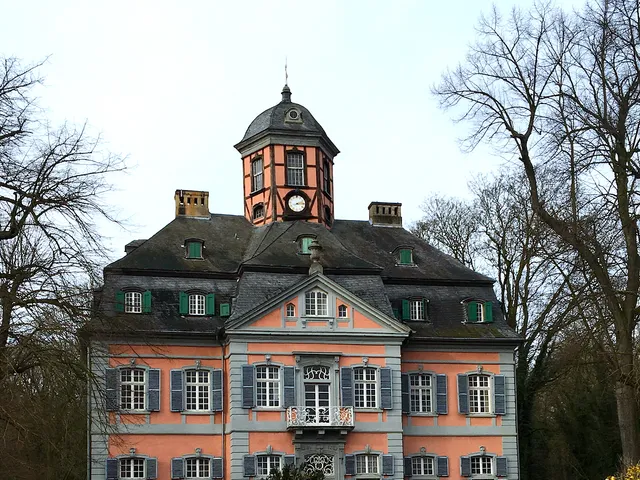
Wahn Palace (Schloss Wahn) is a three-winged late-Baroque palace complex in Cologne's Wahn district, from which it takes its name. Grown out of a medieval moated castle, it today serves mainly the University of Cologne – though its historic interiors are not freely open to the public.
At a Glance
- District
- Wahn (Cologne)
- Style
- Late Baroque, three-winged complex
- Conversion to palace
- 1753–1757, designed by Johann Georg Leydel
- Heritage protection
- since 9 November 1982
- Current owner
- Barons von Eltz-Rübenach (since 1820)
- Use
- University of Cologne's Theatre Studies Collection, civil wedding venue
- Access
- historic ground-floor rooms not freely open to the public
History
The "Hoff zu Wande" was first documented in 1358 as a property of the von Revelen family. At that time it was a moated castle with a residential tower, gatehouse, moat and outer bailey. Ownership passed through the von Loë and von Zweiffel families; in 1588 the castle was destroyed and pillaged by a mercenary army. From 1685 the counts of Schall are recorded as owners – it was they who, in 1753, had the castle rebuilt into a stately late-Baroque palace. After a period in the hands of the Heereman von Zuydtwyck family, the palace passed in 1820 to the barons von Eltz-Rübenach, who own it to this day. At the end of the Second World War the palace was severely damaged; the main house was comprehensively renovated in 1964, followed by the coach house and estate office in 1988.
Architecture
Between 1753 and 1757 the complex was originally built as a unified, four-winged late-Baroque structure. The plans came from Johann Georg Leydel, a collaborator of the celebrated master builder Balthasar Neumann. The model was a French "maison de plaisance", a pleasure palace – yet the complex also fulfilled its function as a manorial estate.
Setting and Features
The palace is reached via a masonry bridge and the historic gate. The courtyard is framed by the three-winged ensemble; at its centre, on a circular island, stands a large chestnut tree together with the iron sculpture "Potential" by Ansgar Nierhoff, a permanent loan from Cologne's Museum Ludwig. The north-facing main house is flanked by the estate office to the east and the cavalier house to the west. Two sweeping outdoor staircases on the terrace lead down to the palace park with its old trees. The grounds also hold the burial chapel of the von Eltz-Rübenach family; among those interred in the family crypt is Paul von Eltz-Rübenach (1875–1943), a former German transport and postal minister.
Present-Day Use
Since 1947 the Eltz-Rübenach family has leased the palace to the University of Cologne, which has housed its Theatre Studies Collection here since 1955. This collection of theatralia is among the largest of its kind worldwide and consists mainly of pictorial and textual material on European theatre from the 16th century to the present – including around 100,000 volumes of theatre literature as well as the estates of Karl Valentin and Willy Millowitsch. Since 2007 Wahn Palace has also been a branch office of Cologne's registry office, holding weddings in its historic rooms. These ground-floor rooms are not freely accessible to the public; they are used for concerts and academic events and can be rented for weddings for a fee.
Good to Know
The main house's rooms bear evocative names: the Garden Hall with its ceiling-high 18th-century oil paintings is considered the oldest room, the Chinese Room is done in the Rococo style, and the Pompeian Room in Neoclassicism. In 2018 the palace made headlines when its owners obtained a last-minute court injunction against a protocol reception for Turkish President Recep Tayyip Erdoğan hosted by the state government – on grounds of political conviction and because the lease did not provide for such use.
Map
Blue dots: other places nearby — tap to explore.
Address
Burgallee 2
51147 Köln
Contact
You might also like — related or nearby

Comments
- Loading comments…
Sources & links
- Official website
- Official website (retrieved 2026-07-23)
- Wikidata (retrieved 2026-07-21)
- Wikipedia (retrieved 2026-07-21)
Auto-generated, last verified: 2026-07-21
How this page is made
This page draws on open sources — Wikipedia, Wikidata, official websites and the city’s open data. Every statement is checked against the sources linked here, and pages are refreshed regularly.
Spotted a mistake anyway? Tell us below — we read every submission.