Schloss Röttgen
Schloss Röttgen is a listed castle-and-stud complex in Cologne's Eil/Rath-Heumar districts spanning about 250 ha — not open to the public.
Schloss Röttgen is a castle-and-stud complex in the Cologne districts of Eil and Rath/Heumar. The roughly 250-hectare estate, ringed by a wall some eight kilometres long, is the private property of the Mehl-Mülhens Foundation and is not open to the public.
At a Glance
- Location
- Cologne, between Eiler Straße, the A 59, Hirschgraben, Heumarer Mauspfad and (Alte) Forststraße
- Origin
- knightly seat dating from the 9th to 13th century; the present manor house was built from 1866
- Use
- active thoroughbred stud (founded 1924)
- Area
- about 250 hectares (roughly two square kilometres, comparable in size to Monaco)
- Owner
- the Mehl-Mülhens Foundation
- Heritage status
- many structures, the wall, woodland and garden are protected monuments
- Access
- not open to the public, enclosed by a wall about 8 km long and 2 m high
From Knightly Seat to Contested Estate
Röttgen's roots reach far back: a knightly seat arose here between the 9th and 13th centuries, possibly a water-protected structure — the grounds sit in the hollow of a former arm of the Rhine. In 1402 Johann Kreuwel von Gimborn was enfeoffed with the "Hoff zome Roetgine"; like the nearby place-name Rath, the name is thought to derive from woodland clearing.
Over the centuries the estate passed by inheritance through the Bourscheidt and Harff families before falling in 1660 to Bertram von Gymnich, whose wife Maria von Harff brought Röttgen into the marriage. Little is known of the buildings of that era beyond a house chapel. Decades of inheritance disputes followed, some of them violent, carried all the way to the Imperial Chamber Court and dragging on until at least 1704.
Ownership remained contested afterwards: following the death of the canon Franz Dietrich Beißel von Gymnich in 1706, his brother sold the estate to the Cologne painter Johannes Justus Borchers, who was driven out in 1709. Only the imperial Aulic Council in Vienna restored the property to him. In 1776 a French army survey recorded a size of 150 Morgen (37.5 hectares). In 1790 Baron Kornelius Josef Geyr von Schweppenburg acquired the estate at public auction; he had the old knightly manor demolished, though a farmhouse remained.
The New Castle
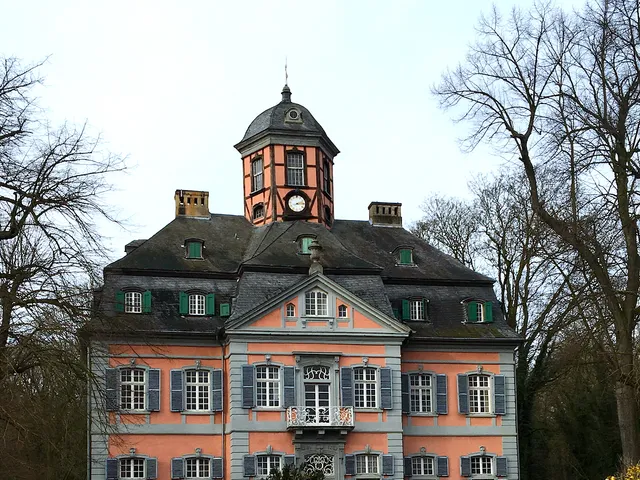
In 1832 Kornelius Geyr's daughter Agnes inherited the estate, which she had described two years earlier as "delightfully beautiful". Her husband, Baron Maximilian von Geyr, found it too far from Cologne, however; the couple leased the estate and lived in the city's Sternengasse. In 1866 Agnes had a new Haus Röttgen built for her son Franz — the manor house that still stands today, a brick building in the Romantic style with Gothic forms and dressed-stone elements of varied origin.
Around 1900 the estate encompassed extensive woodland forming a game park modelled on English landscape gardens, along with numerous old, exotic trees; in 1899 the property covered 227 hectares across the Heumar, Rath and Eil districts. In 1911 Baron von Geyr even secured a renaming to "Burg Röttgen", although only a moat was known of any fortification. In the end the name "Schloss Röttgen" prevailed — not least because the later owner Rudi Mehl insisted on it, going so far as to have the motorway service station beside the stud named accordingly.
The Stud Under Mülhens
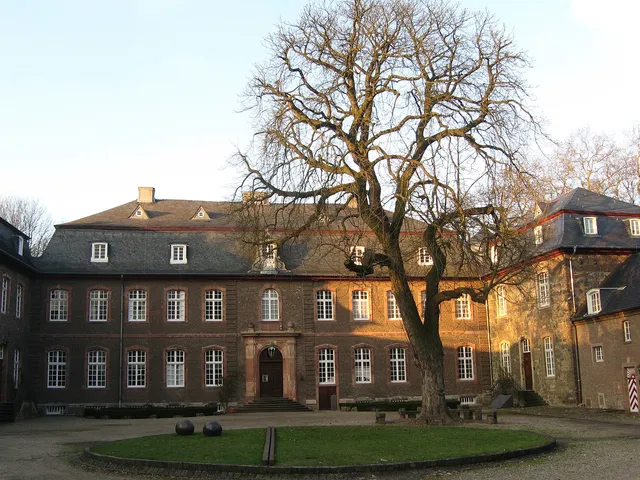
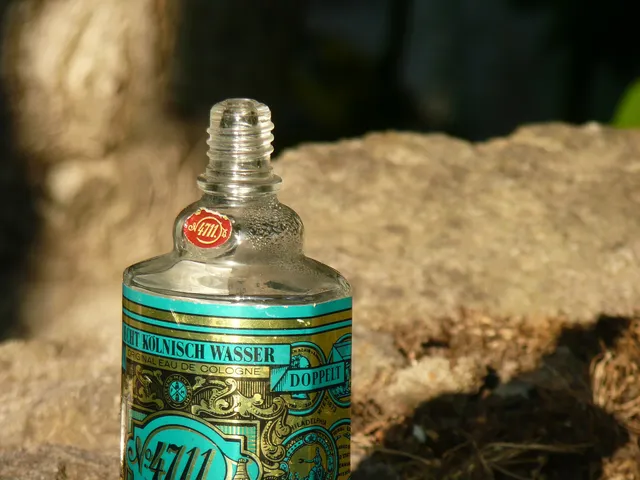
The new tenant, and from late 1918 the owner, was Peter Mülhens, proprietor of the eau-de-Cologne firm 4711. In 1924 he founded the Röttgen thoroughbred stud. The Cologne architect Ludwig Paffendorf designed the stud buildings in a German Renaissance idiom, and the entire estate was enclosed "after the Irish model" by a wall about eight kilometres long and two metres high, known as Mülhens' Wall. Further buildings went up into the 1930s. In 1927 Mülhens also acquired the Leidenhausen estate and had a 2,100-metre training track laid out there for the racehorses.
During the Second World War around 1,000 high-explosive bombs fell on the grounds without seriously damaging the buildings; as late as 1975, ten aerial bombs were found and defused. Peter Mülhens died on 5 August 1945.
Post-War Years and the Germany Treaty
From 1945 to 1949 the castle served as the seat of the British Military Government for North Rhine-Westphalia and as the residence of Major General Alexander Bishop, and afterwards as the residence of the British High Commissioner in the Allied High Commission — first General Brian Robertson, then Ivone Kirkpatrick from June 1950. The site was chosen for its proximity to the British headquarters in the Wahner Heide. In the castle's rooms, Chancellor Konrad Adenauer negotiated the Germany Treaty with the principal victorious powers in 1952.
In 1953 the grounds were returned to the Mülhens family. After the death of Maria Mehl-Mülhens in 1985, the property passed to the Mehl-Mülhens Foundation.
Heritage Status and Points of Interest
Many structures on the grounds are listed monuments — the castle itself, the wall, the gatehouse on the Mauspfad, the sawmill, the estate office, the stable buildings and the observation tower, together with the surrounding woodland and garden. In 1998 Cologne's monuments authority praised Schloss Röttgen as a largely original, integrated work of art of European significance.
The castle and its estate — now about two square kilometres — are not open to the public. Under the forest law that came into force in North Rhine-Westphalia in 1970, which in principle opened woodlands for recreation, the state agriculture minister tried in vain to have the wall removed; the owners invoked an exemption for commercially used woodland — opening the wall would call the stud itself into question. One curious detail: so that the racehorses can safely cross the Hirschgraben to the training track, a hand-operated traffic light was installed specifically for that purpose.
Gallery
Map
Blue dots: other places nearby — tap to explore.
Address
Eiler Str. 10k
51107 Köln
You might also like — related or nearby
Comments
- Loading comments…
Sources & links
- Official website
- Official website (retrieved 2026-07-23)
- Wikidata (retrieved 2026-07-23)
- Wikipedia (retrieved 2026-07-23, rev 259466376)
Auto-generated, last verified: 2026-07-23
How this page is made
This page draws on open sources — Wikipedia, Wikidata, official websites and the city’s open data. Every statement is checked against the sources linked here, and pages are refreshed regularly.
Spotted a mistake anyway? Tell us below — we read every submission.