Zeughaus
An arsenal that never saw real combat: Cologne's Zeughaus (1594–1606) showed its weapons to travelers as early as the 17th century and was part of the city museum 1958–2021.
Cologne's Zeughaus stands on the site of the late medieval Blidenhaus, and its south side rests on remains of the Roman city wall. It was built to house the weapons for the city's defense.
Source: Wikipedia
At a Glance
- Location
- Altstadt-Nord district, Innenstadt borough, between the street "Burgmauer" to the south and Zeughausstraße to the north
- Dimensions
- 66.80 meters long, 17.15 meters wide
- Style
- plain brick building with Dutch Renaissance influences
- Stair tower
- octagonal, 23.60 meters high, on the west side
- Ornamental portal
- by Peter Cronenborch, around 1595, on the north side
- Heritage protection
- listed monument in North Rhine-Westphalia, on the City of Cologne's monument list since 1 July 1980
The Cologne Zeughaus, built as a weapons arsenal, never actually had to be used as one; as early as the 17th century, travellers were shown embellished weapons and objects there, reportedly even a headless mummy and the war chariot from the Battle of Worringen in 1288.
From Blidenhaus to Arsenal
City defense was initially the responsibility of the Gaffeln (guilds), later of the municipal administration. The Blidenhaus, first mentioned in 1348 and also called the "Werkhaus", stored the heavy weapons. A blide was a medieval type of catapult. As the old building no longer met the requirements of the 1583 defense regulations, the Zeughaus was built; "Zeug" here means armament. City architect Peter von Siberg began the work, city stonemason Peter von Blatzheim succeeded him, and Matthias von Gleen completed the building.
Outside and Inside
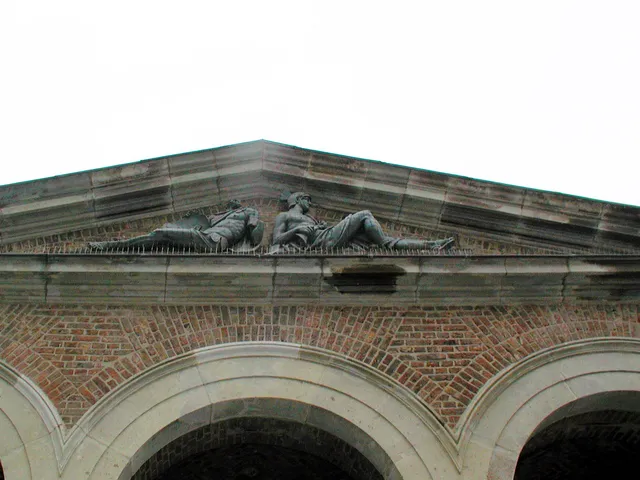
Twelve strictly rhythmic window axes in three rows structure the north side. The ornamental portal interrupts them asymmetrically: it was not originally planned, turned out somewhat oversized, and was meant to symbolize the "glory and power of the city of Cologne." The higher-lying south side has only one larger and one smaller row of windows. Two stepped gables on each long side break up the gabled roof. On the ground floor, the heavy weapons were stored beneath 25 vaulted bays; the upper floor held a ceremonial hall with inlaid woodwork, which also housed lighter weapons. Its grand portal to the stair tower is now in the City Hall.
A Museum Before the Museum
The arsenal was never used in a real emergency and lay in a long "slumber." Since the 17th century, travelers were shown the weapons and objects along with spooky stories. Even a headless mummy and the war chariot from the Battle of Worringen in 1288 were reportedly displayed. After French troops arrived in 1794, the building passed into government ownership and was emptied. It continued to serve as a weapons depot under French and Prussian rule. In the 19th century it was substantially altered, and from 1920 it was used by, among others, the regional tax office.
Destruction and City Museum
In air raids in 1942 and 1943, the building burned down to its outer walls. The city bought back the ruin for the Historical Museum, which was then housed in Deutz. During reconstruction, the lower floors received flat ribbed ceilings and a cantilevered staircase in 1950s style, while the columns remained without vaulting. From 1958 to 2021, the building belonged to the Cologne City Museum (Kölnisches Stadtmuseum). With it came objects that had once passed through the Wallraf collection and the Wallraf-Richartz Museum.
The Golden Bird
In 1991, the artist HA Schult placed an original Ford Fiesta with enormous wings on the stair tower as a "Monument to the Automobile Age." The project was highly controversial. District President Franz Josef Antwerpes criticized that heritage protection is otherwise interpreted very strictly, yet here it was evidently ignored entirely. Because of structural problems, the bird was later removed.
Timeline
- 1348Predecessor building first mentioned as 'Blidenhaus'/'Werkhaus'
- 1594–1606Construction of the Zeughaus as municipal arsenal
- 1794French troops enter Cologne; Zeughaus emptied and taken into government ownership
- 1920Civilian use begins, e.g. by the regional tax office
- 1942/1943Burned down to outer walls in two air raids
- 1958Becomes part of the Cologne City Museum complex
- 1980Listed in Cologne's monument register (1 July)
- 1991HA Schult installs the 'Golden Bird' on the stair tower
Gallery
Map
Blue dots: other places nearby — tap to explore.
You might also like — related or nearby
Comments
- Loading comments…
Sources & links
Auto-generated, last verified: 2026-11-08
How this page is made
This page draws on open sources — Wikipedia, Wikidata, official websites and the city’s open data — plus basic place data and photos from Google Maps where a place is listed there. Every statement is checked against the sources linked here, and pages are refreshed regularly.
Spotted a mistake anyway? Tell us below — we read every submission.