Villa Parkstraße 5
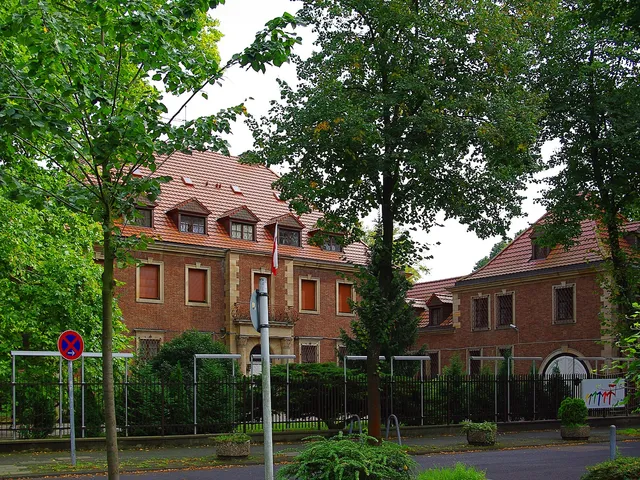
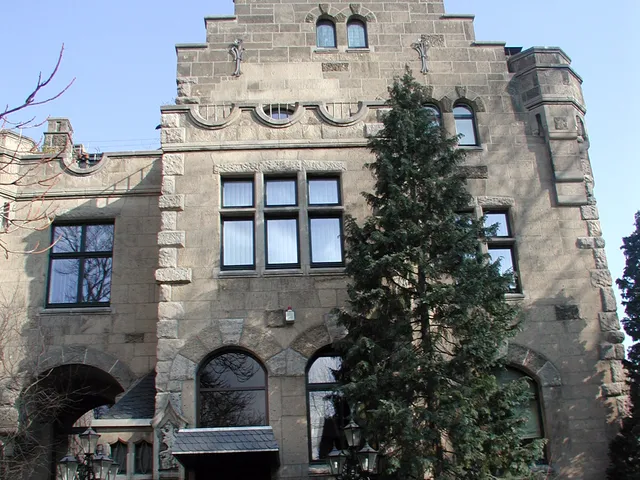
Publisher's villa in Cologne-Marienburg, seat of the Imperial Iranian Embassy from 1958 and today owned by an Iranian foundation.
The site was originally home to the “Maschinen-Fabrik P. Kyll”. After the company moved its production to Sürth in 1908, the newspaper publisher Josef Neven DuMont (1857–1915) bought the plot, which lies a good four metres above the Oberländer Ufer and so offered unobstructed views of the Rhine.
Source: Wikipedia
At a Glance
- Type
- listed villa in the Marienburg villa colony
- Location
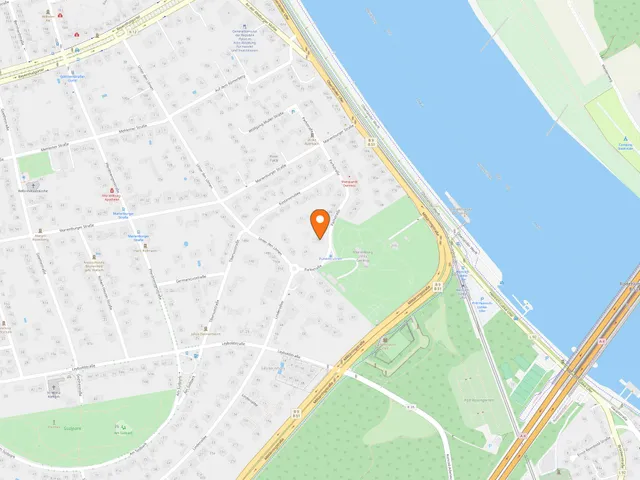
- Marienburg district, Rodenkirchen borough
- Built
- 1913–1914
- Architect
- Paul Pott
- Plot
- 103 metres of street frontage, 48 metres deep
- Embassy seat
- 1958 until at least 1978
- Heritage list
- since 9 December 1988 (no. 4767)
In September 1961, around 500 Iranian students occupied the Imperial Iranian Embassy in the villa for several hours to protest the forced withdrawal of passports from two compatriots studying in the USA.
From Factory Site to Villa Quarter
The old manufacturer's villa at Oberländer Ufer 170 was converted and housed the “Café Restaurant Rheineck” from 1910. Neven DuMont had the factory halls demolished and extended Parkstraße north across the former works. He kept the east side for himself. On the west side, three plots were developed at different times: Villa Selmar Auerbach (no. 10) in 1913/1914, Villa Wilhelm Auerbach (no. 8) in 1914/1915 and Villa Franz Ott (no. 2) not until 1924. Pott designed these houses as well.
Family, Nazi Era and War
A year after the villa was completed, the publisher was involved in a car accident on 20 October 1915 on his way to the newspaper's offices and died on 31 October. His widow Anna, née Mahler, continued to live in the house, which later passed to their son August Neven DuMont. From 1935/1936 the local Nazi Party group of Bayenthal used the villa, which remained in the family's ownership. The grounds were divided into three building plots in 1938, and in 1939 the GAG partly converted the house for the party. War damage, mainly to the south wing, was largely repaired before the war ended, after which the property stood unused.
Seat of the Iranian Embassy
After Bonn became the seat of government in 1949, many diplomatic missions settled in largely undamaged Marienburg. The Iranian mission was first based at two addresses in Rodenkirchen before moving into the villa in 1958, where it housed the chancery and the ambassador's residence. In September 1961, around 500 Iranian students occupied the building for several hours. They were protesting against the forced return of two compatriots studying in the USA, whose passports had been withdrawn, and against political repression in Iran. The chancery moved to Bonn in 1973/74, while the villa served as the residence until at least 1978.
Ownership and Condition Today
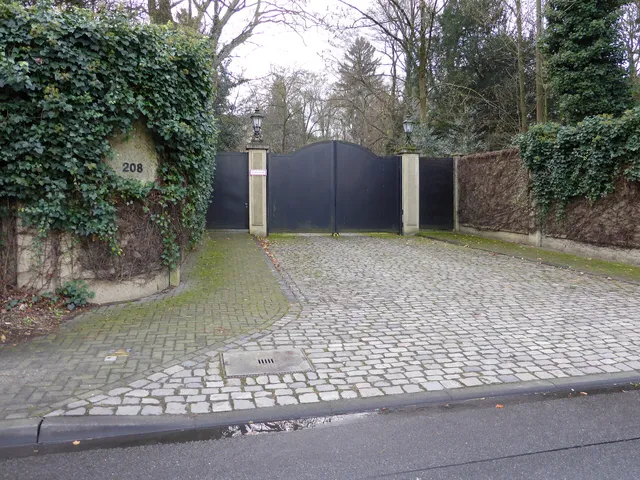
By the time of the Islamic Revolution in 1979 at the latest, the foundation “Bonyad-e Mostazafan va Janbazan” had taken over the property. Its name is translated both as “Revolutionary Foundation of the Oppressed and War Veterans” and as “Foundation of the Oppressed and Self-Sacrificing”. The foundation is considered influential, is the second-largest company in Iran and is close to the Islamic Revolutionary Guard Corps. Alterations include the stained glass, the enclosure, a relief above the hall windows and a balustrade above the portico and front annex. The complicated ownership situation is a major reason why part of the estate is not in the best condition.
The Vanished Garden
The garden was based on a 1912 design by Cologne's director of horticulture, Fritz Encke, which was never fully carried out. Nothing of this layout survives; a meadow with trees now occupies its place.
Timeline
- 1908Kyll machine factory relocates to Sürth; Neven DuMont acquires the site
- 1913–1914Villa built for Josef Neven DuMont, designed by Paul Pott
- 1915Josef Neven DuMont dies after a carriage accident; widow continues living in the villa
- 1935/1936Local NSDAP group Bayenthal uses the villa
- 1938Grounds are divided into three building plots
- 1939Partial conversion by GAG for the NSDAP
- 1958Imperial Iranian Embassy moves into the villa
- 1988Listed in the Cologne register of monuments
Map
Blue dots: other places nearby — tap to explore.
You might also like — related or nearby
Comments
- Loading comments…
Sources & links
Auto-generated, last verified: 2026-11-11
How this page is made
This page draws on open sources — Wikipedia, Wikidata, official websites and the city’s open data — plus basic place data and photos from Google Maps where a place is listed there. Every statement is checked against the sources linked here, and pages are refreshed regularly.
Spotted a mistake anyway? Tell us below — we read every submission.