Villa Oberländer Ufer 208
Villa modeled on an English country house: home of Moritz Bing from 1915, whose assets were declared forfeit in 1941; South African residence from 1949.
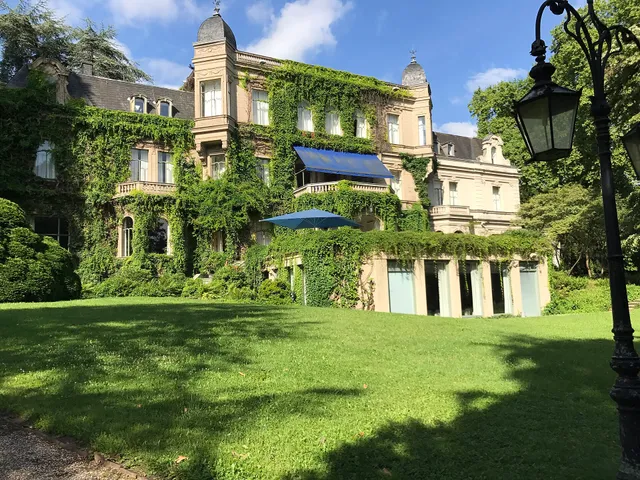
The listed villa in Köln-Marienburg was built in 1911–1912 for Heinrich Bales, a decorative painter and master chimney sweep. The plans were drawn up by the Cologne architect Heinrich Müller-Erkelenz.
Source: Wikipedia
At a Glance
- Type
- Villa, listed monument in North Rhine-Westphalia
- Location
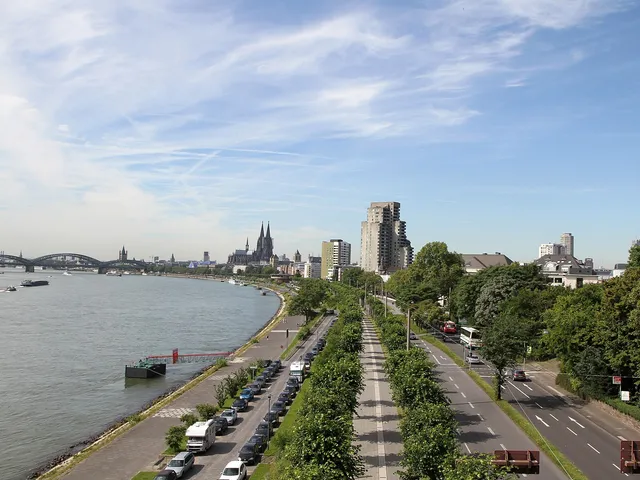
- Marienburg villa colony, Rodenkirchen district of Cologne
- Distances
- about 100 m west of the Rhine bank and about 100 m north of Militärringstraße (Federal Road 9)
- Extension
- single-storey side annex, 1915/1916
- Floor plan
- L-shaped
- Cologne monument list
- since 4 January 1991
From December 1949 the villa served as the residence of the South African envoy (ambassador from 1954) to the then federal capital Bonn, even though it stands in Cologne's Marienburg district; the embassy only moved to Bonn in 1975.
Moritz Bing and the Seizure of His Property
From 1915, the Jewish lawyer Moritz Bing lived in the villa. A year later, the properties at Oberländer Ufer 208 and 206a came into his ownership. After the November pogroms of 1938, he went into exile in Switzerland. On 23 June 1941, the Deutscher Reichsanzeiger No. 143 declared his assets "forfeited to the Reich." His heirs later demanded, as part of postwar restitution, that the property be returned to them. The claims were settled with a payment of DM 35,000 for the house, which had been damaged in the war.
Residence of South African Diplomats
With Bonn becoming the seat of government of the Federal Republic of Germany in 1949, the villa took on a new role. By December 1949 at the latest, when the first accreditation took place, the envoy of the Union of South Africa was living here. The legation became an embassy in 1954, and from 1961 it represented the Republic of South Africa. The first head of mission to live in the house was Major General William Henry Evered Poole. The villa remained in use as a residence until the embassy moved to Bonn in 1975.
Architecture
English country houses served as the model for the design. The south side and the east side facing the Rhine are laid out as showcase façades. Unlike many buildings in Marienburg, the gable surfaces are clad in shingles. The house stands as a free-standing building on its plot.
The Coach House in the Park
A coach house to the east, in the park, belongs to the estate. It was destroyed in the Second World War and rebuilt in 1950 by the City of Cologne's building department. Unlike the villa, the coach house survives only in a heavily altered state.
Timeline
- 1911–1912Villa built to a design by Heinrich Müller-Erkelenz
- 1915/1916Single-storey side extension added to the house
- 1916Moritz Bing becomes owner of the plots at Nos. 208 and 206a
- 1938Moritz Bing emigrates to Switzerland after the November pogroms
- 1941Bing's assets declared forfeit to the Reich on 23 June
- 1949From December, residence of the South African legation
- 1975South African embassy moves to Bonn
- 1991Listed in Cologne's heritage register on 4 January
Map
Blue dots: other places nearby — tap to explore.
You might also like — related or nearby
Comments
- Loading comments…
Sources & links
Auto-generated, last verified: 2026-11-05
How this page is made
This page draws on open sources — Wikipedia, Wikidata, official websites and the city’s open data. Every statement is checked against the sources linked here, and pages are refreshed regularly.
Spotted a mistake anyway? Tell us below — we read every submission.