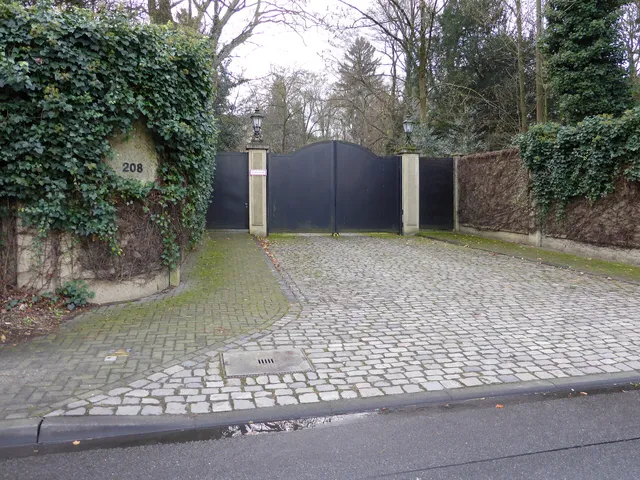
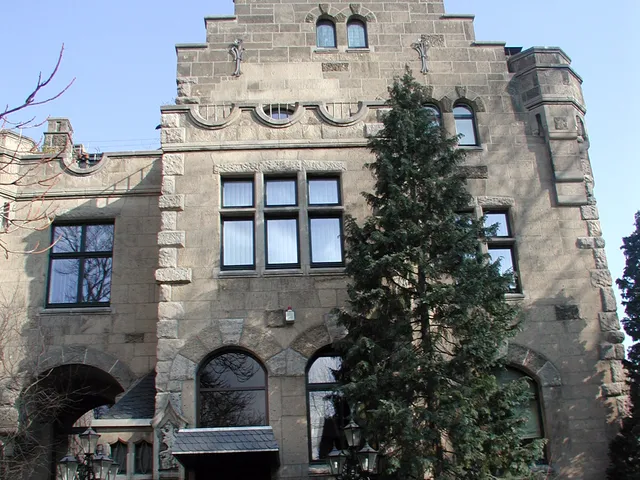
Villa Parkstraße 20
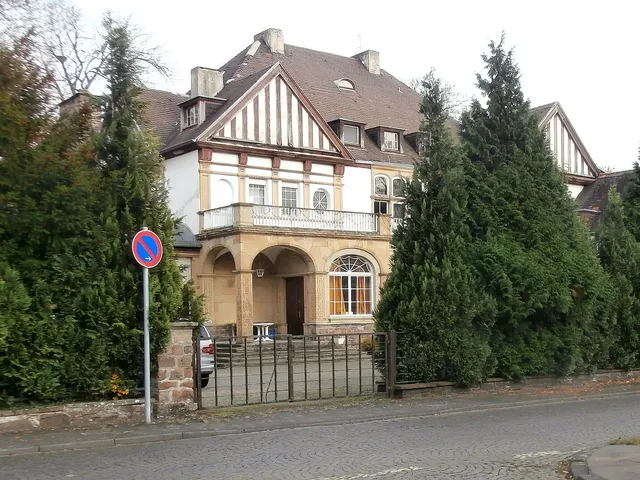
Home of the Brazilian ambassador from 1950 to 2000: a country-house-style villa designed by Paul Pott in 1924/25 in Cologne-Marienburg.
The triangular site between Kastanienallee, Unter den Ulmen and Parkstraße long belonged to the railway carriage manufacturer Julius van der Zypen. It was only after the First World War that it was gradually divided into individual plots.
Source: Wikipedia
At a Glance
- Type
- Villa, listed building (monument no. 220 of the City of Cologne)
- Location
- Marienburg district, Rodenkirchen borough; part of the Cologne-Marienburg villa colony
- Built
- 1924–1925
- Architect
- Paul Pott
- Client
- Car dealer Willy Bleissem
- Garden design
- Fritz Encke, the city's director of horticulture
- Use 1950–2000
- Residence of the Brazilian ambassador
From 1950 to 2000 the villa served as the residence of the Brazilian ambassador – after the Second World War the property had come into the ownership of the City of Cologne and was then rented to the Republic of Brazil once Bonn became the seat of government.
Origins
The building contractor Josef Bauwens was the first to acquire a large part of the subdivided area along Parkstraße. In 1924, Willy Bleissem bought the southern half from him, directly opposite the so-called Marienburg. For Paul Pott, it became the largest estate he was able to build in Marienburg after the war. The sculptor Willy Meller and the painters Josef Mangold and Heinrich Kron contributed to the artistic decoration.
Seat of the Brazilian Ambassador
After the Second World War, the property passed to the City of Cologne via an intermediate owner. When Bonn became the seat of government of the Federal Republic in 1949, numerous countries set up their legations in Marienburg. The Republic of Brazil rented the villa in 1950 and established its ambassador’s residence there. After the seat of government moved to Berlin, the embassy relocated there in the summer of 2000.
Architecture and Interior
Pott designed the ensemble as a small, intimate country house. His models were the country houses by Paul Bonatz that were popular at the time, as well as developments from the English-speaking world. Contemporary critics stressed the building’s “whimsical” character, for example the cap roof over the tea house, whose Japanese wall paintings were by Josef Mangold. Inside the two-storey villa, this cheerfulness continues in Meller’s work, including stucco decoration and the figural newel post in the stair hall. On the garden side, a single-storey kitchen wing with a maid’s room above adjoins the house.
Condition
Apart from minor alterations, the villa has been preserved largely in its original state. The cap roof over the tea house no longer exists, and the veranda on the kitchen wing has been enclosed. The building was added to the City of Cologne’s register of listed monuments on 1 July 1980.
Timeline
- 1924Willy Bleissem acquires the southern half of the plot
- 1924–1925Villa built to a design by Paul Pott for Willy Bleissem
- 1950Brazil rents the villa as the ambassador's residence
- 1. Juli 1980Entered in the Cologne list of monuments (No. 220)
- 2000Brazilian embassy relocates to Berlin
Map
Blue dots: other places nearby — tap to explore.
You might also like — related or nearby
Comments
- Loading comments…
Sources & links
Auto-generated, last verified: 2026-11-11
How this page is made
This page draws on open sources — Wikipedia, Wikidata, official websites and the city’s open data — plus basic place data and photos from Google Maps where a place is listed there. Every statement is checked against the sources linked here, and pages are refreshed regularly.
Spotted a mistake anyway? Tell us below — we read every submission.