Weyertor
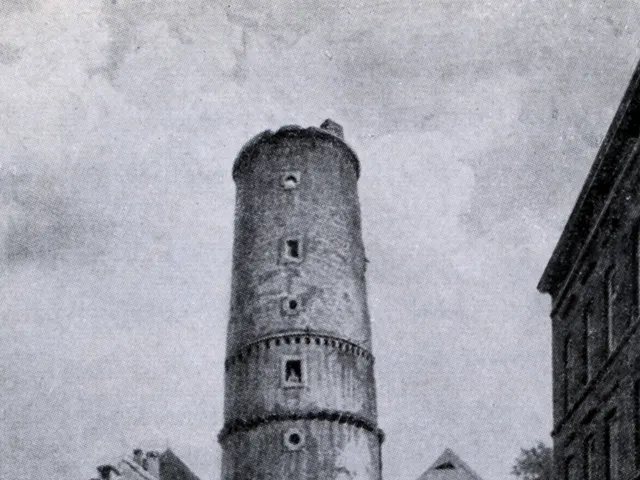
One of medieval Cologne's 14 great land-side city gates, guarding the southwestern approach since the 13th century — demolished in 1889.
The Weyertor was one of 14 major land-side gates belonging to Cologne's great medieval ring wall, positioned at the city's southwestern edge. Construction of the Late Romanesque gate fortress began in the first third of the 13th century; it was torn down in 1889 to make way for further urban expansion.
At a Glance
- Type
- Medieval city gate (gate fortress) of the ring wall
- Location
- Southwest Cologne, today's Altstadt-Süd quarter in the Innenstadt district
- Construction began
- First third of the 13th century, Late Romanesque
- Demolished
- 1889
- Distinction
- According to Adam Wrede, the highest-situated gate of the new ring wall
- Function
- Exit gate onto the road heading southwest
The Weyerstraße was called "Kaiserstraße" (Emperor's Street) in the 15th and 16th centuries because emperors and kings arriving from the west traditionally entered Cologne through the Weyertor and along this road. During construction work at the gate complex in April 1589, workers unearthed three Roman sarcophagi made of red sandstone, containing ceramic jugs, glassware, and unidentified coins.
Name and Origin
The name is thought to derive from a piece of land known as a "Weiherkülchen" — a small pond that had formed at the tail end of the Gleueler Bach stream. Around 1232, Latin documents referred to the gate as "porta piscinae"; by around 1257 it was called "wierporce". On his city panorama of 1570, Arnold Mercator labelled it "Die Weier pforts", and French authorities gave it the name "Porte de l'Etang" in 1812/13.
History and Setting
The gate fortress replaced the older southwestern Griechenpforte and stood at the foot of Weyerstraße, opposite St. Pantaleon church. Beyond it opened the highway used by travellers and merchants heading towards Zülpich, Trier, the Eifel region, and Luxembourg. In the 15th and 16th centuries Weyerstraße was also known as "Kaiserstraße" — the Emperor's Road — because emperors and kings entering Cologne from the west rode through this gate.
Alterations and Archaeological Finds
Over the centuries the structure was rebuilt several times; an outer barbican is first mentioned in 1442. Between 1583 and 1592 further work was carried out, during which the outwork was removed to make room for a bulwark. During the excavations in April 1589, workers uncovered three Roman sarcophagi of red sandstone containing small clay jugs, glassware, and coins.
Timeline
- 1. Drittel 13. Jh.Construction of the Late Romanesque Weyertor begins
- um 1232First documentary mention as "porta piscinae"
- 1265Weyerstraße documented for the first time
- 1386Second outer moat with hedges constructed
- 1442Barbican (Zwinger) at Weyertor first mentioned
- 1571Arnold Mercator depicts the gate as "Die Weier pforts"
- 1583–1592Renovation: bulwark and parapet constructed
- 1889Demolition of Weyertor due to urban expansion
Map
Blue dots: other places nearby — tap to explore.
Address
Am Weyertor
Köln
You might also like — related or nearby
Comments
- Loading comments…
Sources & links
Auto-generated, last verified: 2026-06-27
How this page is made
This page draws on open sources — Wikipedia, Wikidata, official websites and the city’s open data. Every statement is checked against the sources linked here, and pages are refreshed regularly.
Spotted a mistake anyway? Tell us below — we read every submission.