Equestrian Statue of Frederick William IV
Bronze equestrian monument by Gustav Blaeser at the right-bank portal of the Hohenzollern Bridge, unveiled in 1867.
At the right-bank portal of the Hohenzollern Bridge stands the bronze equestrian statue of Prussian King Frederick William IV, created by sculptor Gustav Blaeser and unveiled in 1867.
At a Glance
- Type
- Bronze equestrian statue on a granite pedestal
- Sculptor
- Gustav Blaeser
- Unveiled
- 1867
- Location
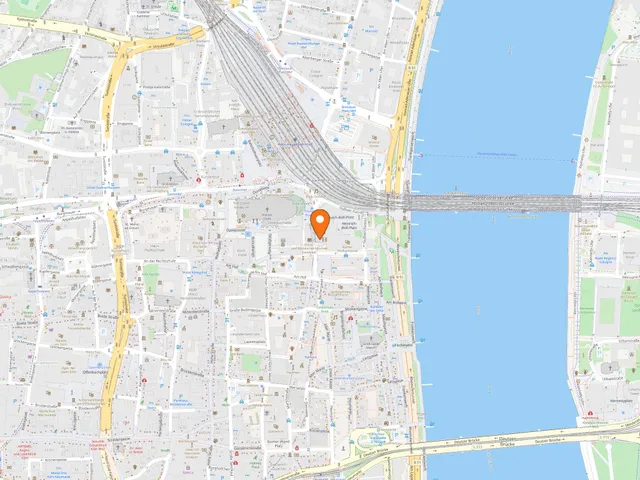
- Right-bank portal of the Hohenzollern Bridge, Deutz district
- Surroundings
- Close to Cologne Cathedral and the main station, roughly 12 minutes on foot
- Admission
- Free
- Suitable for
- Families, groups, school classes, and individual visitors; pram-friendly
King Frederick William IV received Stolzenfels Castle – a ruin since the 17th century – as a gift from the city of Koblenz in 1823 and had it rebuilt in neo-Gothic style by Karl Friedrich Schinkel; when a craftsman asked how the castle should look, he simply replied: "Like in a fairy tale!"
History
Frederick William IV was a passionate advocate for completing Cologne Cathedral. As his marriage produced no heirs, he was succeeded upon his death in 1861 by his brother William I, who would later become the first German Emperor. The statue and its companion piece were originally sited at the earlier Dom Bridge before being moved to their current location.
The Statues at the Bridge
The equestrian statue of William I, created by Friedrich Drake, stands just a few metres away on the opposite side of the railway tracks. In total, four equestrian statues of Hohenzollern rulers are displayed at the bridge: alongside Frederick William IV, those of William I, Frederick III, and William II. A fifth statue — that of Frederick William III — can be found at the Heumarkt in Cologne's old town.
Good to Know
The Hohenzollern dynasty supplied Prussia's kings and Germany's emperors until the end of the First World War. The bronze monuments in public spaces have repeatedly sparked debate about their continued presence and their significance today as historical memorials.
Timeline
- 1823Stolzenfels Castle gifted to Frederick William IV by the city of Koblenz
- 1836Reconstruction of Stolzenfels Castle in Neo-Gothic style under Schinkel begins
- 1848/49Revolution: Frederick William IV consents to constitutional monarchy
- 1861Death of Frederick William IV; brother William I succeeds him
- 1867Equestrian statue inaugurated at the right-bank portal of Hohenzollern Bridge
- 1871Brother William I becomes first German Emperor after the Franco-Prussian War
- 1918End of World War I: House of Hohenzollern loses political power in Germany
Gallery
Map
Blue dots: other places nearby — tap to explore.
Address
Hohenzollernbrücke
50679 Köln
Hours
So: 00:00–24:00
You might also like — related or nearby
Comments
- Loading comments…
Sources & links
- Official website
- Official website (retrieved 2026-06-25)
- Wikidata (retrieved 2026-06-24)
- Wikipedia (retrieved 2026-06-24, rev 259571925)
Auto-generated, last verified: 2026-06-27
How this page is made
This page draws on open sources — Wikipedia, Wikidata, official websites and the city’s open data. Every statement is checked against the sources linked here, and pages are refreshed regularly.
Spotted a mistake anyway? Tell us below — we read every submission.