Isenburg
Moated castle on a water-encircled island in Cologne-Holweide, with a 16th-century tower and an 18th-century manor house.
Although the Isenburg was first documented as early as 1364, the structure standing today no longer reflects that original medieval building.
At a Glance
- Type
- Moated castle, listed monument
- Location
- Johann-Bensberg-Straße, Cologne-Holweide (Mülheim district)
- First mentioned
- 1364 in historical records
- Components
- Tower (16th c.), manor house (18th c.), outer bailey (19th c.)
- Distinctive feature
- Situated on an island surrounded by moats
- Heritage protection
- Since 3 July 1984 (monument register no. 2498)
From 1985 to 2011, part of Isenburg Castle was used as a restaurant, after which the space became private living quarters again.
Layout of the Complex
The castle is divided into a main castle and an outer bailey. The manor house and tower stand on a raised island encircled by water and reached via two bridges, while a three-arched bridge leads from the forecourt to the outer bailey. One moat surrounds the main castle and another the entire grounds, both fed by the Strunder Bach stream.
Tower and Manor House
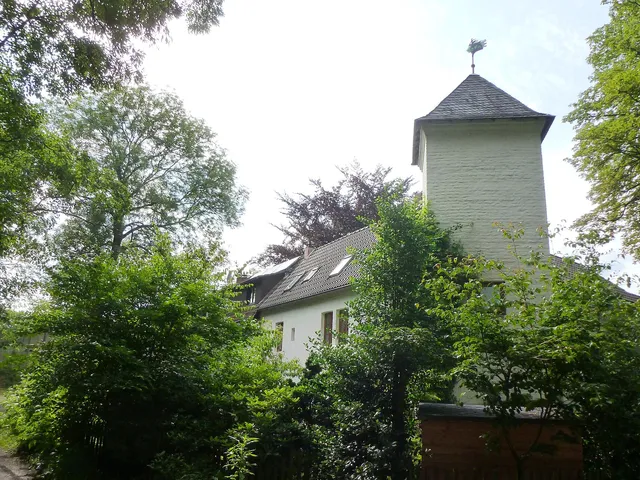
The square 16th-century tower is built of brick and topped with an onion dome, weathervane, and dormer windows. In the 18th century, a three-storey manor house in the classicist style was added onto the tower. It features a rendered façade with ashlar detailing and dormers, bordered on two sides by a terrace that forms the forecourt.
Outer Bailey
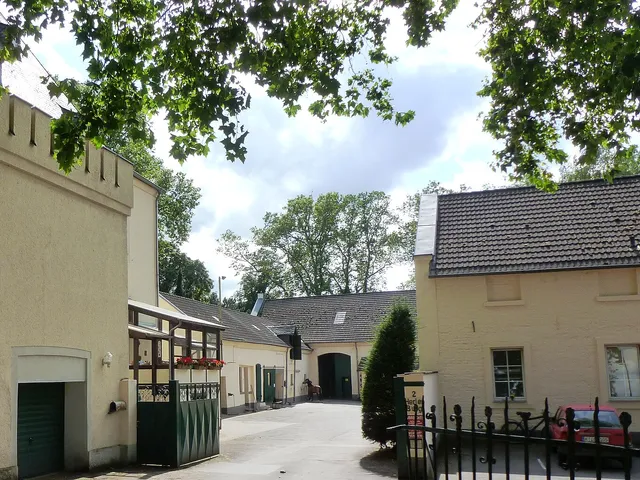
The outer bailey consists of one- and two-storey rendered and brick buildings from the 19th century, arranged around a rectangular courtyard. Among them is the former servants' house, which retains its original room doors, windows, and wooden staircase.
History and Use
The Isenburg marks one of the earliest settled sites in Holweide. In 1983, Bruno Wasser acquired the castle and had the manor house, an extension, and the moat restored, while the outer bailey was converted into condominiums. From 1985 to 2011 part of the castle housed a restaurant, after which the space returned to private residential use.
Good to Know
The Isenburg lent its name to the carnival society "Karnevalsgesellschaft Die Isenburger Köln-Holweide 1974 e. V."
Timeline
- 1364First documented mention of Isenburg.
- 16. JahrhundertConstruction of the square brick tower.
- 18. JahrhundertAddition of the three-storey classicist manor house.
- 19. JahrhundertConstruction of the outer bailey buildings in plaster and brick.
- 1983Sale of the castle to Bruno Wasser with extensive renovation.
- 1984Listed as a protected building on 3 July.
- 1985–2011Partial use of the castle as a restaurant.
Map
Blue dots: other places nearby — tap to explore.
You might also like — related or nearby
Comments
- Loading comments…
Sources & links
Auto-generated, last verified: 2026-09-08
How this page is made
This page draws on open sources — Wikipedia, Wikidata, official websites and the city’s open data. Every statement is checked against the sources linked here, and pages are refreshed regularly.
Spotted a mistake anyway? Tell us below — we read every submission.