Düxer Bock
The unofficial heraldic animal of Deutz: this fountain monument commemorates an old Cologne legend about a tailor and a tax collector.
The Düxer Bock is the unofficial heraldic animal of Deutz, a district of Cologne, and embodies a colourful piece of local urban legend.
At a Glance
- Type
- Bronze sculpture on a fountain column
- Location
- Platz an der Lorenzstraße, Cologne-Deutz
- Erected
- 1964
- Artist
- Gerhard Marcks
- Occasion
- 500th anniversary of the St. Sebastian Marksmen's Brotherhood
- Form
- Goat atop a tall stone column, from whose base water flows into a basin
The house at Siegburgerstraße 24 that gave rise to the Düxer Bock legend no longer exists – it was demolished in 1935/36 to widen the approach road to the Deutz Bridge, after which the city of Cologne promised a replacement monument and only kept that promise nearly 30 years later, in 1964.
Things to do here
- Admire the fountain monument by Gerhard Marcks
- Photograph the billy goat atop the tall stone column
- Listen to the trickling water at the fountain basin
- Discover the legend of the tailor and the tax collector
- Take a little break on the square by Lorenzstraße
The Emblem of Deutz
Beyond the monument itself, the Düxer Bock is a fixture of Deutz identity. Numerous clubs and local initiatives carry the goat in their name, logo, or as a mascot.
The Legend
The story tells of a feud between a Deutz tailor and his neighbour, a tax collector. The tailor kept songbirds in cages outside his window; the tax collector, who lived across the street, was disturbed by their singing during his morning sleep. He took the matter to court and lost, because the tailor pointed out that many Cologne families kept songbirds — even the judge himself. In retaliation, the tax collector hung an underfed billy goat in a birdcage outside his own window, whose bleating rang out across the street. From then on, people mocked the tailor wherever he went with the cry "Schneidermeckmeckmeck" (tailor-bleat-bleat-bleat). When the tax collector later had a stone goat mounted above his front door, the ridicule drove the tailor and his family away. In a conciliatory twist, the tailor's daughter Gertrud eventually marries the tax collector's son, Fritz.
History of the Goat
As early as 1512, a house called "Im Bock" (At the Goat) was recorded on Siegburger Straße; by 1795 it was known as "Das Haus mit dem Bocksbild" (The House with the Goat Image), with a black stone goat above the entrance. In the Middle Ages it was customary for a journeyman tailor who had passed his examination to kiss the stone goat and cheer it three times while waving his hat. A specially made Düxer Bock banner depicted a pair of scales showing that one billy goat outweighs 99 tailors; it was hung out each year on the marksmen's festival days. The building at Siegburger Straße 24 was demolished in 1935/36 to widen the approach road to the Deutz Bridge; a lawn occupies the spot today. The banner and relief are held in the archive of the Cologne City Museum.
The Monument
The upcoming 500th anniversary of the Deutz St. Sebastian Marksmen's Brotherhood revived an old promise to erect a goat monument. Cologne City Council insisted on a modern, contemporary sculpture. It was created in 1964 by sculptor Gerhard Marcks, who was living in Cologne at the time and had long been drawn to animal subjects.
Timeline
- 1512First mention of a house 'Im Bock' on Siegburger Straße
- 1583House known as 'Wirt im Bock'
- 1795House renamed 'Das Haus mit dem Bocksbild'
- 1935/36Historic building at Siegburger Straße 24 demolished for bridge widening
- 1964Monument by Gerhard Marcks erected for the 500th anniversary of the marksmen's brotherhood
Gallery
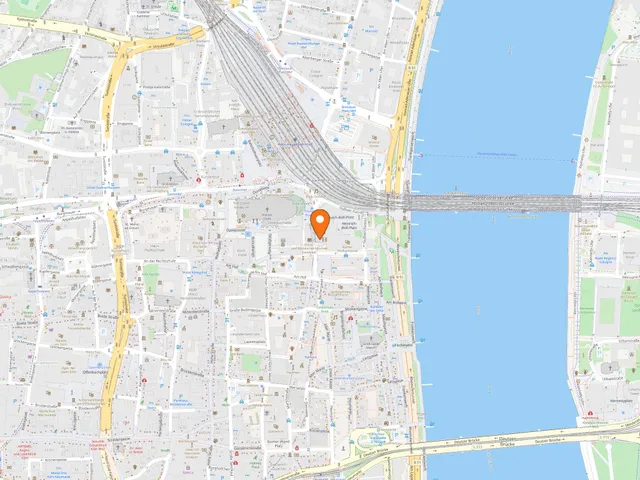
Map
Blue dots: other places nearby — tap to explore.
Address
Am
50679 Köln
Hours
So: 00:00–24:00
You might also like — related or nearby
Comments
- Loading comments…
Sources & links
- Official website
- Official website (retrieved 2026-06-25)
- Wikidata (retrieved 2026-06-24)
- Wikipedia (retrieved 2026-06-24, rev 259390930)
Auto-generated, last verified: 2026-06-26
How this page is made
This page draws on open sources — Wikipedia, Wikidata, official websites and the city’s open data. Every statement is checked against the sources linked here, and pages are refreshed regularly.
Spotted a mistake anyway? Tell us below — we read every submission.