Discalced Carmelite Monastery im Dau, Cologne
Founded in 1614 as the first Discalced Carmelite house in what is now Germany — today only the street „Im Dau" recalls it.
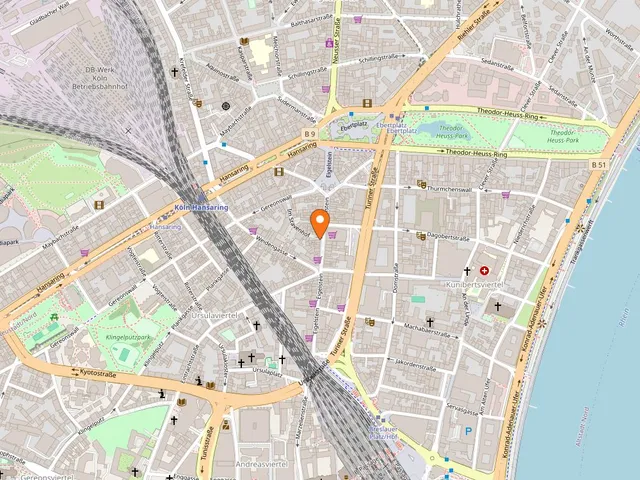
South of Cologne's old town, where the connecting street „Im Dau" now runs near Severinstraße, a monastery complex once stood for nearly three centuries; nothing of it survives today.
Source: Wikipedia
At a Glance
- Type
- former monastery of the Discalced Carmelite Order (OCD)
- Community
- St. Maria, St. Joseph and St. Theresia im Dau
- Location
- Altstadt-Süd, Innenstadt district, near Severinstraße
- Founded
- 1614, the order's first foundation in present-day Germany
- Dissolved
- 1802 during secularization
- Church consecration
- 1628
- End
- last remaining buildings fully demolished in 1945
After the newly built monastery church was completely destroyed by a lightning strike in 1622, it had to be rebuilt from scratch and could only be consecrated in 1628. Following secularization, the church was even converted into a grain silo from 1816, with its vault removed and four grain floors installed.
History
The Discalced Carmelites emerged from a reform movement launched by Teresa of Ávila and John of the Cross in Duruelo, Spain, in 1568. In 1613, through the mediation of Emperor Ferdinand II, the first friars arrived in Cologne from Bologna, led by the Spaniard Tomás a Jesú. The city council initially opposed another religious foundation, eventually permitting it on condition that the community never exceed twelve members. In 1615 the Carmelites acquired part of the „zum Dau" farmstead on Severinstraße.
After Secularization
By 1795 the community counted 20 priests and six lay brothers. Following its dissolution in 1802, the French military administration used the buildings as veterans' quarters. From 1815 the monastery served as a Prussian supply depot, and from 1816 the church itself was converted into a grain store. In 1910 the complex — apart from the chapter house — made way for a parade ground, and by 1945 all remaining buildings had been torn down.
The Monastery Church
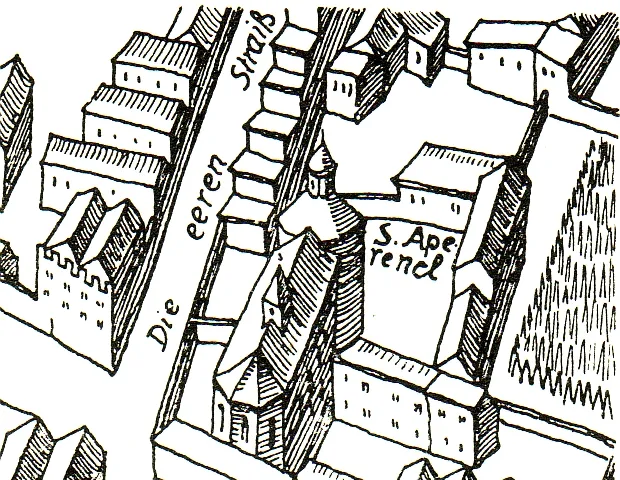
Consecrated in 1628, the church was built by a master builder named Jodokus. Oriented to the south, it was linked to Severinstraße by a passage roughly 40 meters long. The single-nave interior measured about 43 meters in length and 8.7 meters in width, covered by a ribbed vault. A ridge turret rose above the crossing, and beneath the raised monks' choir lay a crypt for the community's benefactors. The north façade was crowned with a triangular gable of Niedermendig lava stone, its portal framed by basalt columns.
Timeline
- 1613First Discalced Carmelites arrive in Cologne.
- 1615Carmelites acquire part of the 'zum Dau' farm on Severinstraße.
- 1620Foundation stone laid for church and monastery.
- 1622Buildings burn down after lightning strike.
- 1626Cologne becomes seat of an order province and novitiate.
- 1628Consecration of the rebuilt monastery church.
- 1802Dissolution of the monastery due to secularization.
- 1910Demolition of the monastery for a parade ground, except chapter hall.
- 1945Demolition of all remaining buildings.
Map
Blue dots: other places nearby — tap to explore.
You might also like — related or nearby

Comments
- Loading comments…
Sources & links
Auto-generated, last verified: 2026-09-15
How this page is made
This page draws on open sources — Wikipedia, Wikidata, official websites and the city’s open data. Every statement is checked against the sources linked here, and pages are refreshed regularly.
Spotted a mistake anyway? Tell us below — we read every submission.