St. Brictius (Cologne-Merkenich)
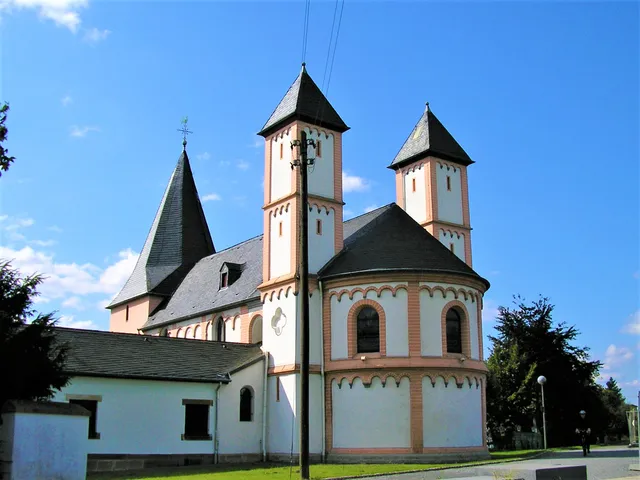
Catholic parish church whose 12th-century Romanesque tower stands freely beside the modern 1963 building.
Over the centuries the site was repeatedly demolished and rebuilt, so that medieval and modern elements now sit side by side.
Source: Wikipedia
At a Glance
- Type
- Roman Catholic parish church
- Location
- Merkenich district, Chorweiler borough, Cologne
- Architectural style
- Modernist
- Namesake
- Brictius of Tours
- Historic patron
- Kunibertsstift (Cologne)
- Protection status
- Listed heritage monument in North Rhine-Westphalia
The pulpit dating from around 1630 did not originally belong to this church but was taken from the demolished Cologne church of St. Lupus.
The Romanesque Tower
The 12th-century tower is the only surviving part of the original Romanesque church. It now stands freely beside the modern building. Inside, the baptismal font is set into a Romanesque capital.
History
Merkenich first appears in records in 1241, but the church itself is not documented until 1285, and it is absent from the Liber valoris. Until secularization, the Kunibertsstift held the right of collation. The single-nave predecessor with a semicircular apse gained a side aisle to the south in the early 19th century. In 1886 it was torn down except for the tower and replaced by a Neo-Romanesque building, which in turn gave way to today's structure in 1963.
Architecture and Furnishings
The 1963 building features two tall semicircular apses each on the chancel and entrance sides, topped by a large, folded gable roof over the nave. The pulpit, dating from around 1630, came from Cologne's St. Lupus church, which likewise belonged to the Kunibertsstift.
Church Music
The organ was built in 1968 by Orgelbau Ernst Seifert, incorporating parts from retired instruments; in 2011 Johannes Klais Orgelbau of Bonn carried out cleaning and preservation work. It comprises 1,036 pipes across 17 stops, played from two manuals and pedal. The bells—three in total—were cast in 1957 by Hans Hüesker at the Petit & Gebr. Edelbrock foundry in Gescher. Each bears the inscription "COL. MERCINIAE MCMLVII" along with a relief of its respective namesake.
Timeline
- 1241Earliest mention of the village of Merkenich
- 1285First documented mention of the church
- um 1630Pulpit made, originally from St. Lupus
- 1886Old building demolished except tower, neo-Romanesque church built
- 1957Casting of the three bells by Hans Hüesker
- 19631886 church replaced by large modern building
- 1968Organ built by Ernst Seifert
- 2011Thorough cleaning and repair of the organ by Johannes Klais Orgelbau
Map
Blue dots: other places nearby — tap to explore.
You might also like — related or nearby
Comments
- Loading comments…
Sources & links
Auto-generated, last verified: 2026-09-03
How this page is made
This page draws on open sources — Wikipedia, Wikidata, official websites and the city’s open data. Every statement is checked against the sources linked here, and pages are refreshed regularly.
Spotted a mistake anyway? Tell us below — we read every submission.