Schönrath
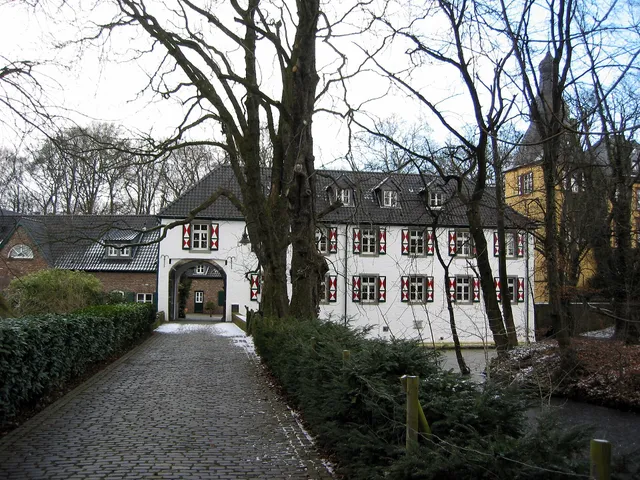
Historic manor near Cologne, for centuries owned by Altenberg Abbey and later the birthplace of Rhenish heavy horse breeding.
For generations, tenant farmers worked the land while the estate's actual owners resided elsewhere.
Source: Wikipedia
At a Glance
- Type
- Manor estate, listed historic monument in North Rhine-Westphalia
- Location
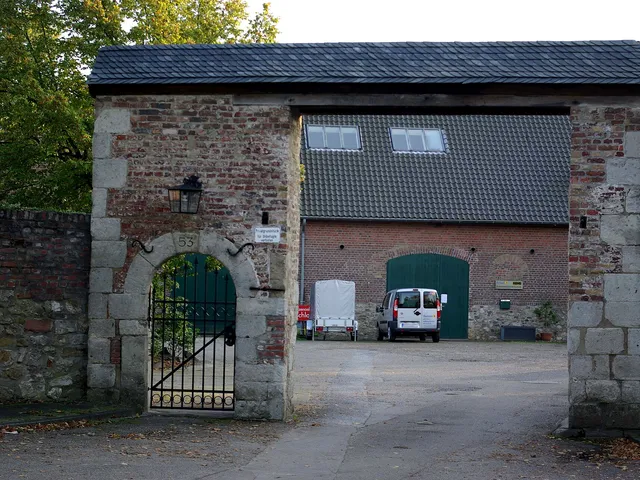
- Am Flachsrosterweg 33, Cologne east of the Rhine
- District
- Höhenhaus (Mülheim borough)
- Size (c. 1803)
- 773 Morgen – the largest of the farms belonging to Altenberg Abbey
- Notable for
- Origin point of the Schönrath-Neurath heavy horse breeding line
According to tradition, the manor traces back to a knight named Sigwin, who in the 14th century donated his estate Schoenroide to the Cistercian Abbey of Altenberg as atonement for a blood debt.
Location and Surroundings
Schönrath originally stood as an isolated farmstead, roughly midway between the Premonstratensian monastery at Dünnwald, the castle at Stammheim, and Mülheim am Rhein. Today it is hemmed in by the A 3 motorway to the west, the Gruiten–Cologne-Deutz railway line to the east, and the Dünnwalder Kommunalweg to the north.
From Monastic Farm to Noble Estate
According to oral tradition, a knight named Sigwin is said to have given away his seat, Schoenroide, in the 14th century to atone for a blood debt. Scholars Mosler and Huck, however, trace the farm's ownership by the Cistercian Abbey of Altenberg back to 1210, a status it retained until the abbey's dissolution in 1803. At 773 Morgen it was by then the largest of the abbey's farms, having grown through the acquisition of neighboring land in Buchheim, Mülheim, Espen, and possibly Merheim. Lay brothers initially worked the land, but from the 15th century onward it was leased to tenant farmers (Halfen). During the French Revolution, the buildings briefly sheltered clergy fleeing the left bank of the Rhine. The last tenant before secularization was Heinrich Rolshoven, succeeded by his son Johann, who married Anna Sibilla Düppes of Gut Iddelsfeld in 1815 before moving to the nearby Gut Neufeld he had built in Holweide; the Becker family then took over. In 1827 ownership passed to the Barons (later Counts) Fürstenberg zu Stammheim, based at Stammheim Castle, who continued to have the farm run by tenants.
Administrative History
At the time of the abbey's dissolution in 1803, Schönrath belonged to the Bergisch Amt Porz. Under French-influenced administration it fell under the Mairie of Merheim in the Arrondissement of Mülheim am Rhein, and from 1815 to the Kreis Mülheim am Rhein as part of the Bürgermeisterei Merheim. Only with that municipality's incorporation into Cologne on 1 April 1914 did the farm officially become part of the city. Because it had previously belonged to the Dünnwald cadastral district, it is still recorded under the Dünnwald land registry today, even though it has been part of the Höhenhaus district since 1934.
Division and the Neurath Farm
Under the Fürstenbergs, the estate was split, and a separate farm called Neurath was established nearby, roughly at today's Neurather Weg 18 in Cologne-Mülheim; it has since been demolished. Even before secularization, some maps hint at this two-part structure: Johann Heinrich Schlieper's 1772 map shows two distinct building markers in the area, as does a topographical map from around 1800. The Wiebeking (1789/92) and Wiebeking-Bechstatt (1799) maps are incomplete or differently labeled here, naming only "Schündenb.," which has been linked to the neighboring Rotter Hof. Some interpret this as evidence that Schönrath once consisted of a main farm and a subsidiary holding.
Horse Breeding
From 1856, Heinrich Johann Litz managed Neurath, adding Schönrath to his responsibilities from 1860. He was the first in the region to apply Liebig's theory of soil fertilization, drawing on manure from latrine-cleaning operations he ran in the town of Mülheim. Building on the Belgian Draft Horse, he bred sturdy working horses. His son Ludwig Nikolaus Litz continued this work and helped establish the reputation of the Rhenish heavy horse, making the Schönrath-Neurath line the most renowned of its kind.
Timeline
- 1210Schönrath owned by Altenberg Cistercian Abbey
- 14. JahrhundertKnight Sigwin allegedly donates his manor Schoenroide to the abbey
- 1416Pilgryms van Schoenroide confirms a tithe sale as juror
- 1772Schlieper's map shows two separate buildings at 'Schonrahter Hoff'
- 1803Abbey of Altenberg dissolved during secularization, Schönrath secularized
- 1815Son Johann Rolshoven marries Anna Sibilla Düppes
- 1827Ownership transferred to the barons (later counts) Fürstenberg zu Stammheim
- 1856Heinrich Johann Litz takes over management of Neurath estate
Gallery
Map
Blue dots: other places nearby — tap to explore.
You might also like — related or nearby

Comments
- Loading comments…
Sources & links
Auto-generated, last verified: 2026-09-08
How this page is made
This page draws on open sources — Wikipedia, Wikidata, official websites and the city’s open data. Every statement is checked against the sources linked here, and pages are refreshed regularly.
Spotted a mistake anyway? Tell us below — we read every submission.