Medieval Synagogue of Cologne
Beneath the Archaeological Zone near City Hall: remains of a Jewish synagogue that stood from the 11th century until the expulsion of 1424.
Between 2007 and 2015, excavations in Cologne's Archaeological Zone uncovered the remains of the building, including thousands of fragments from the reading desk.
Source: Wikipedia
At a Glance
- Type
- Remains of a medieval synagogue
- Location
- Around today's Cologne City Hall, Altstadt-Nord district
- Earliest evidence
- Written records point to the 11th century
- Synagogue floor plan
- Two-storey, 9 by 15 metres
- Community centre
- Around 2,400 square metres, roughly a sixth of the Jewish quarter
- In use until
- Expulsion of the Jews in 1424
- Excavation
- Conducted 2007 to 2015
The synagogue's ornate Gothic bimah (reading platform) was excavated in roughly 3,000 individual fragments and had to be painstakingly pieced back together.
The Jewish Quarter
The Jewish quarter around today's City Hall covered about 1.35 hectares, less than one percent of the city's area at the time. Some 700 to 800 people lived there—by the mid-14th century roughly two percent of Cologne's population of 40,000. Fences or railings separated the quarter from Christian properties. The community centre combined the synagogue, bakehouse, hospital, mikveh, and a hall for celebrations.
Construction and Furnishings
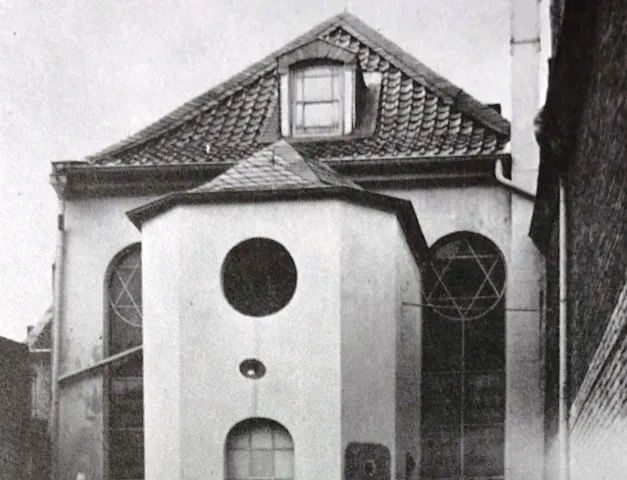
The synagogue stood roughly at the centre of the quarter and served prayer, study, and the rabbinical court. Beneath it lay a finished cellar, likely used for valuables and documents. An annex for women was connected to the men's prayer hall by narrow listening slits of red sandstone; since women could hear little of the service, learned women such as Pura, Jenta, and Vromut acted as prayer leaders for them. The walls were whitewashed, and stone inscriptions were set beneath the beamed ceiling. In the second half of the 13th century the building was restored in Gothic style with a new bimah beneath a canopy, later reconstructed from around 3,000 fragments.
Persecution and End
A pogrom in 1096 killed around 300 Jewish people, and in 1349 the entire Jewish population was murdered and the synagogue destroyed. From 1372 Jewish families were once again admitted, and a smaller synagogue was rebuilt. In 1423 the city council decided not to renew the residency agreement due to expire in 1424; some families relocated across the Rhine to Deutz.
Later Use
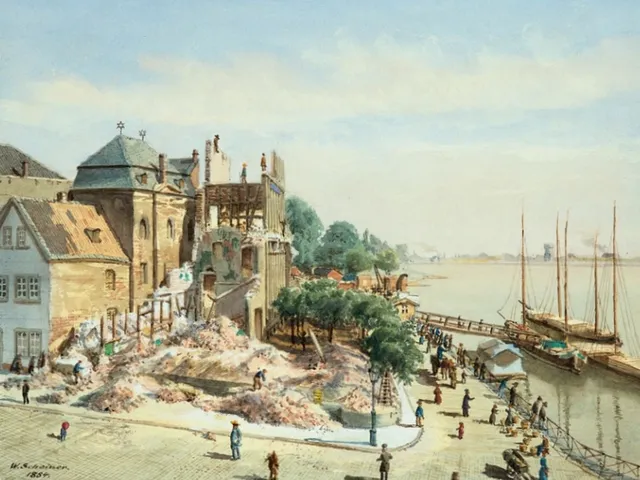
After the expulsion, the building was repurposed as the Christian council chapel of St. Maria in Jerusalem. It was destroyed during the Second World War.
Timeline
- 1012Archbishop Heribert reportedly permits Cologne Jews to build a synagogue, per later source
- 1056–1075Jewish quarter documented in records
- 1075Cologne Jews mourn death of Archbishop Anno on 4 December
- 1096Pogrom kills around 300 Jewish people
- um 1140Dispute over windows with animal depictions documented
- 1270First written mention of the Cologne mikveh
- 1349Massacre kills entire Jewish population, synagogue destroyed
- 1372Jewish families return, synagogue rebuilt smaller
- 1423Council decides on 16 August not to renew residence contract
- 1424Expulsion of Jews, synagogue converted into St. Maria in Jerusalem
Map
Blue dots: other places nearby — tap to explore.
You might also like — related or nearby
Comments
- Loading comments…
Sources & links
Auto-generated, last verified: 2026-09-15
How this page is made
This page draws on open sources — Wikipedia, Wikidata, official websites and the city’s open data. Every statement is checked against the sources linked here, and pages are refreshed regularly.
Spotted a mistake anyway? Tell us below — we read every submission.