Hohenstaufenbad
Cologne's largest public swimming bath: a grand building on Hohenstaufenring — not lost to the war, but deliberately demolished in 1958.
The Hohenstaufenbad was a public indoor swimming bath on Hohenstaufenring, part of Cologne's ring boulevard system, and the largest public bathhouse in the city. Though it survived the Second World War, it was torn down in 1958.
Source: Wikipedia
At a Glance
- Type
- Public indoor swimming bath, representative civic building
- Location
- Hohenstaufenring, Altstadt-Süd, inner-city district
- Design
- City architect Josef Stübben, office of de Voss & Alfred Müller
- Construction
- Begun December 1884, roughly two years
- Opening
- Sources vary: 1 July 1885 or June 1886
- Scale
- Largest public bath in the city
- Fate
- Demolished 1958
On 27 March 1913, a child named Elly Grünheck was celebrated as the one-millionth visitor to the Hohenstaufenbad – even though the bath had already failed financially shortly after its 1886 opening and was taken over by the city from its insolvent operating company as early as 1887.
Things to do here
- Stand on the Hohenstaufenring and picture the vanished grand building
- Trace the story of Cologne's largest public swimming bath
- Compare historic photos of the bath with today's streetscape
- Take a stroll along Cologne's Ringe boulevards
- Reflect on the post-war demolition and lost architectural heritage
Background and Construction
In the 19th century, municipal bathhouses served a vital hygienic purpose: as late as 1883, only 3% of Cologne's homes had a bath. City architect Josef Stübben commissioned the firm de Voss & Alfred Müller in March 1883 to design and build the complex. To fund it, the AG Hohenstaufenbad was incorporated on 12 May 1883 with capital of 600,000 marks, and operated the baths after opening. The complex occupied an entire city block between the ring road, Badstraße (now Schaevenstraße), Mauritiuswall, and Rubensstraße.
Architecture
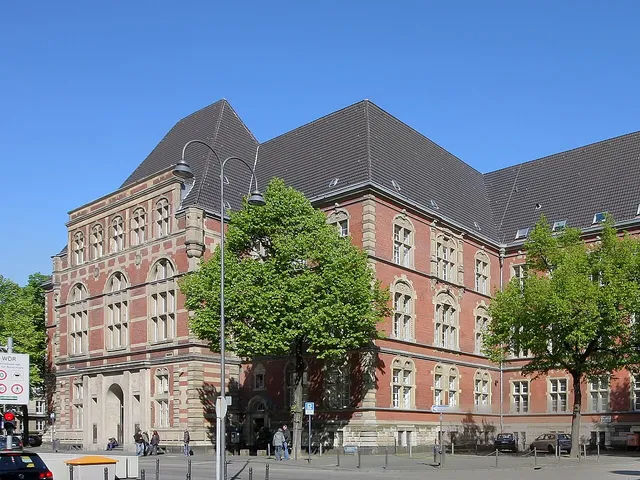
The street-facing main building was a two-storey rectangular block with a tall base, two single-bay side wings, and a three-bay central projection. Its street façade featured a flight of steps, a triple-arched entrance, and an open loggia on the first floor. The structure was built in brick with dressed stonework detailing.
Use and Operation
The bathhouse catered to the prosperous middle classes and introduced a new bathing culture in the tradition of Roman thermae, at a time when most residents had relied on bathing establishments along the Rhine. When the operation proved financially unviable, the City of Cologne took over the company in 1887 and assumed full management in 1889. On 27 March 1913, a child named Elly Grünheck was welcomed as the millionth visitor; in 1916 alone, the baths recorded 316,576 individual bathing sessions.
Demolition
An air raid on 30 June 1943 gutted the Hohenstaufenbad by fire, but the structure itself survived — windows were even replaced after the war. Post-war reconstruction planners dismissed Wilhelmine-era buildings as unworthy of preservation and used even minor damage as grounds for demolition. The Hohenstaufenbad was cleared by 1958, alongside other salvageable ruins such as the old Cologne Opera House, the City Hall, the main railway station, the neo-Gothic Gürzenich staircase, and the towers of the Hohenzollern Bridge.
Timeline
- 1883Planning commission to de Voss & Alfred Müller; AG Hohenstaufenbad founded (12 May)
- 1884Construction begins in December
- 1885Court ruling in construction dispute (21 Jan.); opening according to one source on 1 July 1885
- 1886According to another source, handed over for use in June 1886
- 1887City of Cologne takes over AG Hohenstaufenbad (10 October)
- 1889Final municipal management from 1 April
- 1913Elly Grünheck welcomed as 1,000,000th visitor (27 March)
- 1958Demolition of the Hohenstaufenbad
Map
Blue dots: other places nearby — tap to explore.
You might also like — related or nearby
Comments
- Loading comments…
Sources & links
Auto-generated, last verified: 2026-06-26
How this page is made
This page draws on open sources — Wikipedia, Wikidata, official websites and the city’s open data. Every statement is checked against the sources linked here, and pages are refreshed regularly.
Spotted a mistake anyway? Tell us below — we read every submission.