Trankgassentor Gate
A medieval gate in Cologne's riverside fortifications that vanished for good in 1898 after several rebuildings.
The Trankgassentor was one of the gates in the riverside fortifications that Cologne built along the Rhine in the 13th century. Today only the street name Trankgasse recalls the long-vanished structure.
Source: Wikipedia
At a Glance
- Type
- gateway within a tower of the riverside city wall
- Location
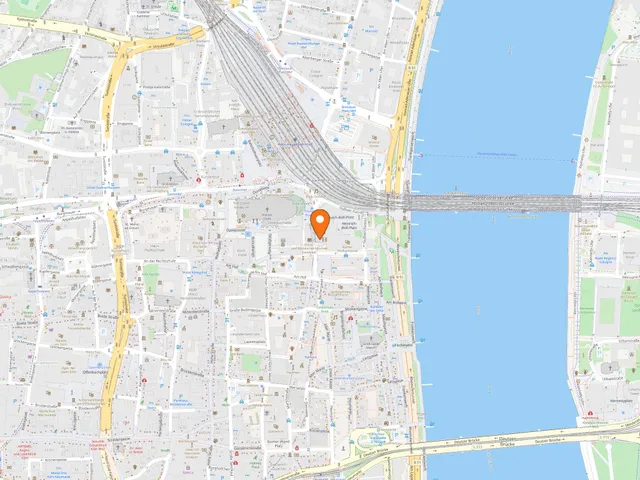
- at the end of today's Trankgasse, close to the Frankenturm
- First recorded
- 1293 as „turis de Drancgassin"
- Old gate demolished
- deemed unsound from 1583, taken down in 1825
- Rebuilt
- 1851–1853 to a design by Bernhard Wilhelm Harperath
- Finally demolished
- 1898 under city architect Josef Stübben
- Present state
- no remains survive
Name and Location
The gate stood at the end of the „drank gaß", today's Trankgasse, whose course traced the old northern town moat. The name points to a cattle watering place or a path down to the Rhine – a „Drancgaß" also existed near St. Severin. The lane leading from the old cathedral to the riverbank went by changing names: „in vallo" in 1136, „in vallo que dicitur Gravagaza" in 1170, and finally „in Drancgazzen" in 1215. The name later passed from the lane to the gate, which first appears by name in the records in 1293.
The Medieval Structure
Exactly when the gate was built cannot be established with certainty; at first it may have been confused with a tower mentioned in 1246, which could have resembled the Frankenturm. As a structure in its own right, the Trankgassentor is documented no later than 1293. Anton Woensam's city view of 1531 and Mercator's plan of 1571 both show a building a few metres from the Frankenturm, projecting from the line of the wall like a risalit. The three-storey tower had a round-arched passage and a tent roof. To the south stood a narrow annex, originally topped with battlements, flush with the city wall and rising one storey above it; on the north side another annex, its upper floor resting on the wall, served as a projecting defensive gallery.
Prussian Rebuilding and Demolition
The old gate was already considered unsound in 1583 and was pulled down in 1825. After Bernhard Wilhelm Harperath was appointed city architect in 1844, three new gates rose along the old town's riverfront under his direction. The new Trankgassentor was built to his design between 1851 and 1853. It received a double archway and two piers crowned with bronze eagles – piers and eagles taken from a gate then being demolished on Friedrich-Wilhelm-Straße. Yet within a few decades this structure too gave way to the growing city: as the landward walls were removed, the new Cologne Neustadt took shape and a continuous riverside road was laid out, city architect Josef Stübben had the gate demolished for good in 1898. No trace of it remains today.
Map
Blue dots: other places nearby — tap to explore.
You might also like — related or nearby
Comments
- Loading comments…
Sources & links
Auto-generated, last verified: 2026-08-14
How this page is made
This page draws on open sources — Wikipedia, Wikidata, official websites and the city’s open data. Every statement is checked against the sources linked here, and pages are refreshed regularly.
Spotted a mistake anyway? Tell us below — we read every submission.